

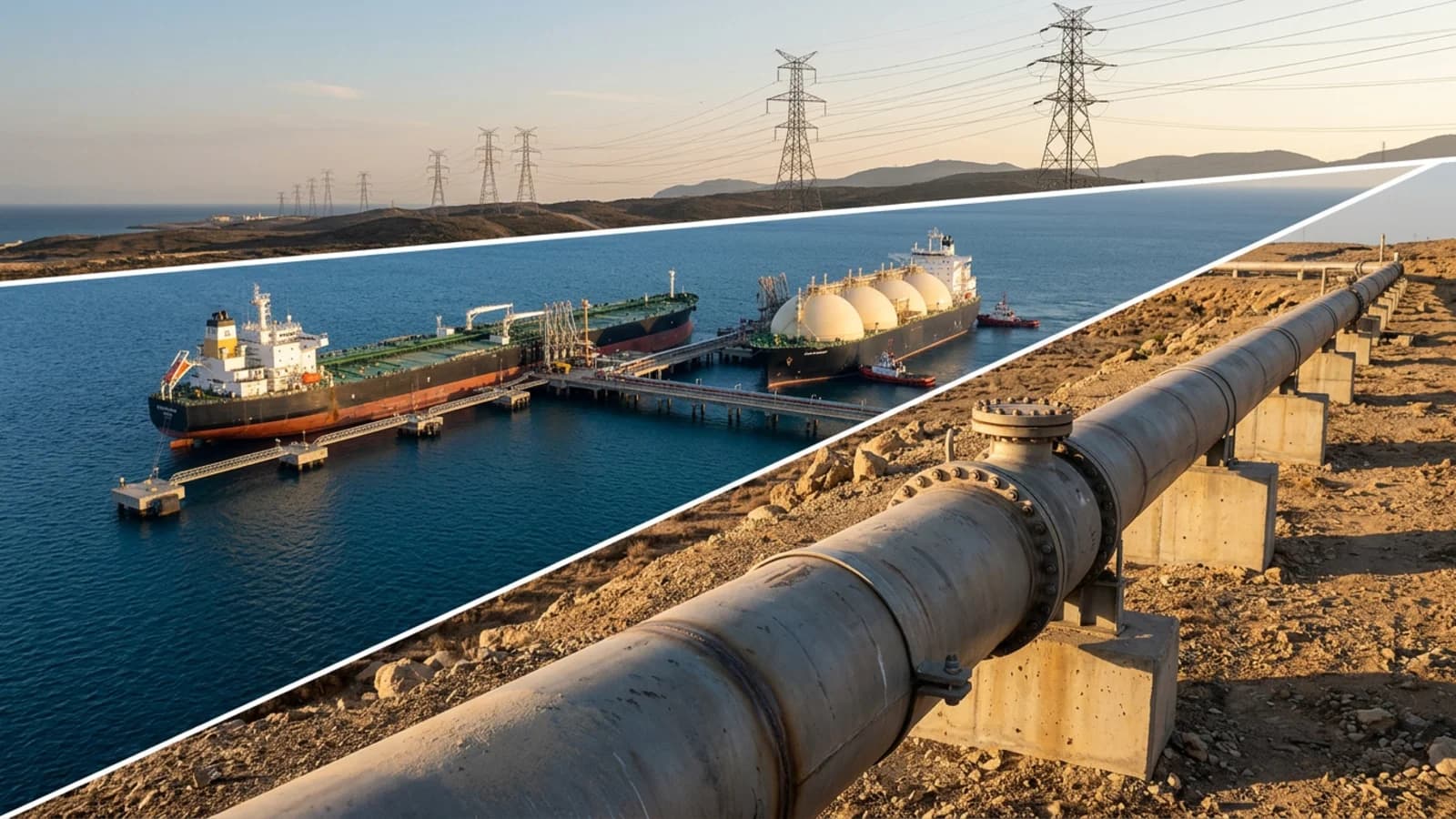
The short version: Most of the world's oil travels by sea, gas increasingly travels as a super-cooled liquid, and electricity is starting to travel thousands of kilometers by cable. Behind every barrel and every electron sits a hidden ecosystem of shipyards, pipelines, control rooms, insurers, inspectors and traders. That ecosystem is where the risks, the jobs and the next wave of innovation sit.
Every morning, before you've finished your coffee, the world has already used millions of barrels of oil. Almost none of it was produced anywhere near where it's used.
It got there on ships as long as three football fields, through pipes kept warm like hot-water bottles, along lines that cross permafrost and fault lines, and through cables laid along the seabed. We talk endlessly about producing energy. We rarely talk about moving it. Yet the moving part decides prices, shapes conflicts and quietly employs millions of people.
This is a guide to the hidden highways of energy: how they work, how flow is kept moving, who builds and runs them, and where you can be part of what comes next.
1. Moving Energy, Without the Mumbo Jumbo
Energy has a simple problem: it's rarely found where people need it. Oil sits under deserts and seabeds. Gas fields are often far from cities. Sun and wind are strongest where few people live. So the energy industry is, to a surprising degree, a transport industry. Insiders call this part "midstream": everything between production and use.
There are five main highways:
Tankers carry crude oil, fuels, gas and chemicals across oceans.
Pipelines carry oil, gas and fuels across land and under the sea.
LNG chains turn gas into a liquid so it can be shipped, then back into gas.
Power lines and undersea cables carry electricity between regions and countries.
New-cargo chains move hydrogen, ammonia and captured carbon dioxide.
Aha moment: about 77.5 million barrels a day, roughly 76% of all the oil and liquid fuels the world produces, moved by sea in 2023 [US EIA, 2024]. Oil tankers made up almost 29% of the world's shipping capacity by weight in 2022 [US EIA, 2024]. Energy isn't just carried by global shipping. It's one of its biggest customers.
Jargon buster
Midstream: the part of the energy industry that moves and stores energy.
Deadweight tonnes (dwt): how much weight a ship can carry, including cargo and fuel.
VLCC: very large crude carrier, a tanker carrying about 2 million barrels.
LNG: liquefied natural gas, gas chilled into a liquid for shipping.
FSRU: a ship that stores LNG and turns it back into gas, acting as a floating import terminal.
Flow assurance: the engineering of keeping oil and gas moving smoothly through pipes.
Chokepoint: a narrow sea passage that large volumes of energy must pass through.
HVDC: high-voltage direct current, the most efficient way to move electricity over long distances.
2. Inside the Tanker World: Types and Specialities
Tankers aren't one kind of ship. They're a family of specialists, each built for a cargo and a route.
Crude oil tankers (by size)
ULCC (ultra large crude carrier): 320,000–550,000 dwt, about 2.9–4+ million barrels. Today mostly used for floating storage [TankerMap].
VLCC (very large crude carrier): 200,000–320,000 dwt, about 1.8–2.2 million barrels; around 330 metres long. The workhorse of long routes such as the Gulf to Asia [TankerMap; Britannica].
Suezmax: 120,000–200,000 dwt, about 0.9–1.3 million barrels; the largest size that can pass through the Suez Canal fully loaded. Common on West Africa–Europe routes [TankerMap].
Aframax: 80,000–120,000 dwt, about 600,000–800,000 barrels; regional trades such as the North Sea, Baltic, Mediterranean and Caribbean [TankerMap].
Panamax: 60,000–80,000 dwt; sized for the Panama Canal [TankerMap].
Aha moment: a single VLCC holds roughly 2% of the oil the whole world uses in a day. That's about half an hour of global consumption, in one ship [calculated from US EIA and Britannica figures].
Product and chemical tankers
LR2, LR1 and MR tankers carry refined fuels such as petrol, diesel and jet fuel. MR (medium range, 37,000–55,000 dwt) is the most numerous product tanker class [TankerMap].
Chemical tankers carry many different liquids at once in separate, often coated or stainless-steel tanks, so cargoes never mix. Some switch between fuels and vegetable oils between voyages [TankerMap].
Gas carriers
LNG carriers keep gas at about -162°C. Most are around 170,000 cubic metres; Qatar's giant Q-Max ships carry up to 266,000 cubic metres [Wikipedia, LNG carrier].
Two tank designs dominate: the Moss design uses large spheres you can see on deck; the membrane design uses thin stainless steel or Invar membranes shaped to the hull, using space more efficiently. Membrane designs, largely licensed from France's GTT, have become the industry trend [Wikipedia, LNG carrier; iMarine, Aug 2026].
LPG carriers move propane and butane, either pressurised or refrigerated. The biggest are known as VLGCs (very large gas carriers).
Ammonia, CO₂ and liquid hydrogen carriers are the newest specialists (see section 6).
Offshore and service specialists
Shuttle tankers load crude directly from offshore fields, holding position with computer-controlled thrusters (dynamic positioning).
FPSOs and FSOs (floating production/storage and offloading units) act as floating oil processing and storage hubs at offshore fields.
Bunker tankers refuel ships in port.
FSRUs are floating LNG import terminals. There were 49 in the world's LNG fleet at the end of 2025 [IGU via SAFETY4SEA, Jul 2026].
3. Who Builds the Ships: Yards, Countries and Companies
Shipbuilding has become one of the most concentrated industries on earth.
China won over 60% of the world's new ship orders in 2025, about 1,500 of roughly 2,500 vessels, according to Clarksons data. South Korea won about 260 orders (just over 10%) and Japan about 230 (about 9%) [Maritime Executive, Feb 2026].
LNG carriers are the high-tech battleground. South Korea's yards long dominated them. That's changing fast: in the first half of 2026, Chinese yards won 52 of 90 global LNG carrier orders (57.8%), against South Korea's 37 (41.1%) [iMarine, Aug 2026].
The names to know:
South Korea: HD Hyundai Heavy Industries, Hanwha Ocean, Samsung Heavy Industries, HD Hyundai Samho [iMarine, Aug 2026].
China: Hudong-Zhonghua, Jiangnan Shipyard, Dalian Shipbuilding Industry Corporation, CMHI Haimen, Yangzijiang, with Hengli Heavy Industries entering the market [iMarine, Aug 2026].
Japan: long-established builders, and Kawasaki Heavy Industries, which built the world's first liquid hydrogen carrier [Hydrogen Council].
France: GTT, whose membrane technology sits inside a large share of the world's LNG carriers through licensing [iMarine, Aug 2026].
Aha moment: you don't need to build ships to win in shipbuilding. A French engineering company earns from LNG carriers built in Korea and China by licensing the tank technology inside them.
4. The World's Great Pipelines
Pipelines are the quiet arteries of energy. Here are some of the most important.
Oil and fuel pipelines
Druzhba ("Friendship"), Russia to Central Europe: about 4,000 km, built in the 1960s, historically 1.2–1.4 million barrels a day [NS Energy].
ESPO (Eastern Siberia–Pacific Ocean), Russia: more than 4,800 km from Siberian fields to the Pacific coast, feeding exports to China, Japan and South Korea [NS Energy].
Kazakhstan–China pipeline: about 2,800 km from western Kazakhstan to Xinjiang [Offshore Technology].
Caspian Pipeline Consortium (CPC), Kazakhstan to Russia's Black Sea coast: about 1,510 km, up to 1.4 million barrels a day, carrying most of Kazakhstan's oil exports [Wikipedia, CPC].
Baku–Tbilisi–Ceyhan (BTC), Azerbaijan–Georgia–Turkey: 1,768 km, up to 1 million barrels a day, opened 2006 [Wikipedia, BTC].
Saudi Arabia's East-West pipeline: carries crude from the Gulf to the Red Sea, normally 5 million barrels a day and temporarily raised to 7 million, one of the few large bypasses of the Strait of Hormuz [US EIA, 2024].
UAE's Habshan–Fujairah pipeline: 1.5 million barrels a day to the Gulf of Oman, another Hormuz bypass [US EIA, 2024].
Trans-Alaska Pipeline System: 1,288 km from Prudhoe Bay to Valdez, opened 1977; peaked at 2.03 million barrels a day in 1988 and now carries around 470,000 [Wikipedia, TAPS].
Trans Mountain, Canada: 1,150 km from Alberta to the Pacific coast, expanded to 890,000 barrels a day in 2024 [Wikipedia, Trans Mountain].
Colonial Pipeline, United States: more than 8,850 km from Texas to New York, carrying up to 3 million barrels a day of petrol, diesel and jet fuel [Wikipedia, Colonial Pipeline].
East African Crude Oil Pipeline (EACOP), Uganda to Tanzania: 1,443 km, designed to be electrically heated to keep waxy crude at around 50°C; set to be the world's longest heated crude pipeline [Pipeline Journal, 2026].
Gas pipelines
West–East Gas Pipeline, China: a network carrying gas from Xinjiang and Central Asia to China's east coast; the full system is planned at more than 8,700 km [Offshore Technology].
Central Asia–China gas pipeline: from Turkmenistan through Uzbekistan and Kazakhstan to China; its first three lines carry up to 55 billion cubic metres a year [Wikipedia, Central Asia–China].
Power of Siberia, Russia to China: 3,968 km when complete, delivering 38 billion cubic metres a year to China since 2019 [Wikipedia, Power of Siberia].
Yamal–Europe: 4,107 km from Russia through Belarus and Poland to Germany [NS Energy].
TurkStream: 930 km under the Black Sea from Russia to Turkey, 31.5 billion cubic metres a year, commissioned 2020 [Wikipedia, TurkStream].
Nord Stream: subsea lines from Russia to Germany that were put out of action by explosions in 2022.
Trans-Mediterranean (Transmed): 2,475 km from Algeria to Italy via Tunisia and Sicily [Offshore Technology].
Rockies Express, United States: carrying gas from the Rocky Mountains to the Midwest and East [NS Energy].
Aha moment: pipelines are geopolitics made of steel. Druzhba, Nord Stream and TurkStream show how a single line can shape alliances, sanctions and energy security for decades. And when the US EIA looked at Hormuz, it estimated only about 2.6 million barrels a day of unused bypass capacity could replace the roughly 21 million barrels a day that pass through the strait [US EIA, 2024].
5. How the Flow Is Kept Moving
Moving energy is easy to describe and hard to do. Keeping it flowing safely, day and night, is a discipline of its own.
In pipelines
Pressure is the engine. Oil and gas lose energy to friction and elevation, so pump stations (for liquids) and compressor stations (for gas) push them along [IPIECA, 2023].
Slippery oil. Tiny amounts of drag-reducing agents, often just a few parts per million of polymer, calm turbulence so more oil flows with the same pumping power [Wikipedia, Drag reducing agent; IPIECA, 2023].
Keeping it warm. Some crude contains wax that clogs pipes as it cools, and gas can form ice-like hydrates under high pressure and low temperature. Engineers use insulation, pipe-in-pipe designs, electrical heating and chemical inhibitors to stay outside those danger zones [IPIECA, 2023].
Pigging. Devices called pigs travel through the pipe with the flow. Cleaning pigs scrape out wax, sand and liquids [IPIECA, 2023]; smart pigs inspect the pipe wall for corrosion, dents and cracks [INGAA].
Batching. Product pipelines carry different fuels one after another, like train carriages without walls. On the Colonial Pipeline, a batch takes 14–24 days to travel from Houston to New York Harbor [Wikipedia, Colonial Pipeline].
Control rooms and cybersecurity. Operators monitor pressure and flow remotely and can shut sections in seconds. Aha moment: in 2021, a ransomware attack forced Colonial to shut down for five days, causing fuel shortages along the US East Coast [Wikipedia, Colonial Pipeline]. Today, cybersecurity is part of keeping the flow moving.
Testing. Hydrostatic testing pressurises pipes with water well above normal operating pressure to prove they're safe [INGAA].
Aha moment: engineering for earthquakes and permafrost. The Trans-Alaska Pipeline sits on more than 78,000 vertical supports and uses insulation and ground chillers to protect frozen ground. Across a major fault, it rests on sliding supports designed to move 20 feet sideways. In the 2002 Denali earthquake, the ground shifted about 14 feet, and the pipeline didn't break [Wikipedia, TAPS].
At sea
Scheduling and chartering. Brokers, charterers and traders match cargoes, ships and ports, often weeks ahead.
Bunkering and ship-to-ship transfers keep ships fuelled and cargoes moving between vessels offshore.
Managing boil-off. LNG tanks work like giant thermoses, but some cargo always warms and turns back into gas, about 0.1–0.25% a day. Ships burn that gas as fuel or reliquefy it [Wikipedia, LNG carrier].
Tracking. Satellites and vessel-tracking systems show where ships and cargoes are in near real time.
In power grids
Balance, every second. Electricity supply and demand must match continuously. Grid operators balance them using power plants, batteries and interconnectors.
Converter stations turn AC into DC for long-distance HVDC lines and back again at the other end, where HVDC loses only about 3% of its power per 1,000 km [GlobalSpec].
6. LNG, Power Lines and the New Cargoes
LNG: gas made portable. Gas is chilled to about -162°C, shrinking it about 600 times [US EIA]. LNG trade reached a record 437 million tonnes in 2025, flowing from 24 exporting markets to 50 importing ones, carried by a fleet of 804 vessels [IGU via SAFETY4SEA, Jul 2026]. Aha moment: when Russian pipeline gas stopped flowing to Germany in 2022, the country built its first floating LNG terminal at Wilhelmshaven in 194 days [Energy Connects, Nov 2022].
Power lines: energy as electrons. China's Changji–Guquan line carries 12 gigawatts across 3,324 km at 1,100 kilovolts [NS Energy]. Viking Link, a 765 km HVDC cable between Denmark and the UK, can power up to 2.5 million homes [State of Green, Dec 2023].
The new cargoes:
Liquid hydrogen must be cooled to about -253°C, shrinking it to 1/800 of its gas volume [Hydrogen Council]. Aha moment: that's only about 20 degrees above absolute zero. In 2022, the Suiso Frontier carried about 75 tonnes more than 9,000 km from Victoria, Australia, to Kobe, Japan, the world's first liquid hydrogen voyage [Hydrogen Council; HESC].
Ammonia is easier to ship and is being studied as a hydrogen carrier and a ship fuel (analysis).
Carbon dioxide now moves the other way: captured and buried. Norway's Northern Lights project ships CO₂ to a terminal, then pipes it 100 km offshore and about 2,600 metres below the seabed; its first phase stores 1.5 million tonnes a year [Equinor, Aug 2025].
7. Why It Matters: To You, Your Country and the World
To you. The price of petrol, electricity, flights and food includes the cost and risk of moving energy. When a route is disrupted, freight and insurance costs rise within days and flow through to consumers.
To your country. Energy routes are national security. Countries that depend on one route or supplier are exposed; countries with options can bargain. That's why governments build strategic storage, bypass pipelines, import terminals and interconnectors.
To the world. Global energy squeezes through a few narrow passages. The Strait of Hormuz carried about 20.9 million barrels a day in 2023, around 20% of global oil consumption; the Strait of Malacca carried even more, about 23.7 million [US EIA, 2024]. Disruption, like that seen during the 2026 Middle East conflict, ripples quickly through prices and shipping costs everywhere.
8. The Hidden Ecosystem: Sub-Industries That Keep Energy Moving
Behind every tanker and pipeline is a network of industries most people never see.
Shipbuilding and design: yards in China, Korea and Japan, plus naval architects and containment specialists such as GTT.
Steel and pipe making: specialist steel mills and pipe manufacturers, plus coatings that stop corrosion.
Rotating equipment: pumps, compressors, turbines and valves that keep flow moving.
Classification societies: independent organisations such as DNV, ABS, Lloyd's Register, ClassNK and Bureau Veritas that set technical standards and survey ships throughout their lives.
Marine insurance: the 12 P&I clubs of the International Group cover about 87% of the world's ocean-going tonnage for liabilities such as pollution, injury and wreck removal [International Group of P&I Clubs].
Shipbroking, chartering and commodity trading: the people who match cargoes, ships, buyers and sellers.
Ports, terminals and storage: tank farms, jetties, LNG terminals and strategic reserves.
Bunkering: supplying fuel to ships, increasingly including LNG and alternative fuels.
Ship management and crewing: officers, engineers and crews who run ships around the clock.
Inspection and integrity: in-line inspection, drones, divers, robots and non-destructive testing.
Control systems and cybersecurity: pipeline and grid control rooms, and the people who defend them.
Data and tracking: satellite and vessel-tracking analytics that turn ship movements into market intelligence.
Grid equipment: HVDC converter makers and cable manufacturers.
Maritime law, finance and regulation: lawyers, financiers, regulators and bodies such as the International Maritime Organization.
Ship recycling: the end-of-life industry that dismantles old vessels.
Aha moment: a single tanker voyage can involve a shipyard in one country, a classification society in another, an insurer in a third, a charterer in a fourth, a crew from a fifth and a buyer in a sixth. Energy transport is one of the most global teams on earth.
9. Hubs and Main Players
Middle East: the source and the strait. Gulf producers ship much of the world's seaborne oil through Hormuz. Qatar is expanding LNG capacity to 142 million tonnes a year by around 2030, an increase of almost 85% [LNG Industry, Feb 2024].
United States: the LNG surge and the pipeline giant. The Gulf Coast leads growth in world LNG exports [IGU via SAFETY4SEA, Jul 2026], and the US has one of the world's densest pipeline networks, including Colonial and Trans-Alaska.
China: shipyards and superhighways. China builds most of the world's new ships [Maritime Executive, Feb 2026] and leads in ultra-high-voltage power lines [NS Energy].
South Korea and Japan: high-tech shipbuilding. Korea's yards remain world leaders in LNG carriers [iMarine, Aug 2026]; Japan pioneered liquid hydrogen shipping.
Russia and Central Asia: the pipeline map. Druzhba, ESPO, Power of Siberia, CPC and the Central Asia–China line tie the region to Europe and Asia.
Europe: flexibility and new chains. LNG terminals, interconnectors such as Viking Link, CO₂ storage in Norway, and global leaders in classification, insurance and shipping finance.
Singapore and Malacca: Asia's gateway. The world's busiest oil chokepoint by volume [US EIA, 2024], making Singapore a hub for shipping, trading and marine fuel.
Australia: LNG and the hydrogen pioneer. A major LNG exporter and home of the first liquid hydrogen export voyage [Hydrogen Council; HESC].
Africa: new routes, real debates. EACOP shows both the opportunity of new export routes and the controversy around them [Pipeline Journal, 2026].
The pattern: the Middle East holds the source and the strait, China and Korea build the ships, Russia and Central Asia shape the pipeline map, the US and Qatar race to supply LNG, Europe runs much of the services ecosystem, and Australia tests tomorrow's cargoes.
10. Connecting the Dots
Direct industries: oil and gas, shipping, pipelines, power utilities, ports. Indirect industries: steel, shipbuilding, insurance, finance, trading, chemicals, construction, cybersecurity, data. Enabling technologies: cryogenics, sensors, robotics, satellites, AI, advanced materials.
A shipping lane is a price setter. Disruption raises insurance and freight costs and forces long detours, moving fuel, goods and food prices worldwide.
Gas moves food. Gas is a key input for fertiliser, so gas routes indirectly shape food prices. (See our Insight "Gas, Fertiliser and Food Security".)
Shipyards are now strategic assets. The country that builds the ships has leverage over global trade and energy security [Maritime Executive, Feb 2026].
Cyber is now physical. A ransomware attack can empty petrol stations, as Colonial showed [Wikipedia, Colonial Pipeline].
The non-obvious one: data now moves energy. Satellite tracking, pipeline sensors and AI monitoring are becoming as important as steel and engines. The company that sees a leak, delay or risk first protects money, the environment and lives.
11. 2030: What the World Looks Like
These are directional outlooks, not dated forecasts.
USA: a larger share of global LNG supply and continued investment in pipeline integrity and grids.
China: a dominant shipbuilder, a growing LNG carrier builder, and a denser ultra-high-voltage power network.
Middle East: expanded LNG capacity in Qatar [LNG Industry, Feb 2024] and continued investment in routes and storage that reduce dependence on Hormuz.
Europe: more interconnectors, more LNG terminals, early hydrogen and CO₂ networks, and continued strength in maritime services.
Russia and Central Asia: pipelines increasingly oriented towards Asia.
Africa: new oil and gas export routes alongside fast-growing off-grid solar, with debate over priorities.
South America: growing offshore oil production shipped to global markets.
Asia-Pacific (including Australia and India): Asia remains the biggest energy importer; Australia balances LNG with hydrogen and clean-energy ambitions; India's demand keeps rising.
Three scenarios:
Base case: oil and LNG trade stay large, power grids grow fastest, and new cargoes scale slowly.
Upside: cheaper HVDC, storage and clean fuels accelerate, and more energy moves as electricity.
Downside: chokepoint conflicts and regulatory uncertainty raise costs and slow investment in cleaner shipping. The IMO's planned global framework to cut shipping emissions was adjourned for a year in 2025 after member states couldn't agree [Ammonia Energy Association, Oct 2025].
12. Skills and Careers: How to Get Involved and Thrive
Moving energy is one of the most practical, global and hands-on careers there is. Here's where people work, mapped to the ecosystem:
Ships and shipyards: naval architects, marine engineers, welders, electricians, ship officers, crews, superintendents.
Pipelines: pipeline and integrity engineers, control-room operators, corrosion specialists, field technicians, inspection crews.
LNG and new cargoes: process and cryogenic engineers, terminal operators, safety specialists.
Grids: power-system and HVDC engineers, cable specialists, grid operators.
Commercial: shipbrokers, charterers, schedulers, commodity traders and analysts.
Risk and rules: marine insurers, classification surveyors, maritime lawyers, regulators.
Digital: data analysts, satellite and AIS specialists, automation and cybersecurity professionals.
Human skills that matter: safety leadership and judgement under pressure; communication across cultures and time zones; systems thinking; calm problem-solving; ethics, especially where communities and environments are affected.
Pathways: engineering degrees, maritime academies, trade qualifications (welders, electricians, technicians), and moves from aviation, the military, mining, logistics or finance.
Innovators wanted. Some of the biggest openings are for people who can:
detect leaks and corrosion faster with sensors and AI
inspect pipes, tanks and cables with robots and drones
protect control systems from cyberattacks
cut shipping emissions with new fuels, retrofits or smarter routing
reduce LNG boil-off and improve super-cold storage
speed up cable manufacturing and grid connections
make energy flows more transparent with satellite data
Getting in the room
Events are where shipowners, engineers, traders, insurers, regulators and start-ups meet. Pick one area (LNG, pipelines, shipping or grids), bring three questions (What's your biggest bottleneck? What technology are you watching? Which skills can't you hire?), and follow up within 48 hours. Major gatherings such as ADIPEC in Abu Dhabi, LNG summits and grid technology conferences are listed on Industry Events.
13. Investment and Growth Opportunities
Shipbuilding and LNG shipping: 301 LNG carriers were on order at the end of 2025, with deliveries running to 2031 [IGU via SAFETY4SEA, Jul 2026].
Floating terminals: fast, flexible import capacity for energy security.
Transmission and cables: long-distance HVDC and undersea interconnectors.
Pipeline integrity, inspection and cyber: services that keep ageing networks safe and secure.
New cargo logistics: hydrogen, ammonia and CO₂ transport and storage, still early but growing.
Cleaner shipping: alternative fuels, retrofits and efficiency technology, though global rules remain uncertain [Ammonia Energy Association, Oct 2025].
Data and analytics: tracking and forecasting energy flows.
Questions to ask (not financial advice): Does the asset depend on one route, one customer or one country? How long will demand last through the energy transition? Who carries the political, regulatory and cyber risk? Is the technology proven at commercial scale, or still a pilot?
14. Challenges and Blockers
Chokepoints and conflict: a few straits carry a large share of the world's oil [US EIA, 2024].
Concentration: most new ships are built in a handful of countries [Maritime Executive, Feb 2026].
Safety and environment: spills, leaks and accidents carry huge human, environmental and financial costs.
Cyber risk: control systems are targets [Wikipedia, Colonial Pipeline].
Long-lived assets in a changing world: pipelines and terminals last decades while energy demand shifts.
Community consent: projects such as EACOP face opposition over environmental and land concerns [Pipeline Journal, 2026].
Regulatory uncertainty: delays to global shipping-emissions rules slow investment in cleaner fuels [Ammonia Energy Association, Oct 2025].
Skills shortages: engineers, seafarers, technicians and grid specialists are hard to find in many regions (analysis).
The sceptic's case: energy transport is old, dirty infrastructure with little room for innovation, and local renewables will make it less important.
Our answer: local energy will grow, but the world will keep moving energy over long distances for decades, as oil, LNG, electricity and new fuels. The real shift is that transport is becoming cleaner, smarter, more digital and more electric, which creates new industries rather than ending old ones.
Author's Vision and Predictions
These are forecasts, not facts.
More energy will move as electrons. Long-distance HVDC lines and undersea cables will become the fastest-growing energy highways.
Shipbuilding will be treated as national security. Expect more countries to support their own yards and to compete for LNG and specialist ship orders.
Floating terminals will become standard energy insurance, kept ready the way countries keep strategic oil reserves.
Chokepoint risk will drive a building boom in storage, bypass routes and alternative supply.
Ships will become multi-fuel, able to switch fuels as rules and prices change.
Cyber and data will become core energy infrastructure, as important as steel and pumps.
People, not pipes, will be the bottleneck. The shortage of engineers, seafarers and grid specialists will slow projects more than technology will.
What This Means for You
For Leila, the leader. You want to know where risk and opportunity sit. Energy routes shape your costs, supply chains and markets. What matters: exposure to chokepoints, price shocks and cyber risk. Your why: protect margins and spot the next infrastructure wave. Three things to do: map your energy and freight exposure by route; ask key suppliers about contingency and cyber plans; track LNG, grid and shipyard trends in your markets.
For Omar, the professional. You want skills, events and contacts that keep you valuable. Energy transport is digitising fast, and that's your opening. What matters: staying useful as technology changes. Your why: stay ahead. Three things to do: learn the basics of flow assurance, pipeline integrity or HVDC; attend one energy or maritime event this year; connect with three people working in inspection, LNG or grids.
For Sara, starting out. You want a clear way into a real, global industry. This one needs engineers, technicians, seafarers, analysts, lawyers and traders. What matters: a career with purpose and mobility. Your why: build something that lasts. Three things to do: watch how an LNG carrier or pipeline pig works; explore maritime, engineering or trade courses; ask a professional for a 15-minute chat.
Grow yourself. Pipelines keep flowing because they're maintained before they fail. Do the same for yourself: book one "maintenance stop" this week, a full evening off screens with an early night. Mindset tip: treat rest like a pipeline inspection. It isn't lost time; it's what prevents the breakdown.
Get the next one free. IE Weekly Insights explains one big shift every week, the dots most people miss and the events worth your time. Subscribe on industryevents.com.
The Bottom Line
We obsess over where energy comes from. The real story is how it travels, and who keeps it flowing. The ships, pipes, cables and the people behind them decide what energy costs, who's exposed and who's in control. They're changing faster than at any time in decades: colder, longer, smarter, more digital and more electric. For leaders, that's strategy. For professionals and newcomers, it's opportunity. The highways are being rebuilt. Someone has to design, run and reinvent them. Why not you?
Explore upcoming energy, LNG, shipping and grid events on Industry Events.
Researched with AI assistance; written and verified by IE Insights.
Sources
US Energy Information Administration, World Oil Transit Chokepoints, Jun 2024
US Energy Information Administration, Liquefied Natural Gas explained
Britannica, Very large crude carrier
TankerMap, Oil Tanker Classes and Sizes
Wikipedia, LNG carrier; Colonial Pipeline; Trans-Alaska Pipeline System; Power of Siberia; Baku–Tbilisi–Ceyhan pipeline; Caspian Pipeline Consortium; Central Asia–China gas pipeline; TurkStream; Trans Mountain pipeline; Drag reducing agent
NS Energy, Profiling the world's major oil and gas pipeline projects; Changji–Guquan UHVDC Transmission Project
Offshore Technology, The world's longest oil and gas pipelines
Maritime Executive, China continued shipbuilding dominance in 2025, Feb 2026
iMarine, China snatches 57.8% of global LNG carrier orders in H1 2026, Aug 2026
International Group of P&I Clubs, About the Group
IPIECA, Flowlines and pipelines, 2023
INGAA (Interstate Natural Gas Association of America), Pipeline inspection
International Gas Union, World LNG Report 2026, via SAFETY4SEA, Jul 2026
LNG Industry, QatarEnergy to increase LNG production capacity to 142 million tpy, Feb 2024
Energy Connects, Germany launches first new floating LNG terminal in record time, Nov 2022
Pipeline Journal, The World's Biggest Heated Oil Pipeline: EACOP, 2026
GlobalSpec, HVDC vs HVAC power transmission systems
State of Green, Viking Link switched on, Dec 2023
Hydrogen Council, Suiso Frontier built by Kawasaki Heavy Industries
Hydrogen Energy Supply Chain (HESC), World's first liquefied hydrogen carrier returns to Victoria
Equinor, First CO₂ volumes stored at Northern Lights, Aug 2025
Ammonia Energy Association, IMO Net-Zero Framework adoption postponed, Oct 2025