

The most important technology story of this decade isn't about apps or chatbots. It's about an island, a mine and a gigawatt.
The island is Taiwan, where one company, TSMC, earned 69.9% of the world's contract chipmaking revenue in 2025 [TrendForce via Taipei Times, Mar 2026]. The mine is in the Democratic Republic of Congo, which supplies roughly two-thirds of the world's cobalt [IEA via Energy Transition Africa, 2026]. The gigawatt is the new unit of AI ambition: Saudi Arabia's national AI company plans 1.9 gigawatts of data centre capacity by 2030 [Forbes, Jul 2026]. That's the output of a large power station, devoted to computing.
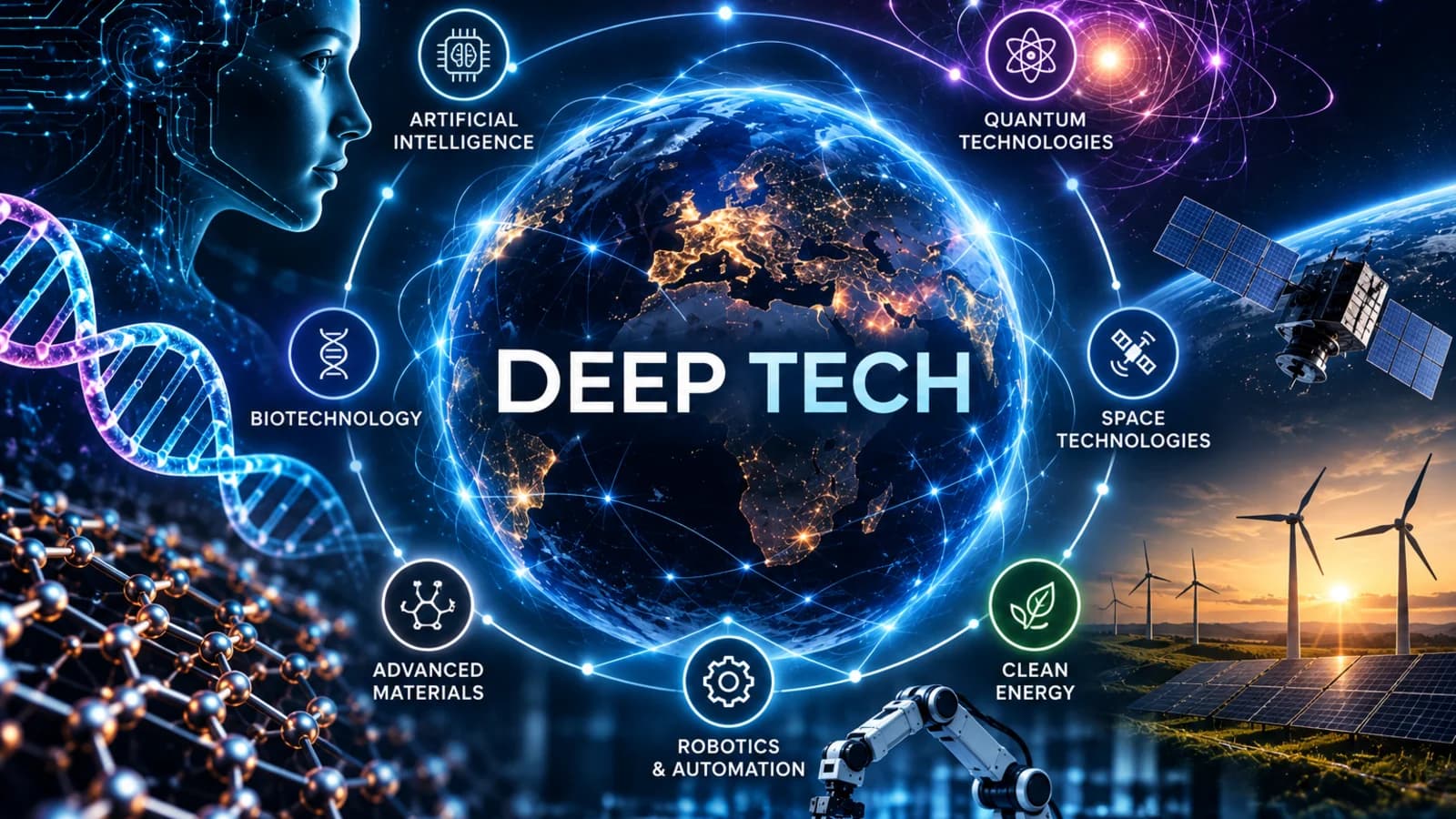
Put those three together and you're looking at deep tech: the hard science and engineering that now decides which economies grow, which countries stay independent, and who holds power for the next thirty years.
The 60-second version
What it is: technology built on hard science (chips, quantum, fusion, advanced materials, biotech, robotics, space) that takes years and serious capital to reach the market.
Why it matters now: it has become the backbone of national security, supply chains, productivity and climate solutions. Governments now treat it like roads and power lines: essential infrastructure.
The surprise: the science is usually ready long before the factories, money and people are. That gap, not the science, is where most deep tech dies.
The opportunity: many of the biggest wins will go to the unglamorous middle: refining, manufacturing, testing, energy, and the people who connect scientists with customers and capital.
1. Deep Tech Without the Mumbo Jumbo
Deep tech isn't one technology. It's a way of solving problems. Boston Consulting Group and Hello Tomorrow, who have studied the field for years, describe it as starting with a big, hard problem and combining science and engineering to solve it [BCG & Hello Tomorrow, Mar 2021].
Two numbers from their research capture the essence. 83% of deep tech ventures build a physical product, and 96% combine at least two technologies [BCG & Hello Tomorrow, Mar 2021]. This is the world of atoms, not just bits.
Here's the simplest way to picture it. Building software is like writing a new recipe. Building deep tech is like inventing a new kind of oven, then building the factory that makes the ovens, then securing the metal to build the factory. Every step takes years, and every step has to work. That's why a software start-up can launch in weeks while a deep tech company may need a clean room, a pilot plant, safety approvals and a decade of patience.
Aha moment: the difficulty is the business model. In software, a competitor can copy your idea in months. In deep tech, years of hard-won know-how become a moat that money alone can't cross quickly. The best investors stop asking "why is this taking so long?" and start asking "how hard will this be for anyone else to repeat?"
The fields worth knowing
Semiconductors and AI chips are the engines inside every digital product. Quantum technology promises computers that can simulate molecules, sensors of extraordinary precision and communications that are extremely hard to intercept. Fusion and advanced energy aim to deliver clean power at scale, alongside next-generation grids and storage. Advanced materials and critical minerals (lithium, cobalt, rare earths, graphite, gallium) are the physical ingredients of the energy and digital economy. Synthetic biology uses living systems to make medicines, food and materials. Robotics and embodied AI put intelligence into machines that work in the physical world. Space covers satellites, launch and Earth observation.
Jargon buster
Fab or foundry: a chip factory. A foundry makes chips designed by other companies.
Nanometre (nm): a measure of how small the features on a chip are. Smaller generally means faster and more efficient.
Qubit: the basic unit of a quantum computer. Powerful, fragile and hard to scale.
Refining or processing: turning raw ore into pure materials factories can use. This is where much of the real power sits.
Valley of death: the gap between a working prototype and a profitable product, where money often runs out.
Dual-use: technology that has both civilian and military uses.
2. Why It Matters: To You, Your Country and the World
To you: your job, your bills, your health
Deep tech feels distant until you look at your own life. The price of your phone, your car, your solar panels and your electricity all depend on chips and minerals produced in a handful of places. When that supply is squeezed, everyone pays.
Aha moment: after China tightened export controls in 2025, European buyers paid about five times the Chinese domestic price for gallium and heavy rare earths [IEA, 2026]. The same material, at five times the cost. Price shocks like that work their way into the products people buy.
Deep tech also creates work far beyond the laboratory. Every new fab, refinery or quantum facility needs electricians, technicians, operators, engineers, lawyers, finance teams and project managers. And it sits behind many of tomorrow's medical advances, from AI that reads scans to quantum simulations of new drugs.
To your city and country: you can't download a factory
Software crosses borders in seconds. A chip fab, a refinery or a fusion supply chain cannot. A country that can't make or secure these things depends on other people's decisions in a crisis, and the pandemic-era chip shortage showed how quickly that can stop car factories and empty shelves.
That's why governments are spending heavily. The United States passed the CHIPS and Science Act in 2022 to bring chipmaking home [US Department of Commerce, 2022]. India now has 12 approved semiconductor projects, three of them already in commercial production [SEMICON India via inkl, Sep 2026]. Cities compete fiercely to host these plants, because each one anchors suppliers, skills and research for decades.
To the world: power, climate and productivity
Power. China's 15th Five-Year Plan (2026–2030) names quantum, AI, humanoid robots, 6G, brain-machine interfaces and nuclear fusion as frontier priorities, and mentions AI more than 50 times [The Quantum Insider, Mar 2026]. The US restricts exports of advanced chips and chipmaking tools. China restricts exports of key minerals, and the number of mineral product codes under its export controls has tripled since 2023 [IEA, 2026].
Aha moment: this isn't a race with one finish line. It's a web of mutual dependence. Each major power holds something the others need. In deep tech, power comes less from inventing everything and more from being indispensable at one point in the chain.
Climate. BCG and Hello Tomorrow found that 97% of deep tech ventures contribute to at least one of the UN's Sustainable Development Goals [BCG & Hello Tomorrow, Mar 2021]. Clean energy, food security and disease are physics, chemistry and biology problems before they become policy problems.
Productivity. Many advanced economies are ageing, and productivity growth has been sluggish for years. Deep tech is the strongest candidate to change that, but history suggests patience. Electricity took decades to transform factories, because owners first used electric motors to copy steam-era layouts. The real gains came when they redesigned how work was done. Expect the same with AI, robotics and new materials.
3. Connecting the Dots: Five Chains Most People Miss
Deep tech never sits in one industry. Its direct industries include semiconductors, computing, energy, defence, space, healthcare and advanced manufacturing. Its indirect industries stretch to mining and refining, chemicals, construction, utilities, logistics, finance, insurance and education. And it rests on enabling technologies such as AI, precision engineering, high-performance computing and advanced materials. The interesting part is how they link.
1. Your AI assistant runs on Taiwanese chips and Chinese-refined minerals. Every AI model depends on advanced chips, most of them made by TSMC [TrendForce via Taipei Times, Mar 2026]. Those chips, and the magnets and batteries around them, depend on minerals that are largely refined in one country. Across critical minerals, the single biggest refining country held an average 72% share in 2025 [IEA, 2026]. A software product turns out to have a very physical supply chain.
2. AI has become an energy industry. When AI ambitions are measured in gigawatts [Forbes, Jul 2026], the story pulls in grid technology, storage, cooling, nuclear power and, one day, fusion. Some of the best AI opportunities may sit in electricity rather than software.
3. A copper mine in Congo depends on acid. About 45% of the DRC's copper production relies on acid-based processing, so a shortage of sulphuric acid can ripple through the world's copper supply [IEA via Energy Transition Africa, 2026]. The most fragile link in a supply chain is often one nobody is watching.
4. Oil wealth is becoming technology power. Abu Dhabi's MGX closed a US$49 billion fund in July 2026, the largest dedicated AI fund ever raised [Forbes, Jul 2026]. Gulf states are converting energy income into stakes in AI labs, data centres and chips, buying a seat at the table of the next economy.
5. The hidden bottleneck is people meeting people. Europe produces twice as many science and engineering graduates as the United States and hosts 30% of the world's leading deep tech universities. Yet more than 80% of its deep tech exits are acquisitions, often by American buyers [Dealroom via Tech.eu, Mar 2026]. The science was there. What was missing were the connections to scale-up capital, first customers and people who had built factories before.
4. Hubs and Main Players: Seven Places, Seven Strategies
Australia: brilliant labs, building the bridge
Hubs: Sydney, Brisbane and Melbourne. Key players: PsiQuantum, Silicon Quantum Computing, Harrison.ai, the National Reconstruction Fund Corporation, CSIRO and the leading research universities.
Australia punches well above its weight in quantum science. The federal and Queensland governments committed A$940 million to PsiQuantum to build a utility-scale quantum computer at Moreton Bay, north of Brisbane [Startup Daily, May 2026]. The A$15 billion National Reconstruction Fund has invested A$20 million in Sydney's Silicon Quantum Computing [NRF Corporation] and also backs AI medical imaging company Harrison.ai [TechCrunch, Feb 2025].
Aha moment: Silicon Quantum Computing builds quantum chips with atomic precision and can design, make and test a chip in under a week [NRF Corporation]. In a field where many teams wait months between experiments, that speed is a genuine competitive weapon.
A second one: Australian companies own about 12% of foreign-owned mining in Latin America [The Rio Times, 2026]. Australia is already a quiet force in the world's critical-minerals map, well beyond its own borders.
Australia's edge is research quality, mineral wealth, mining know-how and stable alliances. Its challenge is a small home market and a long habit of exporting raw materials and talent rather than finished products.
United States: capital, customers and the CHIPS bet
Hubs: Boston, the San Francisco Bay Area, Austin and Arizona. Key players: Nvidia, Intel, AMD, IBM, Google, national laboratories, defence agencies and the world's deepest pool of venture capital.
America's advantage is that it has the money, the research and the customers, including a defence establishment willing to be the first buyer of unproven technology. Its vulnerability is that much of its advanced chip manufacturing, and many of the refined minerals it relies on, still come from elsewhere [IEA, 2026].
China: scale, planning and control of inputs
Hubs: Beijing, Shanghai, Shenzhen and Hefei. Key players: national research institutes, state-backed investment funds, Huawei, SMIC, and leading battery and robotics manufacturers.
China directs money at named frontier fields through its five-year plans [The Quantum Insider, Mar 2026], and it has built extraordinary depth in processing. Its share of global copper smelting has grown from around 15% in 2005 to about 50% today [IEA, 2026]. Its edge is speed, scale, manufacturing depth and control of key inputs. Its constraint is restricted access to the most advanced chipmaking tools.
Germany: engineering muscle, now chasing breakthroughs
Hubs: Munich, Dresden ("Silicon Saxony") and Berlin. Key players: ESMC (a joint venture of TSMC with Bosch, Infineon and NXP), fusion start-ups Proxima Fusion and Marvel Fusion, SPRIND and the Fraunhofer institutes.
Germany's High-Tech Agenda, announced in July 2025, names fusion as one of six critical technologies and aims to build a fusion power plant in Germany [Fusion Industry Association, Jul 2025]. In Dresden, ESMC is building Europe's first foundry for 28/22nm and 16/12nm chips, targeting production in 2027 and 40,000 wafers a month [TrendForce, Nov 2025]. A 2024 law also gave SPRIND, Germany's federal agency for breakthrough innovation, more freedom to back risky ideas [Library of Congress, 2024].
Aha moment: Germany's hidden strength isn't its famous brands. It's thousands of mid-sized family-owned industrial firms, the Mittelstand, that make the precision parts and machines deep tech depends on. Its challenges are high energy costs and a shortage of growth-stage funding.
Singapore: small country, deliberate bets
Hubs: one-north and the national research campuses. Key players: A*STAR, the National Research Foundation, the National Quantum Office and global chip and advanced-packaging firms.
In February 2026 Singapore launched RIE2030, a S$37 billion research and innovation plan for 2026 to 2030, 32% larger than the previous plan [Quantum Computing Report, Feb 2026].
Aha moment: Singapore will be the first place outside the United States to host Quantinuum's Helios quantum computer, expected to be running by late 2026 [Quantum Computing Report, Feb 2026]. A city-state of about six million people has moved ahead of far larger nations in access to cutting-edge quantum hardware. Its edge is policy consistency and trust; its constraint is a small talent pool, so it must keep attracting global firms and people.
Saudi Arabia: turning energy into compute
Hubs: Riyadh and KAUST at Thuwal. Key players: HUMAIN, the Public Investment Fund and King Abdullah University of Science and Technology.
HUMAIN has signed about US$23 billion of agreements, including a US$10 billion joint venture with AMD, and plans 1.9 gigawatts of AI data centre capacity by 2030 [Forbes, Jul 2026]. Saudi Arabia brings capital, cheap energy, a young population and fast decision-making. The test is whether its research base and local talent can grow as quickly as its data centres.
UAE: the capital allocator
Hubs: Abu Dhabi and Dubai. Key players: MGX, G42, Mubadala and the Technology Innovation Institute.
MGX invests across the entire AI stack, from frontier AI labs to data centres and platforms [Forbes, Jul 2026]. The UAE's strengths are sovereign capital, global partnerships and openness to foreign talent. Its challenge is turning that investment power into globally significant home-grown companies.
The pattern: the United States and China compete for the frontier. Germany and Singapore win through precision and focus. Saudi Arabia and the UAE turn capital and energy into position. Australia has the science and the minerals, and its big question is whether it builds industries around them.
5. 2030: What the World Looks Like
United States. Still the leader in AI chips, capital and frontier research, with more chipmaking on home soil than today. The open question is whether new fabs reach full output and whether enough skilled workers can be found to run them.
China. The 15th Five-Year Plan runs to 2030, so expect a sustained push in quantum, AI, robotics and fusion [The Quantum Insider, Mar 2026]. China will likely remain the world's main processor of critical minerals and a leader in batteries and robotics, while working around limits on advanced chipmaking tools.
Europe. Strong science, weaker scale. The EU set a goal of 20% of global chip production value by 2030, but the European Court of Auditors notes the Commission's own forecast points to 11.7% [European Court of Auditors, 2025]. Expect Europe to lead in specific niches, such as chipmaking equipment, fusion research and industrial AI, rather than across the board.
Middle East. Saudi Arabia and the UAE will be major global AI infrastructure hubs, with gigawatt-scale data centres and sovereign funds holding stakes around the world [Forbes, Jul 2026]. The real test for 2030 is whether they also produce world-class companies of their own.
Africa. Africa's leverage lies in the ground. The DRC already supplies about two-thirds of the world's cobalt, and Madagascar, Mozambique and Tanzania are expected to supply around a third of mined natural graphite by 2040 [IEA via Energy Transition Africa, 2026]. Aha moment: despite that, China is expected to control about 90% of battery-grade graphite production [IEA via Energy Transition Africa, 2026]. Africa mines more and more, but the value is captured where the minerals are processed. Its 2030 story will be decided by whether refining and processing are built at home.
South America. The "lithium triangle" of Argentina, Bolivia and Chile holds around 43% of identified global lithium resources, and Chile and Argentina produced about 27% of the world's mined lithium in 2025. Chile and Peru produced over a third of global copper in 2024 [The Rio Times, 2026]. Brazil leads the world in niobium and has significant rare earth deposits. By 2030 the region will be a battleground for supply deals between the United States, China and Europe, and a strong candidate to build processing industries of its own.
Asia-Pacific, including Australia and India. Taiwan, South Korea and Japan will stay central to chips. Singapore's RIE2030 plan runs to the end of the decade [Quantum Computing Report, Feb 2026]. India is moving from policy to production in semiconductors [SEMICON India via inkl, Sep 2026]. Australia could host one of the world's first utility-scale quantum computers [Startup Daily, May 2026] if construction stays on track.
Three scenarios for deep tech to 2030
In the base case, growth continues, supply chains become more regional, and export controls remain a permanent feature on both sides. In the upside case, breakthroughs in quantum or fusion arrive early and cheaper clean energy accelerates everything else. In the downside case, trade fragmentation deepens, minerals become scarce or expensive, and capital retreats after a hype correction. The signals to watch are export-control announcements, mineral prices, and whether flagship projects in Dresden, Moreton Bay and the Gulf hit their dates.
6. Investment and Growth Opportunities
The headline markets are enormous. Forecasters expect global semiconductor revenue to pass US$1 trillion by 2030 [Counterpoint Research, Aug 2025]. McKinsey estimates quantum technology could generate up to US$97 billion in revenue by 2035, after almost US$2 billion was invested in quantum start-ups in 2024 [McKinsey, Jun 2025]. In Europe, deep tech took a record 32% of all venture capital in 2025, worth US$20.3 billion [Dealroom via Tech.eu, Mar 2026].
But the smartest money often looks past the headlines to the bottlenecks around them:
Refining and processing. The 2025 export controls showed that leverage sits in processing, not only in mining.
Energy for computing. Grids, storage, cooling and clean power for data centres.
Picks and shovels. Testing, specialised equipment, precision components and advanced chip packaging.
Growth-stage capital. Europe's funding gap, and its habit of selling promising companies early, shows money is missing between start-up and scale-up [Dealroom via Tech.eu, Mar 2026].
Skills and training. Technicians and engineers are a bottleneck in every region.
Partnerships with resource-rich regions. Africa and South America want processing at home and need partners to build it.
Questions to ask (not financial advice)
Does the team have a credible path from lab to factory, and has anyone on it done this before? Who will be the first customer, and is government or defence demand involved? How exposed is the business to export controls or a single country's supply of key inputs? Where will growth-stage money come from? And is the market forecast based on real demand, or on a breakthrough that hasn't happened yet?
7. Challenges and Blockers
Deep tech is hard for reasons that don't go away with enthusiasm.
Time and cost come first: projects run for a decade and need large, patient money. Many companies die in the valley of death between prototype and production. Talent is short everywhere, especially technicians, engineers and people who can bridge science and business. Energy is becoming a constraint, as AI and advanced manufacturing demand huge amounts of reliable power. Geopolitics can cut access to tools, chips or minerals overnight. Ambitions slip: Europe's 20% chip target is a reminder that political goals and factory timelines don't always match [European Court of Auditors, 2025]. And hype is a constant risk; quantum and fusion have both been "ten years away" for a very long time.
The sceptic's case: deep tech is a capital furnace. Governments pick losers as often as winners, and hype pulls money away from proven technologies that could help people sooner.
Our answer: some of that is fair, and many bets will fail. But the alternative is worse: a world where a few places control chips, minerals and energy technology, and everyone else waits for permission. The smart approach is a portfolio. Back many shots, set clear milestones, and invest in the supply chains and skills that pay off even when individual companies don't.
8. Skills to Get Involved and Thrive
You don't need a PhD in physics to build a career in deep tech. You need the right mix of skills and the courage to step into unfamiliar rooms.
Human skills that will be gold. The most valuable is translation: explaining science to boards and investors, and business needs to scientists. Close behind are systems thinking (seeing how chips, minerals, energy and policy affect each other), resilience (projects run for years and hit walls), collaboration across disciplines and cultures, and ethical judgement, because so many of these technologies are dual-use.
Technical skills. Fundamentals in physics, chemistry, materials science or biology. Process, electrical and mechanical engineering, especially scaling from lab to factory. Data science and AI applied to research and manufacturing. Advanced manufacturing, quality and reliability. And the fast-growing specialties of technology policy, export controls and intellectual property.
Pathways. University science and engineering remain the classic route, but they aren't the only one. Technicians trained through vocational programs run clean rooms and pilot plants. People from mining, energy, defence, finance and law bring exactly the experience deep tech companies lack. Some of the best people in the field came from somewhere else entirely.
Getting in the room: events and networking
Breakthroughs happen in laboratories. Deals, first customers and career breaks usually happen when people meet. Six habits make the difference:
Pick one field and one region. "Quantum in Australia" or "chips in Germany" beats "deep tech everywhere".
Mix your event types. Trade shows reveal the supply chain. Investor events show where the money is moving. Research conferences show what's coming in five years.
Bring three good questions. What's your biggest bottleneck? Who do you wish you'd met earlier? Which skill is hardest to hire?
Follow up within 48 hours. One thoughtful message beats twenty business cards.
Give before you ask. Share an article, make an introduction, offer an insight.
Stay in the community between events. Industry associations, university open days and specialist meet-ups keep the conversation alive.
Author's Vision and Predictions
These are forecasts, not facts. They're my reading of where the evidence points, and I'll be watching to see where I'm wrong.
1. The boring middle will make the most money. By 2030, refining, processing, advanced packaging and testing will attract more serious capital than many headline technologies. The 2025 export controls showed where the real leverage lies.
2. Energy will become AI's real speed limit. Before 2030, access to reliable, affordable power will decide where AI gets built more than chip supply will.
3. Africa and South America will insist on processing, not just digging. Expect more resource-rich countries to require local refining as a condition of mining deals, and more joint ventures to make that happen.
4. The Gulf will move from investor to builder. Within five years, Saudi Arabia and the UAE will produce deep tech companies of real global significance, not just stakes in other people's.
5. Quantum will earn its first real money in chemistry and materials. Narrow, valuable uses, such as simulating molecules for drugs, batteries and industrial chemicals, will arrive before general-purpose quantum computing.
6. Australia faces a fork in the road by 2030. Either it becomes a processor and maker, building on quantum, minerals and medical AI, or it remains a quarry with brilliant laboratories. The tools now exist. The test is execution.
7. The most valuable deep tech role will be the translator. The person who can explain physics to a board, and a board's needs to a physicist, will be among the hardest people to hire this decade.
What This Means for You
Executives. Map your physical dependencies: which chips, minerals and energy inputs does your business rely on, and from which countries? Consider becoming a first customer for a deep tech supplier; it buys early access your competitors won't have. And partner with one laboratory or university on a real problem you face.
Investors (questions to ask, not financial advice). Look past the headline technology to the bottlenecks around it: processing, energy, equipment and skills. Ask who the first customer is and how exposed the business is to export controls. Check that growth-stage funding exists before the company needs it.
Professionals. Engineers and scientists should learn the commercial side: cost, customers and scale-up. Finance and legal professionals will find export controls, intellectual property and long-horizon investment are fast-growing specialties. Supply chain and operations leaders should get to know critical-mineral and chip supply chains, now a board-level topic.
Students and young people. Pair a science or engineering skill with business, policy or communication; the combination is rare and valuable. Look beyond famous companies to suppliers, labs and pilot plants. And go to at least one industry event this year to ask people about their real day-to-day work.
Signals to Watch
China's critical-mineral export controls (2026–27): further additions or easing will move prices worldwide.
ESMC's Dresden chip plant (equipment move-in, second half of 2026): a test of Europe's ability to build at scale.
Singapore's Helios quantum computer (late 2026): whether broad access sparks a wave of new local companies.
PsiQuantum's Moreton Bay build (2026–27): whether Australia can host frontier technology at scale.
Key Health Takeaway to Practise This Week
Protect one block of deep work every day. Deep tech is built on long, uninterrupted thinking, and so is almost every meaningful achievement. For the next five days, set aside 60 to 90 minutes with your phone in another room and notifications switched off. Work on one thing only. Notice how much more you get done, and how much calmer you feel when your attention isn't pulled in ten directions.
Big breakthroughs, in laboratories and in lives, rarely come from frantic effort. They come from focus, repeated.
The Bottom Line
Deep tech is where science turns into power: economic, strategic and human. The winners won't simply be the places with the best laboratories. They'll be the ones that connect scientists, builders, investors and first customers fastest. That connection is open to anyone willing to show up, learn and contribute.
The future is being built in clean rooms, refineries and research labs. The doors are more open than you think.
Explore upcoming technology, semiconductor, robotics, mining and space events on Industry Events, and subscribe to the IE newsletter for the next Insight.