

Weekly 7-Industry Insights: Robotics and Dark Factories
China now makes the overwhelming majority of the world's humanoid robots — and builds them inside the most automated factories on earth. This week we connect the dots across seven industries — robotics, AI, manufacturing, energy, semiconductors, materials and logistics — to show how one capability was assembled, where it lives, and the opportunities opening up around it.
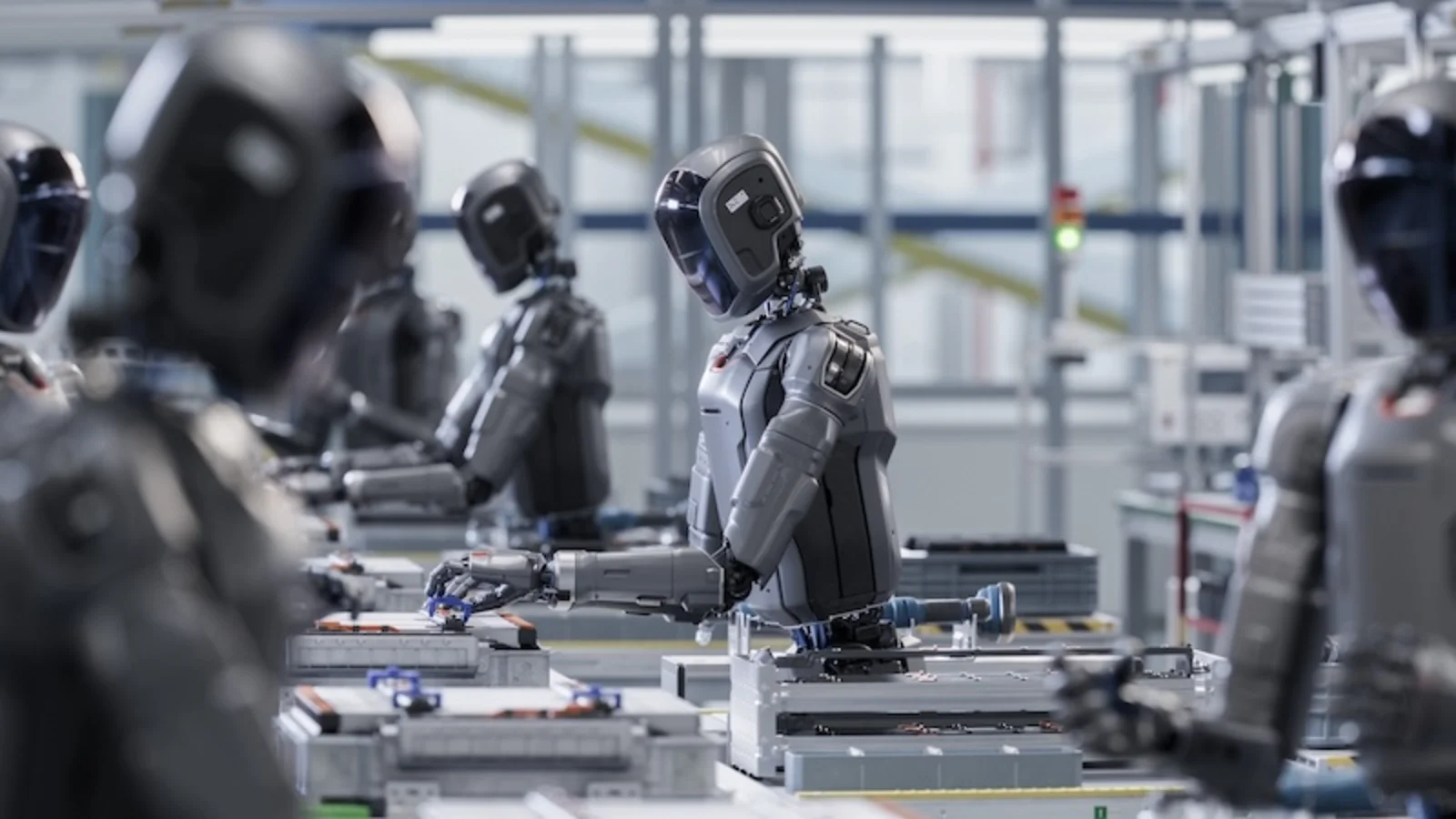
Two images have come to define Chinese manufacturing in 2026. One is the "dark factory" — a plant so automated it can run with the lights off, machines producing around the clock with barely a human on the floor. The other is the humanoid robot — a Unitree G1 executing an autonomous kung fu routine on live television, or logging 130,000 steps across −47°C snowfields to prove it can walk in the cold. [Forbes, Apr 2026]
They look like separate spectacles. They are not. They are two ends of a single industrial system that China has spent a decade assembling — and understanding how the pieces fit together is far more useful than marvelling at either one alone.
The dark factory is the demand side: highly automated production that increasingly wants flexible, general-purpose machines to fill the gaps fixed robots can't. The humanoid is the emerging supply of exactly that. And underneath both sits the thing that makes them possible in the first place — a manufacturing base, a materials advantage, and three cities that have quietly become the centre of gravity for the whole field.
The base most people underestimate
Start with scale, because it explains everything above it. China installed roughly 276,000 industrial robots in 2025 — by preliminary figures from the International Federation of Robotics, more than Japan, the United States, Germany and South Korea combined. [Robotics Center / IFR, 2026] That isn't just a big number. It's a factory floor generating an enormous stream of real-world operating data, and a workforce and supplier ecosystem fluent in deploying automation at volume. Humanoid developers feed on exactly that base — the factories are both the customer and the training ground.
On top of the robots sits the materials advantage, which is harder to replicate than any single technology. China dominates the extraction and processing of the rare-earth elements — neodymium, praseodymium, dysprosium, terbium — that go into the high-strength permanent magnets inside every robot actuator and motor. [Rare Earth Exchanges, Jul 2026] Layer on a decade of component expertise carried over from the electric-vehicle and drone industries, and the result, per the Berlin think tank MERICS, is that China controls 63% of the key companies in the global humanoid-component supply chain — which is why a Chinese firm can build a comparable robot at less than half the price of an international rival. [MERICS]
This is the point that gets missed in the coverage of dancing robots: the advantage isn't the dance. It's that the entire bill of materials — magnets, actuators, sensors, batteries, assembly — sits within reach of a single, integrated domestic ecosystem. And that ecosystem has an address. Three, in fact.
Three cities, three roles
Shenzhen is the hardware engine. If China can build a useful humanoid cheaply, Shenzhen is a large part of why. The city's supply-chain density — the same density that once made it the world's smartphone and drone capital — now produces the actuators, controllers and precision components a robot needs, at prices and speeds no other cluster can match. Sub-$10,000 robotic arms and teleoperation hardware come out of this ecosystem. [Robotics Center, 2026] Shenzhen is the answer to "how is this even possible" — the physical layer beneath every headline.
Hangzhou is the startup story. It is home to Unitree Robotics, which did not exist a decade ago and, by 2025, had become one of the world's top humanoid sellers — shipping more than 5,500 units and turning its first profit, an adjusted net income of around 600 million yuan ($90 million), up 674% year on year. [Rest of World, Mar 2026] Unitree's blockbuster STAR Market IPO — priced to raise roughly $900 million at a valuation near $9 billion — became the moment the whole sector's commercial readiness was put to the market's test. [CNBC, Aug 2026] Hangzhou is where the entrepreneurial energy of the field concentrated.
Shanghai is the scale story. In the first half of 2026, Shanghai's AgiBot overtook Unitree to become the world's largest humanoid vendor, shipping roughly 8,400 units in six months — a 562% year-on-year surge — and passing its 15,000th cumulative robot, built across a portfolio of full-size bipedal, half-size bipedal and wheeled platforms. [Humanoids Daily / SAG, Aug 2026] Between them, AgiBot and Unitree now control around 75% of the global humanoid market. [Humanoids Daily] Shanghai is where "prototype" became "production run."
Three cities, three functions — hardware, entrepreneurship, scale — and together a geography of capability that is genuinely difficult to reproduce elsewhere, because it took a decade of overlapping industries to build.
Where the dots connect: seven industries, one system
The reason this is one industry and not two becomes clear when you look at what actually links a dark factory to a humanoid — and it runs through seven distinct sectors, each pulling the others forward.
Manufacturing provides the deployment environment: real production lines where a robot keeps learning under real conditions, which is where embodied intelligence actually improves. AI and software supply the foundation models for robotics, which matured sharply through 2025 and 2026, giving these machines a general-purpose "brain" for tasks that once needed bespoke programming. [China Humanoid Report, Jun 2026] Robotics contributes the bodies, actuators and control systems. Falling costs in energy and batteries — the same components that power China's EVs — have roughly halved the bill of materials for a useful humanoid since 2024, with analysts projecting per-unit costs falling toward $20,000 at scale by 2030, comparable to a car. [Forbes, Apr 2026] Semiconductors provide the compute the AI layer runs on; materials, specifically China's dominance of rare-earth processing, provide the magnets inside every motor; and logistics is where the compressed value chain physically plays out.
Read across those seven and the pattern is unmistakable: none can be analysed alone anymore, because a shift in one ripples through the rest. And the demand tying them together is already real, not speculative. The largest buyers of these robots are China's own industrial champions — BYD, CATL, Foxconn — the electronics and EV giants deploying humanoids into the very production lines that generate the data to improve them. [Robotics Center, 2026] That is the loop that makes the whole thing self-reinforcing: factories buy robots, robots learn in factories, better robots make better factories. A Ministry of Industry and Information Technology official has said China expects humanoid output to exceed 100,000 units in 2026, with one industry tracker forecasting shipments around 62,500 units, up 94% year on year. [DataM Intelligence, Aug 2026; TrendForce via China Humanoid Report]
Where the dots connect: the business opportunity
For anyone reading this as an operator or investor rather than a spectator, the shape of the opportunity follows directly from the structure above — and it is broader than "buy a robot company."
The clearest openings sit in the layers around the headline hardware. Components and subsystems — actuators, sensors, precision reducers, power electronics — are where much of the durable value and margin actually accumulates, and where the supply chain is deepest. Embodied-AI software — the models, simulation environments and control systems that turn a walking chassis into a working tool — is the layer where capability is still scarce and where the field's real bottleneck lies. Deployment and integration — the unglamorous work of getting a humanoid to do something genuinely useful on a specific production line — is a services opportunity that barely exists yet and will have to. And the picks-and-shovels layer beneath all of it — the batteries, the rare-earth magnets, the chips, the charging and energy infrastructure an automated plant consumes — is where demand is most certain even while the robots themselves remain immature.
That immaturity is worth stating plainly, because it is also where opportunity lives. More than 100 humanoid firms now crowd the Chinese market; analysts expect consolidation to a few dozen, and even enthusiasts concede the machines have not yet reached their "ChatGPT moment." [Rest of World, Mar 2026; Chatham House, Sep 2026] On stage they do acrobatics; in an unstructured warehouse they still struggle. But the same analysts note the decisive shift: by the first half of 2026, industrial and commercial applications made up more than 70% of humanoid shipments, up from around 50% a year earlier. [Humanoids Daily / SAG, Aug 2026] The field is moving from performance to work — and the businesses that solve the "actually useful" problem are the ones that will matter when the consolidation settles.
Where the dots connect: the jobs
A dark factory needs fewer hands but more expertise, and the humanoid build-out sharpens the same pattern. This is not a story of employment disappearing — it is a story of it changing shape, and the change is unusually legible for anyone deciding where to build a career.
On the building side, the demand is concentrating in automation and controls engineering, industrial software development, machine-vision and robotics integration, actuator and mechatronics design, data engineering, and the embodied-AI and simulation modelling that trains these systems. On the running-and-protecting side, an autonomous plant creates new, durable roles in operational-technology security, industrial data governance, and the systems-resilience engineering that keeps a software-controlled factory running when something breaks.
But the highest-value position, as it so often is, sits at the seams — in the word and. The person who understands robotics and the specific industrial process it's being dropped into; the software engineer who understands AI models and the physical constraints of a factory floor; the operations manager who understands automation and the energy economics that cap how much of it you can afford. Cheap labour is a fading advantage once labour is a small share of production cost. The advantage that replaces it is people who can hold two of these disciplines at once — and those people are, right now, scarce everywhere.
What to actually watch
The temptation is to keep score by counting robots or watching them dance. That misses the point. The thing to watch is whether the loop keeps tightening: whether the factories keep generating the data that improves the robots, whether the robots keep getting cheap enough and capable enough to deploy at scale, and whether the software layer — still the field's genuine bottleneck — matures fast enough to turn walking machines into working ones.
China has assembled something unusual: the materials, the manufacturing base, the buyers, and the three-city geography to do all of it in one connected system. The humanoids and the dark factories are not two trends. They are the same industrial capability, viewed from two ends — and the opportunities, technical and commercial, are opening in the space between them.
This shift lives at the intersection of robotics, AI, manufacturing, energy, semiconductors and logistics — which is exactly why no single conference or report captures it. A robotics exhibition reveals the hardware; an AI summit reveals the software bottleneck; an energy conference reveals the constraint; a manufacturing forum reveals the demand. Following where these industries actually converge is the surest way to see the opportunities before they're obvious.
If you want to see this space up close, these upcoming events on Industry Events sit directly on the robotics, automation and industrial-AI thread running through this piece:
World Summit AI Amsterdam 7–8 Oct 2026, Amsterdam, Netherlands
4th Data Science & AI Summit 2026 – London 1–2 Oct 2026, London, UK
4th Tech Summit on AI & Robotics 28–30 Sep 2026, France
ICRSA 2026 – Robotic Systems & Applications 30 Oct–1 Nov 2026,Guangzhou, China
ICMRA 2026 – Mechatronics, Robotics & Automation 13–15 Nov 2026,China
ICIMA 2026 – Intelligent Manufacturing & Automation11–13 Dec 2026Dalian, China
Industry & Automation Expo 5 Nov 2026, Romania
19th Engiexpo Industrial Exhibition 2026 21–23 Nov 2026 Pune, India
The humanoids and the dark factories are not two trends. They are the same industrial capability, viewed from two ends — and the conversations shaping it are already being scheduled.