

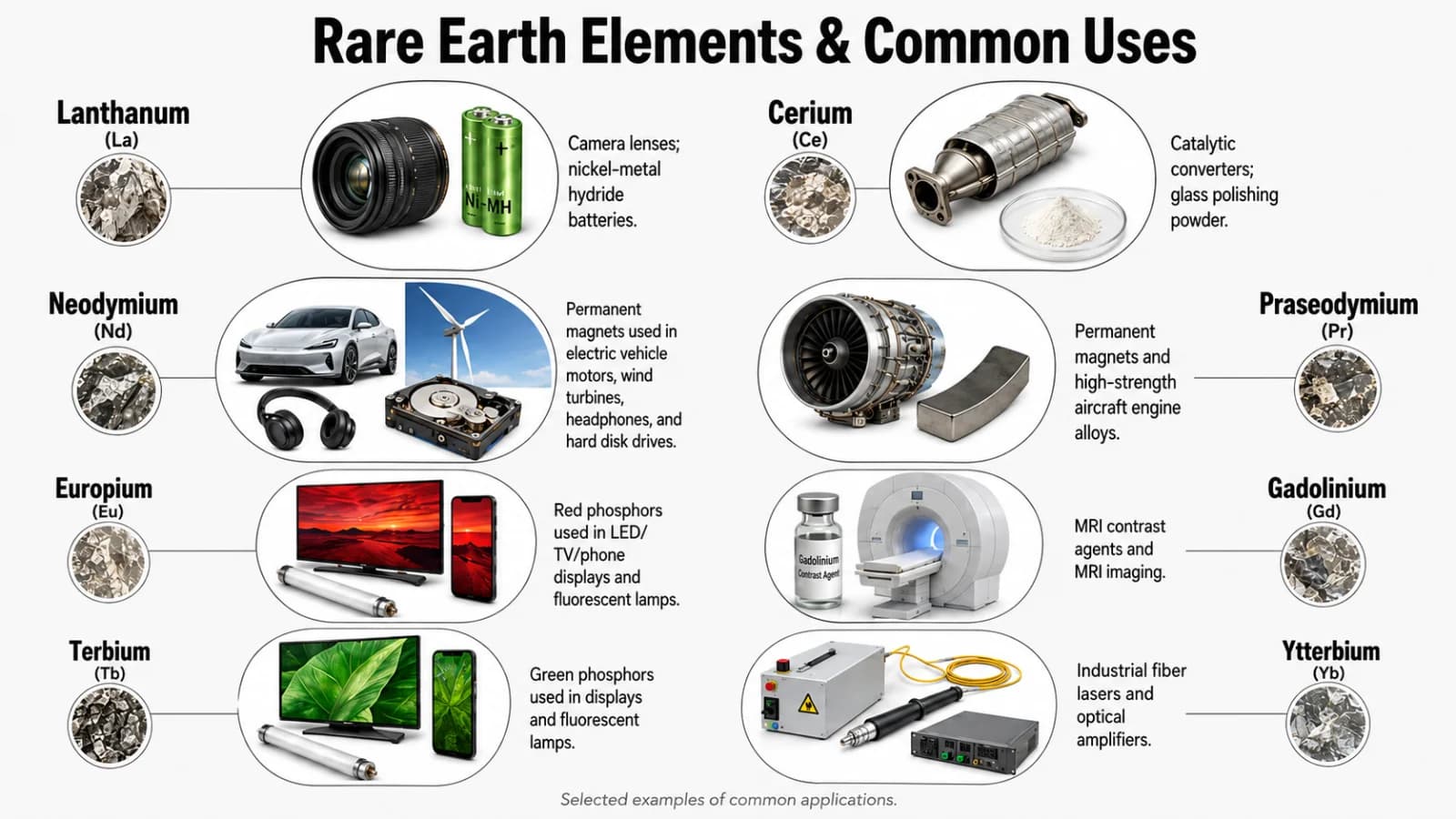
Here’s something most people never think about: the phone in your pocket, the electric car pulling up beside you, the airplane flying overhead, the MRI machine at your local hospital, and the wind turbines turning on the horizon all depend on a group of metals with names most of us would struggle to pronounce.
They’re called rare earth elements.
They help power the small speakers in your earbuds, the vibration in your phone, the motors inside electric vehicles, the guidance systems in aircraft, the sensors in medical equipment, and the advanced electronics used in satellites, defense systems, robotics, and clean energy infrastructure.
Despite the name, rare earth elements are not especially rare. The real challenge is that they are rarely found in high enough concentrations to mine cheaply. And once they are mined, separating them from one another is an extremely complex, expensive, and messy process.
That difficulty has turned these little-known metals into something far bigger than a science topic. Rare earths now sit at the center of global supply chains, clean energy, aviation, healthcare, national security, artificial intelligence infrastructure, and many of the technologies that will define the future.
That’s why this series exists: to demystify rare earths, explain why they matter, and show where the opportunities are. Whether you are a student, investor, founder, professional, or simply curious about the future, we want to help you understand this industry and explore how you can position yourself to be part of it, support its development, and contribute to the technologies shaping tomorrow.
Part I: What Are Rare Earth Elements?
The Periodic Table's Best-Kept Secret
The rare earth elements are a group of seventeen chemically similar metallic elements. They consist of:
The fifteen lanthanides: elements with atomic numbers 57 to 71, ranging from lanthanum (La) to lutetium (Lu)
Two honorary members: scandium (Sc, atomic number 21) and yttrium (Y, atomic number 39), which share similar physical and chemical properties and are almost always found in the same deposits
Despite their name, rare earth elements are not actually rare. As Dr. Lauren Macreadie, senior lecturer in chemistry at the University of New South Wales, explains: "They are known as rare, however, as they are usually dispersed rather than found in large, concentrated deposits". In fact, some are more abundant in the Earth's crust than gold or platinum. What makes them "rare" is the economic challenge of finding them in concentrations high enough to mine profitably. Rare earths are divided into two groups:
The Light Rare Earths (LREEs)
Lanthanum, cerium, praseodymium, neodymium, samarium, europium
More abundant, easier to extract, cheaper
Used in batteries, glass polishing, and some magnets
The Heavy Rare Earths (HREEs)
Gadolinium, terbium, dysprosium, holmium, erbium, thulium, ytterbium, lutetium, plus scandium and yttrium
Much rarer, far more valuable, fiendishly difficult to separate
Essential for advanced magnets, lasers, medical imaging, and military tech
This distinction matters. Light rare earths are more abundant and easier to extract. Heavy rare earths are rarer, more valuable, and often critical for the most advanced technologies.
Part II: Where Are They Found?
A Geography of Concentration
The global distribution of rare earth reserves is remarkably uneven. According to the International Energy Agency's 2026 report, here is where the world's known reserves are located:
Country Reserves (Million Metric Tons)
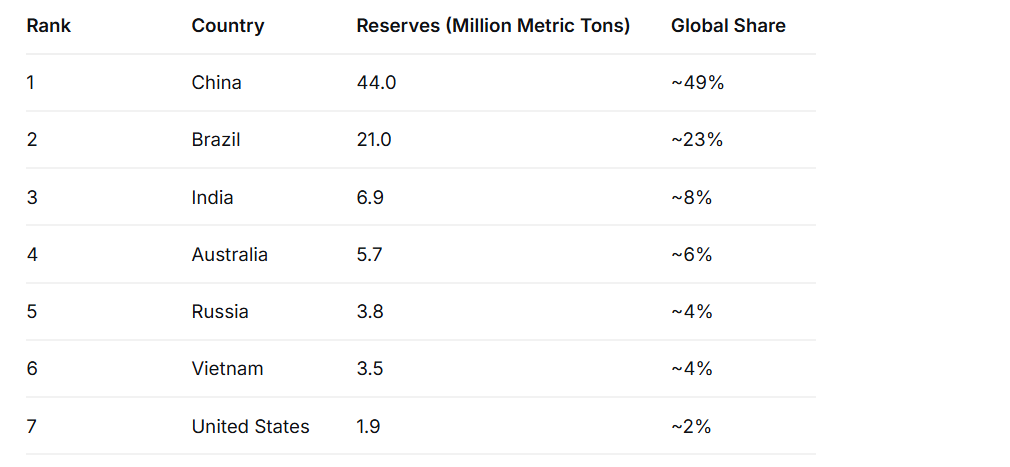
Together, these seven countries represent roughly 97 percent of the world's known reserves.
Where the Metals Actually Hide
Rare earths are not found as pure metals in the ground. They are locked inside complex minerals. At least 245 individual REE-bearing minerals have been identified, mainly carbonates, oxides, silicates, and phosphates.
The world's most significant deposits occur in several types of geological formations:
Carbonatites: Igneous rocks rich in carbonate minerals. These have been the world's main source of light rare earths since the 1960s. Major examples include the Bayan Obo deposit in China's Inner Mongolia and the Mountain Pass mine in California.
Ion-adsorption clay deposits: Found primarily in southern China, these are the world's primary source of heavy rare earths. The rare earths are loosely adsorbed onto clay particles, making them relatively accessible but environmentally challenging to extract.
Placer deposits: Monazite-bearing sands found in beaches and riverbeds. These were important sources before the 1960s and may become important again.
Part III: What Are They Used For?
Rare earths are not used in large quantities, often just a "pinch" per device but that pinch is irreplaceable. As the International Energy Agency notes, they play a crucial role in strategic applications ranging from energy and transport to AI, aerospace, medical, and defense systems.
Let's explore how different rare earths power different industries.
Magnets: The Crown Jewel
Permanent magnets represent the fastest-growing and most strategically important application, accounting for around 95% of total rare earth consumption by value.
The stars here are neodymium, praseodymium, dysprosium, and terbium. Neodymium-iron-boron (NdFeB) magnets are among the strongest permanent magnets in existence. They enable:
Electric vehicles: Each EV motor relies on these magnets for efficient energy conversion
Wind turbines: A single wind turbine contains about 60 kilograms of rare earths
Industrial motors: From factory robots to precision manufacturing
AI data centres: The servers powering artificial intelligence depend on these components
As George Barakos, senior lecturer in mining engineering at Curtin University, explains: "Magnets are the most famous, most popular alloy coming from rare earth elements". They enable the conversion of energy between electrical and mechanical forms—the very foundation of electric motors and generators.
Screens and Lighting: The Visual Revolution
Europium, yttrium, and terbium are used to produce phosphors—materials that emit light when excited by electrons. These phosphors are found in:
Smartphone and computer displays
Energy-efficient compact fluorescent lamps
LED lighting
Television screens
Without these elements, the vibrant, energy-efficient screens we take for granted would be dim, power-hungry relics.
Medicine: Saving Lives
The medical applications of rare earths are nothing short of revolutionary:
Gadolinium is crucial for magnetic resonance imaging (MRI). It is one of the most magnetic elements on the periodic table and is used in contrast injections to produce higher-resolution, more accurate images.
Yttrium and neodymium are used in medical lasers. The Nd:YAG laser, created by doping yttrium aluminium garnet with neodymium, is used in cosmetic medicine, tattoo removal, and various surgical procedures.
Yttrium-90 is used in cancer treatment through radioembolization therapy, delivering targeted radiation to tumours.
Defense: The Strategic Imperative
Rare earths are essential for military superiority:
Dysprosium contributes to the stealth of military aircraft, missiles, and vehicles
Europium and yttrium are used in night-vision goggles and advanced heads-up displays
Precision-guided systems rely on rare earth magnets for accuracy and reliability
Everyday Life: The Unseen Backbone
Beyond the headlines, rare earths are embedded in countless everyday items:
Catalytic converters in cars use cerium-based catalysts to reduce emissions
Petroleum refining depends on lanthanum-based catalysts
Rechargeable batteries, including those in hybrid cars like the Toyota Prius, use lanthanum-based alloys in their anodes
Fiber optic cables use erbium for signal amplification
Glass polishing and the creation of special optical glass rely on rare earth additives
Part IV: How Are They Extracted and Processed?
If rare earths are so valuable, why isn't everyone mining them? The answer lies in the extraordinary difficulty of extraction and purification.
First, rare earths are almost never found in pure form. They are mixed with other elements in ore deposits. Second, the seventeen rare earth elements are chemically similar to one another, making them notoriously difficult to separate. As the MIT notes, their "physical similarities in atomic radius and charge" mean that separating them into individual elements is a painstaking, multi-step process.
The Value Chain: From Rock to Magnet
The journey from ore to finished product spans several technically demanding stages:
1. Mining and Extraction
Depending on the type of deposit, different mining methods are used:
Hard rock mining: For carbonatite deposits like Mountain Pass or Bayan Obo, ore is blasted, crushed, and milled
In-situ leaching: For ion-adsorption clay deposits, a solution is pumped into the ground to dissolve the rare earths, which are then pumped back up
Placer mining: For beach sands, material is dredged and concentrated
2. Beneficiation and Concentration
The crushed ore undergoes physical processes—magnetic separation, gravity separation, and flotation—to concentrate the REE-bearing minerals. This is the first step in turning waste rock into something valuable.
3. Chemical Processing
This is where the real complexity begins. The concentrated minerals undergo chemical treatment using various acids and other reagents. Common methods include:
Oxidation roasting followed by acid leaching
Alkali decomposition
High-temperature roasting with concentrated sulfuric acid
4. Separation: The Critical Bottleneck
Separation is the technical core of rare earth processing—and the biggest bottleneck in the supply chain. Because the elements are so chemically similar, separating them into individual high-purity oxides requires hundreds of solvent extraction steps.
This is where China's dominance becomes most apparent. While China accounts for about 60% of global mined production, it controls approximately 91% of global rare earth processing capacity. This means that even if rare earths are mined elsewhere, they often must be shipped to China for separation.
As one industry executive put it, "rare earth refining and separation capacity remains a critical bottleneck for West-backed projects".
5. Metal Refining and Magnet Production
The separated oxides are then converted into metals, alloyed with other elements, and formed into the permanent magnets that power modern technology. China's share of sintered permanent magnet production reached 94% in 2024.
Emerging Technologies
Research is underway to develop more efficient and environmentally friendly extraction methods:
Bioleaching: Using microorganisms to extract rare earths from ores
Microwave heating and mechanochemical treatment
Sequential leaching and solvent extraction to recover REEs from low-grade mine tailings
Part V: The Supply Chain Challenge
The Concentration Problem
The rare earth supply chain is among the most geographically concentrated of all critical minerals. The IEA ranks magnet rare earths, yttrium, and other critical minerals among those most vulnerable to disruption.
This concentration exists at every stage:
Reserves: China holds ~49%
Mining: China accounts for ~60% of global production
Processing: China controls ~91% of global refining capacity
Magnet production: China produces ~94% of sintered permanent magnets
A History of Disruption
In 2010, China began placing restrictions on rare earth supplies through quotas, licenses, and taxes, citing environmental concerns and the need to retain resources for domestic use. This sent shockwaves through global industries and prompted a wave of exploration, stockpiling, and efforts to develop alternative sources.
More recently, in April 2025, China tightened export licences on seven rare earth elements. As the IEA notes, "disruptions in the supply of rare earth elements... threaten the expansion of emerging technologies".
The Price Disparity
The concentration of processing capacity creates significant price disparities. For example, yttrium oxide reached US$270 per kilogram** in Europe compared to a Chinese free-on-board price of just **US$11. This tenfold difference reflects the stranglehold China has on midstream processing.
The Recycling Challenge
Recycling could help alleviate supply pressures, but current recycling rates for rare earths remain less than 1 percent globally—far below other critical materials. The technical and economic challenges of recovering rare earths from end products remain significant.
Part VI: The Future and What It Means
Demand Is Only Going Up
Under today's policy settings, demand for magnet rare earths is set to expand by a third by 2030. The main growth engines are:
Electric mobility: EVs require powerful permanent magnets
Wind power: Each turbine needs about 60kg of rare earths
Automation and robotics: Precision motion control relies on rare earth magnets
AI and data centres: The computing infrastructure of the future depends on these materials
By 2040, the world will need at least four times more critical minerals than clean energy technologies demand today.
A Global Race for Security
Countries are waking up to the strategic importance of rare earths. The United States, Europe, Japan, and Australia are all investing in domestic mining projects, processing facilities, and partnerships to diversify supply chains.
As Fraunhofer researchers note: "Taking into account the advance of green technologies expected over the coming years, it is already clear that a supply of rare earths will be crucial to industry in the medium and long term".
What This Means for You
Whether you are a business leader, a policymaker, an investor, or simply a citizen of the modern world, rare earths matter to you:
For businesses: Supply chain vulnerability is a real risk. Diversification and strategic stockpiling may become essential.
For policymakers: Rare earth security is national security. Investment in domestic processing capacity is a strategic imperative.
For investors: The rare earth market represents both opportunity and risk. Companies that can secure supply chains will have a competitive advantage.
For everyone: The technologies you rely on—from your phone to your car to your healthcare—depend on these invisible elements.
Conclusion
Rare earth elements are not a footnote in the story of modern technology. They are the central characters—the quiet, uncelebrated enablers of everything we have built and everything we hope to build.
They are in the magnets that spin our electric motors, the phosphors that illuminate our screens, the contrast agents that save lives in MRI machines, and the lasers that enable precision manufacturing and advanced medicine. They are essential to the green energy transition, the AI revolution, and national security.
Yet their supply chains remain dangerously concentrated. The technical challenges of extraction and separation are immense. And demand is only accelerating.
Understanding rare earths is no longer optional. It is essential knowledge for anyone who wants to understand the world we live in—and the world we are building.
The invisible engine of modern life is, at last, coming into view.