

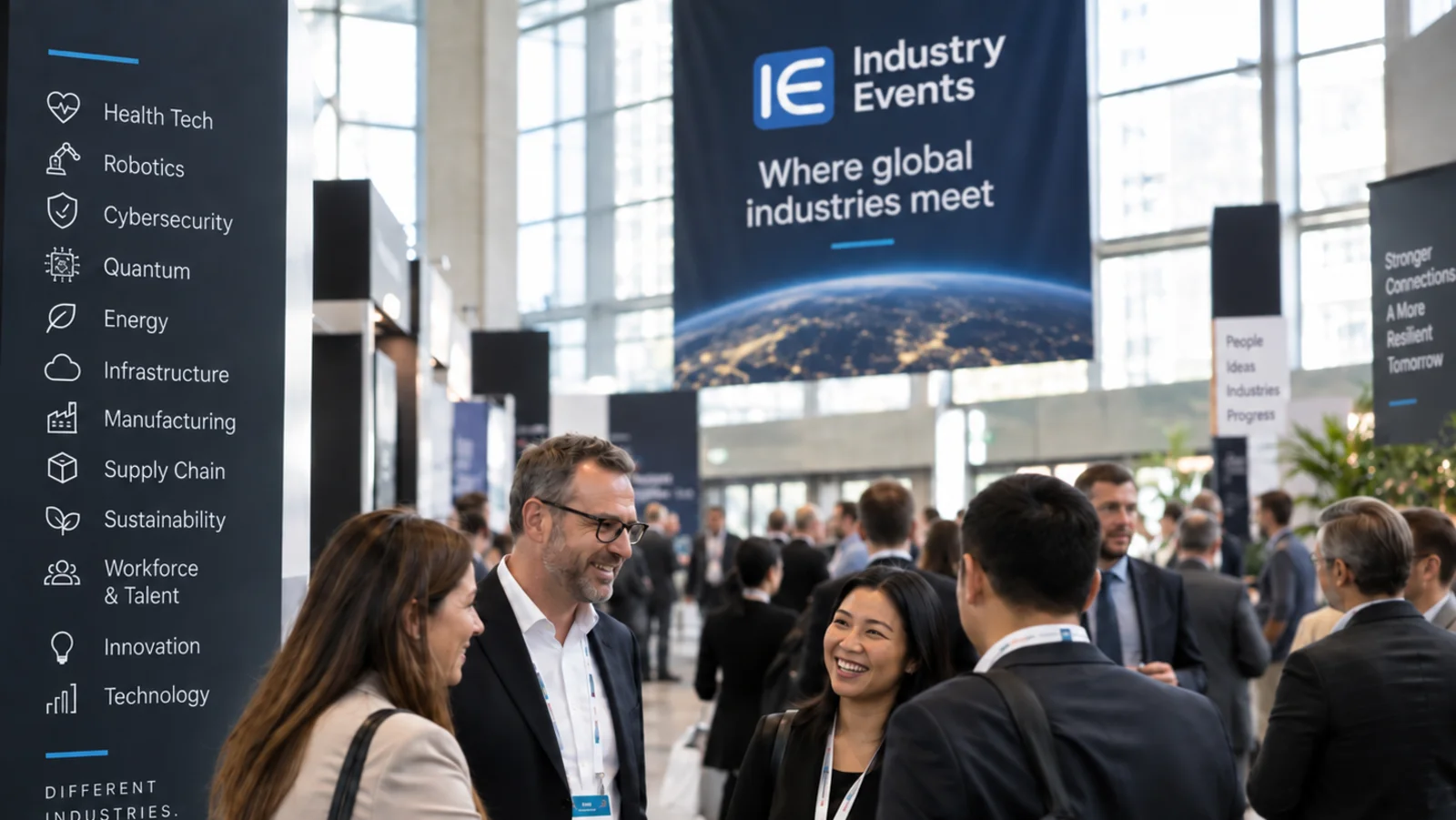
Most people and companies still think in silos and professions.
The economy increasingly does not.
AI needs electricity. Electricity needs grids. Data centres need land. Robots need chips. Satellites need telecom networks. Telecom networks need cybersecurity. Defence needs all of them.
That is the useful way to think about the next industrial cycle: not as a collection of booming sectors, but as a chain of dependencies, cross-industries and cross sectors.
And dependencies create opportunities.
The New Business Map
Start with today buzz, AI.
The International Energy Agency projects global data-centre electricity consumption will more than double to around 945 TWh by 2030, with AI the most important driver of that increase. Accelerated servers account for almost half of the projected net increase in data-centre electricity consumption.
That immediately makes AI something more than a software market.
It makes AI an energy, infrastructure and real-estate market.
The constraint is no longer simply access to models or GPUs. Increasingly, it is access to electricity, transmission, substations, cooling and land with the right connection to the grid.
That gives us the first collision:
AI × Energy × Real Estate: compute growth increases the value of power, grid access, cooling and powered land.
Then comes telecommunications.
AI systems do not live in isolation. They connect data centres, companies, machines, vehicles, edge devices and eventually enormous numbers of autonomous systems.
China's 15th Five-Year Plan for 2026–2030 makes this convergence unusually explicit. It combines AI, computing infrastructure, 5G-Advanced, 6G, industrial internet, robotics, advanced chips and satellite networks within the same industrial strategy.
China is effectively treating compute + connectivity + manufacturing as one system.
That produces the second collision:
AI × Telecoms: networks move from carrying human communications to connecting data centres, AI services and intelligent machines.
The third follows almost immediately.
China's plan also calls for coordinated satellite communications, navigation and remote sensing, alongside faster development of low-Earth-orbit satellite internet.
Australia is moving in the same direction for different reasons. Its 2026 defence investment programme calls for a resilient, secure multi-orbit satellite communications capability.
The terrestrial network and the orbital network are starting to merge.
Telecoms × Satellites × Space: fibre, mobile and satellite increasingly become different layers of the same communications system.
Then consider mining.
Adelaide-based Fleet Space Technologies combines its low-Earth-orbit satellites, ground sensors and AI to generate subsurface information for mineral exploration. The Australian Space Agency says the company has grown into an approximately A$800 million global company and uses its ExoSphere platform across five continents.
Fleet then adapted the technology into SPIDER for lunar exploration.
Mining technology went into space.
Space technology came back into mining.
Space × Mining × AI: satellites and AI increasingly become tools for discovering and managing physical resources.
Robotics creates another connection.
China installed roughly 295,000 industrial robots in 2024, representing more than half of global installations. Its new national plan now pushes robotics, embodied intelligence, AI and advanced manufacturing together.
Australia comes at the same market from a different position. Its National Robotics Strategy specifically targets stronger development, commercialisation and adoption of robotics, while the country's mining industry already operates more than 700 autonomous haulage trucks, based on the government's cited industry data.
The important robot may therefore not look human.
It may be a truck.
AI × Robotics × Manufacturing: AI leaves the screen and starts operating physical equipment.
This creates an obvious secondary problem.
Every intelligent machine is also another computer that can fail—or be attacked.
The factory becomes a cyber target.
So does the satellite.
The mine.
The hospital.
The autonomous vehicle.
The power network.
Cybersecurity stops being an IT category and becomes an engineering requirement.
Cybersecurity × Physical Infrastructure: security moves inside products, factories, robots, power systems and communications networks.
Defence accelerates this further.
Australia's 2026 Integrated Investment Program allocates around A$425 billion over the decade and specifically prioritises autonomous and uncrewed systems, counter-drone capabilities, cyber, electronic warfare and multi-orbit satellite communications.
A modern autonomous defence platform contains software, sensors, semiconductors, communications, cybersecurity, manufacturing and energy storage.
It is difficult to identify where the defence industry ends and the technology industry begins.
Defence × AI × Robotics × Space: military procurement increasingly becomes technology and industrial policy.
Underneath almost all of this sits another market.
Semiconductors.
AI needs chips.
Robots need chips.
Satellites need chips.
Telecom systems need chips.
Defence systems need chips.
China's 2026–2030 plan explicitly targets integrated circuits and high-end chips while simultaneously expanding AI, robotics, communications and advanced manufacturing.
That is not an accidental combination.
Semiconductors × Industrial Sovereignty: access to chips increasingly determines what countries can build independently.
Which brings the story back to minerals.
Australia's Critical Minerals Strategic Reserve draws on A$1 billion of project support through the Critical Minerals Facility plus another A$150 million for selective stockpiling. The government explicitly links these minerals to high-tech manufacturing, AI, digital systems and defence technologies.
Mining policy has therefore become technology policy.
Critical Minerals × Energy × Manufacturing: the strategic value increasingly sits not only in extracting resources but in processing them and embedding them into higher-value supply chains.
And finally, space itself changes character.
Once satellites support communications, mining, defence, agriculture, navigation and climate monitoring, they stop being a niche aerospace market.
They become infrastructure.
Space × Telecoms × Cyber × Climate: orbital infrastructure increasingly becomes part of the everyday economy—and therefore part of its security architecture.
Put the ten collisions together and a simple pattern appears:
AI → power → grids → minerals → manufacturing → chips → machines → networks → satellites → cybersecurity.
These are not ten independent markets.
They increasingly form one industrial system.
China Builds the System. Saudi Arabia Builds the Hub. Australia Connects the Pieces.
The three countries are useful because they represent three very different strategic models.
China's model is integration.
The 15th Five-Year Plan does not treat AI, robotics, semiconductors, telecommunications, computing infrastructure and space as unrelated industries.
It deliberately links them.
China's advantage is reinforcement.
Factories create demand for robots.
Robots create demand for chips.
Networks connect the machines.
AI improves them.
Energy powers the system.
Satellite infrastructure extends it.
This creates enormous industrial depth.
It also creates risk.
Large-scale industrial policy can generate overcapacity, poor capital allocation and trade resistance. The more successful Chinese manufacturers become internationally, the more likely other governments are to view that success as a strategic dependency rather than simply cheap supply.
China's problem may therefore evolve from building competitive industries to managing the geopolitical consequences of having built them.
Saudi Arabia starts from almost the opposite position.
Saudi Arabia's model is concentration.
The Kingdom has energy, capital, geographic position and the ability to mobilise large infrastructure projects.
What it does not yet have is China's accumulated industrial ecosystem.
That explains the logic of HUMAIN.
PIF launched HUMAIN in May 2025 to operate across the entire AI stack: data centres, cloud infrastructure, models and applications. Crown Prince Mohammed bin Salman chairs the company.
On 31 August 2026, HUMAIN and DataVolt announced that construction was underway at Oxagon on an AI data-centre campus, with HUMAIN participating in 100MW of the 360MW first phase.
That one project explains the Saudi opportunity.
AI becomes power.
Power becomes infrastructure.
Infrastructure requires fibre.
Fibre connects into telecom networks.
The resulting ecosystem needs cybersecurity, engineers, capital and customers.
Saudi Arabia can finance much of the physical stack.
The harder problem is the human stack.
You can build a data centre faster than you can build an ecosystem.
This is where Saudi Arabia's events strategy could become more important than it first appears.
The Kingdom should aim not only to become an AI or technology hub, but an industry-events hub for the industries now colliding with one another.
The objective is not simply more conferences.
It is greater human density.
An AI engineer needs to meet an energy developer.
A robotics founder needs to meet a manufacturer.
A satellite company needs telecom customers.
A cybersecurity company needs operators of physical infrastructure.
A mining company needs AI and sensing specialists.
A Saudi investor needs to meet Chinese industrial companies, Australian mining technologists, European manufacturers, American software firms and emerging African operators.
Saudi Arabia already has the ingredients for this strategy: capital, infrastructure investment, international connectivity and large industrial projects.
The strategic opportunity is to make Riyadh and other Saudi centres places where engineers, entrepreneurs, investors, customers and suppliers repeatedly meet because important business gets done there.
There is an important distinction.
A conference destination attracts visitors.
An industry hub creates repeat participants.
People return because customers are there.
Suppliers arrive because buyers are there.
Investors come because founders are there.
Engineers follow because projects and jobs are there.
That network begins to compound.
This is also where an organisation such as Industry Events can have a useful role without becoming another promoter of generic conferences.
The opportunity is to organise around the collision itself:
AI + energy rather than another generic AI event.
Mining + robotics + space rather than three separate specialist gatherings.
Telecoms + satellites + cyber rather than isolated infrastructure conversations.
Defence + autonomy + semiconductors + manufacturing rather than separate supply chains.
Saudi Arabia does not just need technology companies to build things inside the Kingdom.
It needs the people behind those companies to meet one another inside the Kingdom.
That is how infrastructure can start becoming an ecosystem.
Australia faces a different problem.
Australia's model is specialisation.
It has minerals, mining expertise, robotics capability, energy resources, universities, space companies, cyber expertise and strong defence relationships.
Its challenge is turning those separate advantages into large businesses.
The government's robotics strategy explicitly calls for stronger commercialisation and scaling of Australian technology.
The current defence programme similarly emphasises stronger sovereign industrial capability and deeper partnerships with industry.
Fleet Space provides a useful example of what successful Australian convergence can look like.
Space technology.
AI.
Mining.
Critical minerals.
Global customers.
One company.
Australia does not need to recreate China.
It probably cannot.
It does not need to match Saudi sovereign capital.
It probably will not.
Its best opportunities sit where its existing strengths intersect:
Mining × Space
Mining × Robotics
Critical Minerals × Defence
Energy × Processing
Cyber × Critical Infrastructure
Space × Telecommunications
AUKUS × Advanced Manufacturing
The strategic question is whether Australia can capture enough of the value after the research, mineral discovery or prototype stage.
That remains its recurring test.
Follow the Bottleneck
There is a simpler framework underneath everything above.
Growth in one industry creates constraints in another.
Those constraints become markets.
AI creates electricity demand.
Electricity demand makes grid access valuable.
Robotics creates demand for chips, sensors and integration.
Satellite proliferation creates demand for spectrum, ground infrastructure and cybersecurity.
Critical-mineral demand creates pressure for processing capacity.
Autonomous defence creates demand for manufacturing capacity.
The obvious market receives most of the attention.
The bottleneck often captures more of the economics than people initially expect.
This is why the most useful question for executives is not:
Which industry is growing fastest?
For the next 0–12 months, watch execution rather than announcements.
Watch whether Saudi AI infrastructure moves from announced capacity to operating capacity.
Watch whether Saudi events increasingly attract engineers, founders and industrial buyers—not simply exhibition traffic.
Watch how China's 15th Five-Year Plan translates into provincial investment in computing, robotics, communications and manufacturing.
Watch whether Australia's defence and robotics strategies generate procurement and scaled production rather than pilots.
Watch electricity connections, factory utilisation, cyber incidents and supplier backlogs.
Over 1–3 years, expect several cross-sector categories to become recognisable markets in their own right.
Industrial AI.
Space-enabled mining.
AI-ready telecommunications infrastructure.
Industrial cybersecurity.
Autonomous defence manufacturing.
Satellite-to-device connectivity.
Critical-mineral processing.
Over 3–5+ years, the company categories themselves may become harder to defend.
An energy company may own compute.
A telecom company may operate AI infrastructure.
A mining company may become a robotics company.
A satellite operator may become an agricultural or mining-data company.
An insurer may become a cyber-risk evaluator.
A property developer may become an energy developer because its land is worthless to a data-centre customer without power.
There are plenty of reasons this thesis could weaken.
AI efficiency may improve faster than expected.
Robotics economics may disappoint.
Satellite markets may become overbuilt.
Saudi Arabia could build infrastructure faster than demand or talent develops.
Australian industrial policy could subsidise projects that never become competitive.
Chinese industrial overcapacity could destroy returns and accelerate trade barriers.
Those are real uncertainties.
But they do not change the underlying structural point.
Companies are becoming more dependent on industries they do not traditionally understand.
That changes strategy.
If you run AI, understand energy.
If you run energy, understand data centres.
If you run telecoms, understand satellites and compute.
If you run mining, understand robotics and space.
If you run cybersecurity, understand physical infrastructure.
And if you organise industries, stop assuming the most important people belong in separate rooms.
The next major market may not have a recognised industry name yet.
It may simply be the place where one industry's growth creates another industry's problem—and somebody figures out how to solve it.