

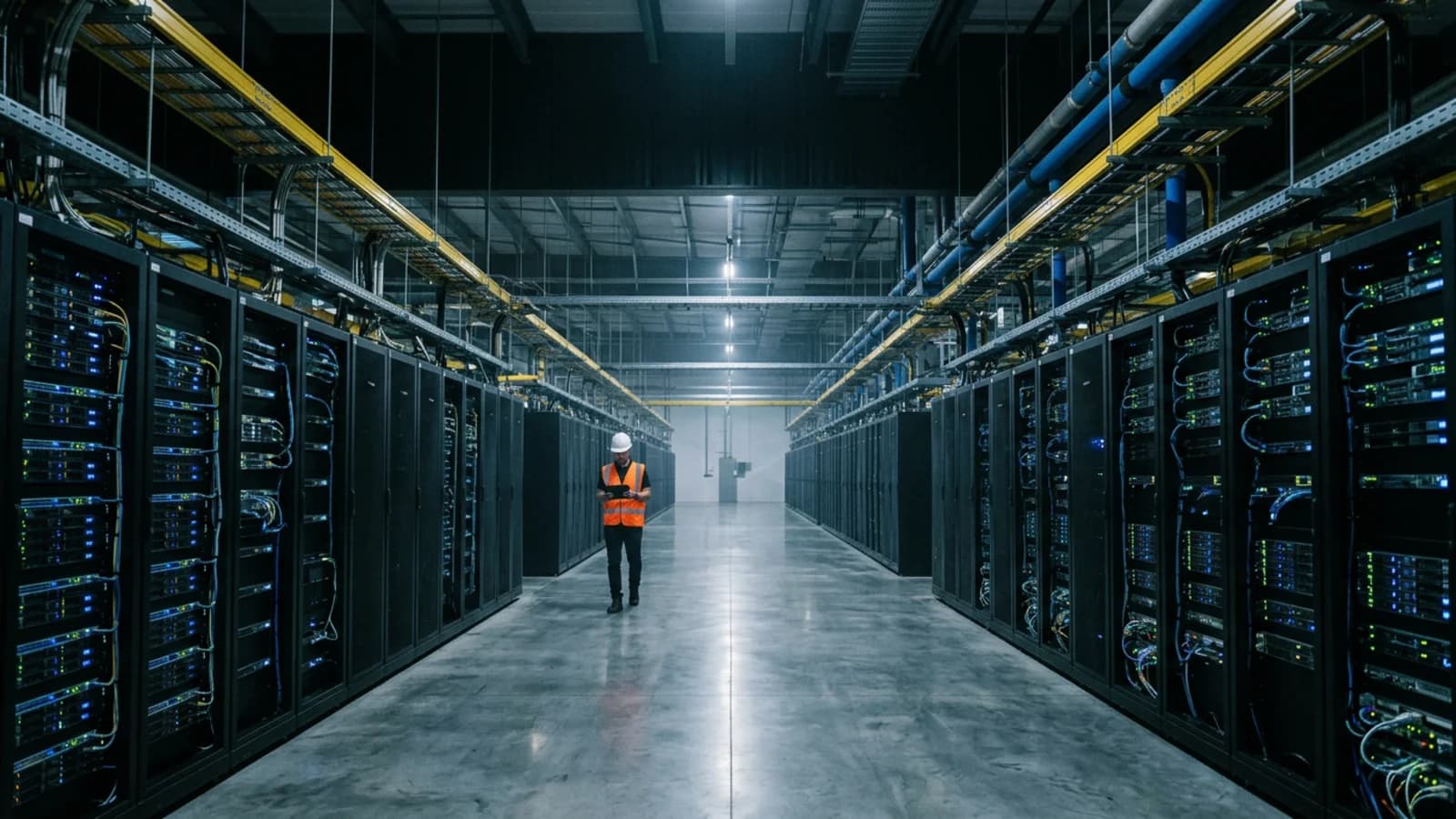
The short version: The "cloud" is a building. Data centres used about 1.5% of the world's electricity in 2024, and the International Energy Agency expects that to more than double by 2030. In Part 1 we build a data centre step by step and walk through it room by room: the land, power, cooling, computers, networks and security. We cover who leads the industry and the thousands of jobs it takes to build and run these buildings around the clock. Part 2 follows the money, the industries that feed and depend on data centres, and the future, from the seabed to orbit.
Every time you send a photo, tap your card, ask an AI a question or stream a show, a machine somewhere wakes up. It sits in a windowless building on the edge of a city, in a row of identical cabinets, humming at a steady temperature, watched by people you'll never meet.
We call it "the cloud", which makes it sound weightless. It isn't. It's concrete, steel, copper, glass fibre, diesel tanks, chillers, batteries, and enough electricity to run a small city.
And right now, the world is building these buildings faster than at any time in history.
Three things most people miss:
A data centre is a power project first and a computer project second. The hardest thing to get today is usually not land or chips. It's a grid connection.
Most of the jobs aren't in IT. Building a data centre needs electricians, plumbers, engineers and project managers by the thousand. Running one needs technicians who keep power and cooling perfect, every second of every day.
AI is changing the building itself. AI computer racks can use more than ten times the power of a traditional rack, so they have to be cooled with liquid instead of air.
How Part 1 flows: a short history, what a data centre is, how one is built, a room-by-room walk through the building, why it matters, who the main players are, and the people who build and run it.
1. From Room-Sized Computers to AI Factories: A Brief History
The first "data centre" was a computer. In 1946, ENIAC, one of the first general-purpose electronic computers, filled a large room at the University of Pennsylvania. It weighed about 27 tonnes, used around 17,000 vacuum tubes and drew roughly 150 kilowatts of power [Wikipedia, ENIAC]. From day one, computing has needed three things: power, cooling and a secure room.
The mainframe era (1950s–1970s). Banks, airlines and governments built dedicated computer rooms with raised floors for cables and air conditioning. Computing was centralised, expensive and locked away.
The internet era (1990s–2000s). The web created demand for "server farms" and colocation: buildings where many companies rent space, power and connections for their own servers. Hubs grew where internet cables met, such as Northern Virginia, London, Frankfurt, Amsterdam, Tokyo and Singapore.
The cloud era (2006 onward). Amazon Web Services, followed by Microsoft and Google, began renting computing on demand. To do that cheaply, they built hyperscale data centres: enormous, standardised campuses with tens of thousands of servers.
The AI era (2022 onward). Generative AI needs huge clusters of specialised chips working together. Data centres are becoming "AI factories", where the product is intelligence and the raw material is electricity.
The pattern: each era needed more computing, which needed more power, which made the building bigger and more complex. The data centre went from a room to a building to a campus, and now to a campus with its own power plant.
2. What a Data Centre Is, Without the Mumbo Jumbo
A data centre is a secure building that houses computers (servers), stores data and connects them to the internet. Its job is to keep those computers powered, cool, connected and safe, without interruption.
Think of it as a highly protected hotel for computers. Each guest (a server) needs a bed (rack space), electricity, air conditioning, a phone line (network connection) and security at the door. The hotel must never close, not even for a minute.
The main types
Enterprise data centres are owned and run by one organisation for itself, such as a bank or a government agency.
Colocation data centres rent space, power and connections to many customers. Major operators include Equinix, Digital Realty and NTT, and in Australia AirTrunk, NEXTDC and CDC.
Hyperscale data centres are giant campuses built by cloud and tech companies such as AWS, Microsoft, Google, Meta, Oracle, Alibaba and Tencent.
Edge data centres are smaller sites close to users, for things that need very fast responses.
AI data centres ("AI factories") are built around dense clusters of graphics processing units (GPUs) and other accelerators, with liquid cooling and very large power supplies.
Jargon buster
Server: a powerful computer without a screen that runs applications and stores data.
Rack: a standard metal cabinet, about two metres tall, that holds servers and network equipment.
MW (megawatt): data centres are measured by power, not floor space. One MW is roughly the peak demand of several hundred homes.
IT load: the power used by the computers themselves.
PUE (power usage effectiveness): total building power divided by IT power. A PUE of 1.5 means that for every 1 unit used by computers, another 0.5 goes on cooling, power losses and lighting. Lower is better; 1.0 is perfect.
Redundancy (N, N+1, 2N): N is just enough equipment, N+1 adds one spare, and 2N is a complete duplicate system.
UPS (uninterruptible power supply): batteries that keep everything running for the seconds or minutes before generators start.
White space: the rooms where the computer racks live. Grey space: the rooms for power and cooling equipment.
GPU: a chip designed for heavy parallel computing, now the engine of AI.
Latency: the delay in sending data. Lower latency means faster responses.
3. How a Data Centre Is Built: From Empty Field to Live Facility
A large data centre typically takes about one and a half to three years to deliver, depending on power, permits and size (IE analysis). Here's the journey.
Step 1: Choosing the site
The location decides everything. Developers look for:
Power: a strong grid connection, or the ability to build one. This is now the biggest constraint in many markets.
Fibre: access to multiple network routes and, ideally, subsea cable landings.
Land: flat, stable ground, safely away from flood zones, flight paths and hazards.
Water: for some cooling designs.
Climate: cooler places allow more "free cooling" from outside air.
People and policy: skilled workers, planning approval, tax settings and data rules.
Latency: closeness to users for fast services, which matters less for AI training.
Aha moment: in Northern Virginia, the world's largest data centre market, about 4,650 MW is already live, yet more than 40,000 MW of new requests are waiting to connect to the local power utility, and vacancy is just 1.8% [Datacentres.com, Aug 2026]. The queue for electricity is many times bigger than the market itself.
Step 2: Design
Architects, electrical and mechanical engineers and IT designers plan the building together, usually with BIM (building information modelling): a detailed 3D digital model of every wall, pipe, cable tray and machine. Many teams also build a digital twin to test airflow, heat and power failures before construction starts.
The key design choice is the reliability level. The Uptime Institute's widely used tiers range from Tier I (no backup, about 28.8 hours of possible downtime a year) to Tier III (N+1, about 1.6 hours) and Tier IV (fully duplicated 2N systems, about 26 minutes a year) [CoreSite, Uptime Institute tiers].
Step 3: Civil works and the shell
Earthworks, foundations, drainage, roads and a reinforced concrete or steel-frame building. Floors must carry heavy loads: a fully loaded AI rack can weigh well over a tonne (IE analysis).
Step 4: Power, cooling and fit-out (MEP)
MEP means mechanical, electrical and plumbing, and it's the heart of the build. It's where most of the cost, time and specialist labour go. To speed things up, much of the equipment is now prefabricated in factories as modules (power skids, electrical rooms, cooling plants) and craned into place.
Step 5: IT installation
Racks, servers, storage, network switches and kilometres of fibre and copper cabling are installed and tested.
Step 6: Commissioning
Before going live, every system is tested in stages, from checking individual equipment to the full integrated systems test. The power is deliberately cut to prove that batteries and generators take over without a gap and that cooling never stops. Commissioning managers are among the hardest roles to hire [BRG ThinkSet, 2026].
What it costs
In the US and Canada, building a new data centre now costs roughly US$8.9 million to US$23.3 million per MW, before the computer chips, up about 21% since late 2024 [Cushman & Wakefield via CRE Daily, Aug 2026]. For AI facilities, the chips and servers can cost several times more than the building.
Enjoying this? Get the next one free. IE Weekly Insights explains one big shift every week, the dots most people miss and the events worth your time. Subscribe on industryevents.com.
4. Section by Section: Inside the Building
Let's walk through a data centre the way electricity, heat and data flow through it.
4.1 The power chain: from the grid to the chip
Power travels a long path before it reaches a server:
Grid connection and substation: high-voltage power from the grid arrives at an on-site substation, where large transformers step it down. Big campuses often need their own dedicated substations.
Switchgear: heavy-duty switches and breakers route power and isolate faults safely.
UPS systems: large battery banks, increasingly lithium-ion, that keep power flowing without a flicker during a grid failure.
Backup generators: rows of large diesel generators, often several megawatts each, start within seconds and can run the site for a day or more on stored fuel. Some sites now use renewable diesel (HVO), batteries or gas engines.
Distribution: power units (PDUs), overhead busways and rack power strips deliver electricity to each rack.
Monitoring: an electrical power monitoring system watches every circuit in real time.
New frontier: because grid power is scarce, operators are signing deals for dedicated solar, wind and battery projects, on-site gas generation, and nuclear power. These range from contracts with existing nuclear plants to agreements for future small modular reactors (IE analysis).
4.2 Cooling: the hidden half of the building
Every watt a computer uses turns into heat, and that heat must be removed continuously. Cooling is usually the biggest energy use after the computers themselves.
Air cooling (traditional): racks are arranged in hot and cold aisles. Cool air is pushed through the front of the servers and hot air is captured at the back, often inside sealed "containment" so the two don't mix. Large air handlers (CRAH and CRAC units) do the work.
Chillers and cooling towers: central plants chill water that carries heat away from the data halls. Cooling towers release that heat outside, often by evaporating water.
Free cooling (economisers): in cool climates, outside air or cold water does much of the work, saving a lot of energy.
Rear-door heat exchangers: water-cooled panels on the back of racks capture heat at the source.
Direct-to-chip liquid cooling: a liquid flows through cold plates sitting directly on the hottest chips, managed by coolant distribution units (CDUs). This is now standard for high-end AI racks.
Immersion cooling: entire servers are submerged in a special non-conductive fluid. It's used for some very dense workloads.
Aha moment: the average rack in a traditional data centre uses less than 8 kW [Uptime Institute via Upsite, 2024]. One of NVIDIA's flagship AI racks uses about 120 kW, and the company's roadmap points to 600 kW racks [DatacenterDynamics, Apr 2025]. That's like going from heating a room to heating a whole street, inside one cabinet. Air simply can't carry that much heat away, which is why liquid has taken over.
Efficiency: the global average PUE has hovered around 1.55 to 1.59 for years, at 1.56 in 2024 [Uptime Institute via Upsite, 2024]. The newest large facilities aim much lower.
Water: US data centres directly consumed about 64 billion litres of water for cooling in 2023, and around 12 times more indirectly through the power stations that supply them [Lawrence Berkeley National Laboratory, via AIhub, 2025]. That's why many new designs use closed-loop or "waterless" cooling in dry regions.
4.3 The white space: where the computers live
Racks stand in neat rows on a raised floor or, increasingly, on a solid concrete slab with cables and pipes running overhead.
Servers run applications. Storage systems hold data on flash drives and hard disks. AI clusters connect thousands of GPUs to act like one giant computer.
Cable management keeps power, copper and fibre organised, labelled and serviceable.
4.4 The network: the data centre's nervous system
Meet-me rooms are where telecom carriers and customers physically connect. A "carrier-neutral" data centre lets customers choose among many networks.
Inside the building, a "spine-and-leaf" design works like a city's road network: every local street (the switch in each row of racks) connects to every main highway (the core switches), so data can reach any rack in just a couple of hops.
AI clusters need extremely fast links between GPUs, using specialised high-speed networking and huge amounts of optical fibre.
Outside, diverse fibre routes, ideally entering the building from different directions, mean that one cut cable can't take the site offline.
4.5 Security and safety: the fortress
Physical security: fences, anti-ram barriers, security staff around the clock, CCTV, access cards, biometrics and "mantraps" (airlock-style double doors that let one person through at a time).
Fire safety: very early smoke detection systems (such as VESDA) sample air continuously. Many data halls use gas-based fire suppression that puts out fires without damaging electronics, backed by "pre-action" sprinklers that only fill with water when a fire is confirmed.
Cyber security: building systems are networked too, so they must be protected like any IT system.
4.6 The control room: the brain
A network operations centre (NOC) and building management systems watch thousands of sensors: temperature, humidity, power, leaks, doors and alarms. Software known as DCIM (data centre infrastructure management) tracks every asset, power circuit and rack. AI is increasingly used to fine-tune cooling and predict failures.
4.7 The support areas
Loading docks, staging and burn-in rooms (where new servers are unpacked and tested), spare-parts stores, fuel tanks, offices, and for large campuses, on-site water treatment and electrical yards.
5. Why It Matters: To You, Your Country and the World
To you. Your banking, health records, emails, maps, payments, entertainment and AI tools all live in data centres. When one fails, you notice within seconds.
To your country. Data centres are now national infrastructure, like ports and power stations. Countries want local capacity for data sovereignty (keeping sensitive data under their own laws), for economic growth and to attract AI investment.
To the world. Data centres used about 415 TWh of electricity in 2024, about 1.5% of global use. The IEA projects this will more than double to about 945 TWh by 2030, roughly what Japan uses today. A typical AI-focused data centre uses as much electricity as 100,000 households, and the largest under construction will use about 20 times that [IEA, Energy and AI, 2025].
Aha moment: in the United States, data centres are expected to account for nearly half of all growth in electricity demand to 2030 [IEA, 2025]. The AI race is also an electricity race.
6. Hubs and Main Players
Where the capacity is
United States: about 45% of global data-centre electricity use [IEA, 2025]. Northern Virginia is the world's largest market, with Texas, Phoenix, Atlanta, Ohio and the Pacific Northwest growing fast.
China: about 25% [IEA, 2025]. Its national "East Data, West Computing" program moves computing to western regions with cheaper land and energy (IE analysis).
Europe: about 15% [IEA, 2025]. The main hubs are Frankfurt, London, Amsterdam, Paris and Dublin, and the Nordics are growing thanks to cool climates and clean power.
Asia-Pacific:
Johor, Malaysia has about 1,110 MW live, third in Asia-Pacific after Tokyo and Singapore, and the region's largest pipeline at about 8,500 MW, but vacancy is below 1% [Knight Frank via New Straits Times, Aug 2026].
Singapore is a premium hub with tight limits on new capacity.
Tokyo and Seoul are major markets, and India (Mumbai, Chennai and Hyderabad) is rising fast.
Australia: deployable capacity is forecast to more than double, from 1,350 MW in 2024 to 3,100 MW by 2030, with more than A$26 billion in new investment and a data-centre workforce growing to about 17,900 [Mandala, Oct 2024]. Sydney is the main hub, followed by Melbourne and Canberra.
Middle East:
The UAE–US AI Campus in Abu Dhabi is planned at 5 GW. Its first 200 MW phase, "Stargate UAE", is being built with G42, OpenAI, Oracle, NVIDIA, Cisco and SoftBank [Gulf News, Oct 2025].
Saudi Arabia is investing heavily in AI data centres as part of its economic diversification.
Who builds and runs them
Hyperscalers: AWS, Microsoft, Google, Meta, Oracle, Alibaba, Tencent and ByteDance. The top nine cloud providers' capital spending is estimated at about US$830 billion in 2026, up roughly 79% in a year [TrendForce via Evertiq, May 2026]. Most of it goes on data centres and the equipment inside.
Colocation and developers: Equinix, Digital Realty, NTT, Vantage, QTS, CyrusOne, STACK and Yondr globally, and AirTrunk, NEXTDC and CDC in Australia.
AI-focused builders: "neoclouds" and AI infrastructure firms building GPU clusters for AI developers.
Equipment makers:
Power and cooling: Schneider Electric, Vertiv, Eaton, ABB, Siemens, Johnson Controls, Trane and Carrier.
Generators: Caterpillar, Cummins and Rolls-Royce (mtu).
Chips: NVIDIA, AMD and Intel, plus custom chips from the hyperscalers.
Networking: Broadcom, Arista and Cisco.
Fibre: Corning.
Builders and engineers: specialist contractors and engineering firms that deliver mission-critical buildings, along with thousands of electrical, mechanical and civil subcontractors.
Investors: infrastructure and private-equity funds, pension funds and sovereign wealth funds, which treat data centres as long-term infrastructure assets.
7. Skills and Careers: The People Behind the Cloud
Jobs to build it
A large data-centre project typically employs 1,500 to 3,000 workers at peak construction, and some employ up to 4,000 [BRG ThinkSet, 2026].
Trades: electricians (the most in-demand), HVAC and refrigeration technicians, plumbers and pipefitters, welders, steel workers, concreters, fibre and cable installers, crane operators.
Engineering: electrical, mechanical, civil, structural and fire engineers, plus controls engineers.
Design and planning: architects, BIM coordinators, MEP coordinators, town planners, environmental specialists.
Project delivery: project managers, construction managers, site superintendents, schedulers, cost estimators, procurement and supply-chain specialists, safety officers.
Commissioning: commissioning managers and agents who test every system before go-live.
Jobs to run and maintain it
Critical facilities technicians and engineers keep power and cooling running 24/7.
Electrical and mechanical maintenance technicians look after UPS systems, generators, switchgear and chillers.
Data centre technicians install, cable and replace servers and parts.
Network engineers run connectivity and fibre.
NOC operators monitor everything, around the clock.
Security officers and security managers protect the site.
Energy and sustainability managers track PUE, renewables, water and carbon.
Customer and site managers look after tenants in colocation sites.
Cyber security specialists protect both IT and building systems.
Skills that matter
Human skills: calm under pressure, attention to detail (one wrong switch can cause an outage), teamwork across trades, clear communication, and a strong safety culture.
Technical skills: high- and low-voltage electrical work, HVAC and liquid cooling, controls and automation, fibre optics, networking, DCIM and monitoring tools, energy management, and project management.
Aha moment: more than 60% of data-centre providers say they struggle to find qualified candidates [iRecruit via BRG ThinkSet, 2026]. A qualified electrician or HVAC technician with mission-critical experience has one of the most future-proof careers in technology, without ever writing code.
Pathways
Trade apprenticeships (electrical, refrigeration, plumbing) lead to construction and facilities roles.
Engineering degrees lead to design, commissioning and operations management.
IT and network certifications lead to technician and network roles.
Data-centre-specific courses and certifications cover design, operations and energy efficiency.
People move in from the military, mining, oil and gas, utilities and manufacturing, all of which value mission-critical discipline.
Getting in the room
This is an industry built on trust and track record. Pick one area (power, cooling, construction, operations or investment), bring three questions (What's your biggest constraint: power, people or equipment? Which cooling approach are you betting on? Which roles are hardest to hire?), and follow up within 48 hours. Data-centre expos, cooling forums and power-for-data-centre summits are listed on Industry Events.
Author's Vision and Predictions
These are forecasts, not facts.
"Power-first" will replace "location-first": the best data-centre sites will be wherever energy is abundant.
Liquid cooling will be as normal as air conditioning in new builds.
Gigawatt campuses will become national assets, discussed alongside ports and airports.
Skilled trades will be the bottleneck and the winners, with electricians and HVAC technicians among the most sought-after workers in tech.
What This Means for You
For Leila, the leader. Every digital strategy now depends on someone's data centre. Three things to do:
Ask where your critical data and AI workloads physically sit, and what happens if that site or region fails.
Check your cloud and AI providers' plans for power, resilience and sustainability.
If you own land, energy or industrial assets, explore whether they suit data-centre partners.
For Omar, the professional. The data-centre boom needs skills from construction, energy, engineering, finance and IT. Three things to do:
Learn the basics of data-centre power and cooling. A short course is enough to talk the language.
Attend one data-centre, cooling or energy-for-data-centres event this year.
Connect with three people: one in operations, one in construction or engineering, and one in energy.
For Sara, starting out. You don't need to be a coder to work in tech. Three things to do:
Look at electrical, refrigeration or engineering apprenticeships and courses. These are the fastest routes into well-paid data-centre jobs.
Learn the basics of networking and IT hardware with a free online course.
Ask a data-centre technician or electrician for a 15-minute chat about their day.
Grow yourself. Data centres stay reliable because of redundancy: a backup for every critical system. Build some into your own life this week. Keep a backup of your important files, set aside a small emergency buffer in your budget, and protect your energy with a regular sleep time. Mindset tip: resilience isn't luck. It's built in advance.
Get the next one free. Subscribe to IE Weekly Insights for one big shift every week, the dots most people miss and the events worth your time.
The Bottom Line
The cloud has an address, a power bill and a workforce. Behind every app and every AI answer stands a building where electricity becomes computing, heat is removed every second, and people keep watch day and night. Understanding how that building works is the first step to seeing where the opportunities are.
Coming in Part 2: the data centre economy (the industries that feed it and depend on it), where the money is going, the risks, and the future of data centres, from liquid-cooled AI factories to servers on the seabed and in orbit.
Explore upcoming data centre, cloud and digital infrastructure events on Industry Events.
Researched with AI assistance; written and verified by IE Insights.
Sources
International Energy Agency, Energy and AI (Executive Summary), Apr 2025
Uptime Institute Global Data Center Survey 2024, via Upsite Technologies (PUE 1.56; average rack density below 8 kW)
Uptime Institute Global Data Center Survey 2024, via Upsite Technologies (PUE 1.56; average rack density below 8 kW)
DatacenterDynamics, Nvidia's Jensen Huang, Ian Buck and Charlie Boyle on the future of data centre rack density, Apr 2025
Cushman & Wakefield, 2026 Data Center Development Cost Guide, via CRE Daily, Aug 2026
TrendForce, via Evertiq, AI boom pushes hyperscaler CapEx towards USD 830 billion in 2026, May 2026
Datacentres.com, Northern Virginia data centre market: 4,650 MW live, Aug 2026
BRG ThinkSet, The Data Center Labor Shortage: A Hidden Bottleneck for AI Infrastructure, 2026
Mandala, Australian data centre investment forecast (via W.Media), Oct 2024
Knight Frank Malaysia, via New Straits Times, Johor data centre boom hits capacity wall, Aug 2026
Gulf News, Stargate UAE: first phase of 200 MW to complete by 2026, Oct 2025
Lawrence Berkeley National Laboratory, 2024 United States Data Center Energy Usage Report, via AIhub, Sep 2025
CoreSite, Breaking down data center tier classifications (Uptime Institute tiers)
Wikipedia, ENIAC