

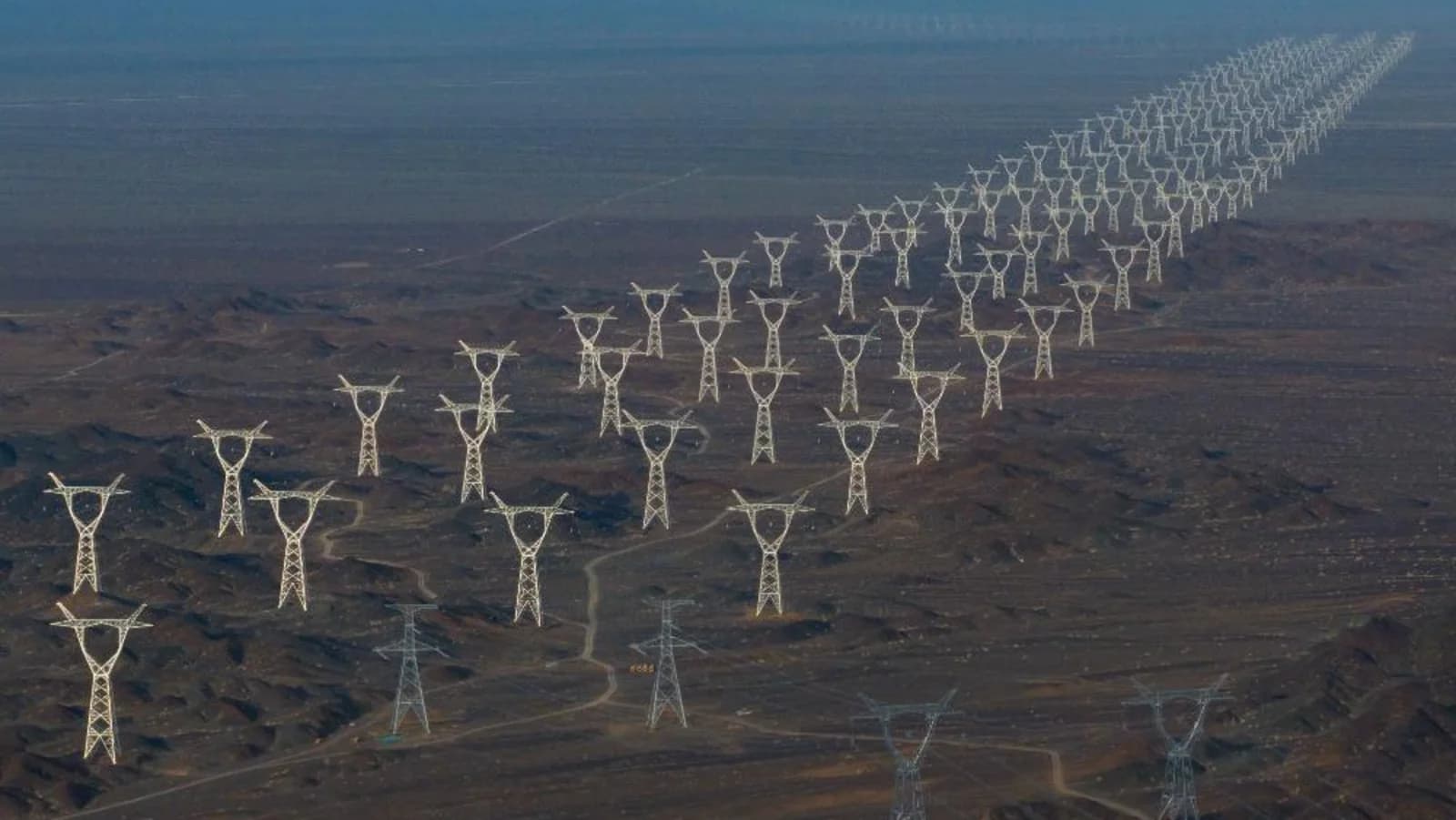
There is an interesting way to understand China's industrial ambitions. Instead of starting with its electric vehicles, robots, artificial intelligence, or semiconductor factories, start with the electricity grid.
Every one of those industries needs power. Some require enormous amounts of it, and increasingly, that electricity must be reliable, affordable, and available wherever new factories and computing facilities are built.
China appears to have understood something important: developing the technologies of the future is only half the challenge. The other half is building the infrastructure that allows those technologies to operate at scale.
In 2025, China's electricity consumption reached approximately 10.4 trillion kilowatt-hours, crossing the 10-trillion mark for the first time. That was more than twice US annual electricity consumption. Demand came from manufacturing, households, transport electrification, digital services, and other economic activity.
State Council of China
Yet the scale of electricity consumption is only part of the story.
China is also transforming how electricity is produced, transported, stored, and managed. Its approach combines some of the world's largest solar and wind developments with ultra-high-voltage transmission lines, battery storage, pumped hydro, digital grid management, and a continuing reliance on conventional generation.
The ambition is to create a power system capable of supporting a highly electrified industrial economy while reducing emissions and strengthening national energy security.
If China succeeds, its advantage may extend well beyond cheaper electricity. It could influence where future industries develop, which companies dominate critical technologies, and how other countries build their own energy infrastructure.
Why the Grid Is Becoming an Industrial Advantage
For much of the twentieth century, electricity networks expanded alongside industrialization. Power stations supplied factories and cities, while transmission lines connected generating facilities to customers.
In many developed economies, electricity demand grew relatively slowly during the first two decades of this century. Efficiency improvements, changes in industrial activity, and more efficient appliances helped limit growth.
That period is ending.
Electric vehicles are replacing combustion engines. Heat pumps are replacing some fossil-fuel heating systems. Industrial processes are being electrified. Data centers are expanding to support cloud computing and AI.
These technologies are creating new electricity demand in places where grid infrastructure may already be constrained.
The International Energy Agency estimates that around 1,650 gigawatts of solar and wind projects in advanced stages of development were awaiting grid connections in 2024. It also found that procurement times for large power transformers could extend to four years.
The problem is not necessarily an inability to produce electricity. Increasingly, it is an inability to deliver it to the right place at the right time. That can change investment decisions.
A company planning an advanced manufacturing facility needs to know whether electricity will be available before it commits billions to construction. The same applies to semiconductor factories, battery plants, hydrogen projects, and AI computing campuses.
A country with a reliable electricity system can attract industries that might struggle to establish themselves elsewhere.
China's investment in the grid is therefore more than an energy policy. It is part of its industrial strategy.
China's 4 Trillion Yuan Electricity Plan
In January 2026, State Grid Corporation of China announced plans to invest approximately 4 trillion yuan in fixed assets between 2026 and 2030, around 40% more than in the previous five-year period.
That is roughly US$560 billion, depending on exchange rates, across five years.
The program includes expanding long-distance transmission, modernizing urban and rural distribution networks, improving digital infrastructure, and strengthening the integration of renewable electricity.
China also intends to increase its interregional and interprovincial transmission capabilities by more than 30% compared with the end of the previous five-year period.
CHINA'S GRID AND ENERGY TRANSFORMATION
¥4 trillion
State Grid planned fixed-asset investment, 2026–2030
10.4 trillion kWh
China's electricity consumption, 2025
1,840 GW
Installed wind and solar capacity, end of 2025
136 GW
Operational new energy-storage power capacity, end of 2025
Sources: State Grid, China's National Energy Administration, and IEA. Investment is planned; other figures are reported historical totals. Storage capacity excludes conventional pumped hydro.
The strategic question behind this investment is straightforward.
China has enormous renewable energy resources, but much of its best wind and solar potential is far from its biggest industrial and population centers.
Western and northern regions offer vast areas suitable for renewable generation. Major manufacturing and commercial activity, however, is concentrated further east and along the coast.
China needs a way to connect the two.
Its answer has been to develop an extraordinary network of ultra-high-voltage transmission lines.
Moving Electricity Thousands of Kilometers
In June 2025, China began operating a new transmission connection between Hami in Xinjiang and Chongqing, approximately 2,260 kilometers away.
The project uses ±800-kilovolt ultra-high-voltage direct-current technology, commonly called UHVDC.
It is expected to transport more than 36 billion kilowatt-hours of electricity annually, supported by generating capacity that includes substantial wind and solar resources.
State Council of China
Why use such high voltages?
Electricity transmission involves losses, and moving large amounts of power over long distances can be expensive.
For a given amount of power, increasing the voltage reduces the current required. Lower current generally reduces resistive losses in transmission conductors.
High-voltage direct-current systems can therefore be particularly attractive for moving large quantities of electricity over long distances.
They require sophisticated converter stations at each end, where electricity is converted between alternating and direct current.
Those converter stations are expensive and technically complex, so HVDC is not necessarily the best solution for every route.
But across thousands of kilometers, the advantages can be substantial.
China is effectively building electricity highways between resource-rich regions and major demand centers.
The implications extend into industrial development. A manufacturing region no longer needs to depend exclusively on generating capacity located nearby. It can potentially access electricity produced far away, subject to transmission capacity, operational conditions, and market arrangements.
This does not make geographical constraints disappear. But it changes what is possible.
And China is continuing to expand the concept.
The Other Half of the Strategy: Renewables at Extraordinary Scale
China's investment in transmission is closely connected to its expansion of renewable energy.
During 2025, the country added more than 430 gigawatts of wind and solar capacity, according to its National Energy Administration.
By the end of that year, total installed wind and solar capacity had reached approximately 1,840 gigawatts.
Wind and solar together accounted for roughly 47% of China's installed generating capacity, exceeding thermal generating capacity for the first time.
However, installed capacity is not the same as electricity produced. Because wind and solar output varies with weather and time of day, those technologies supplied approximately 22% of China's actual electricity generation in 2025.
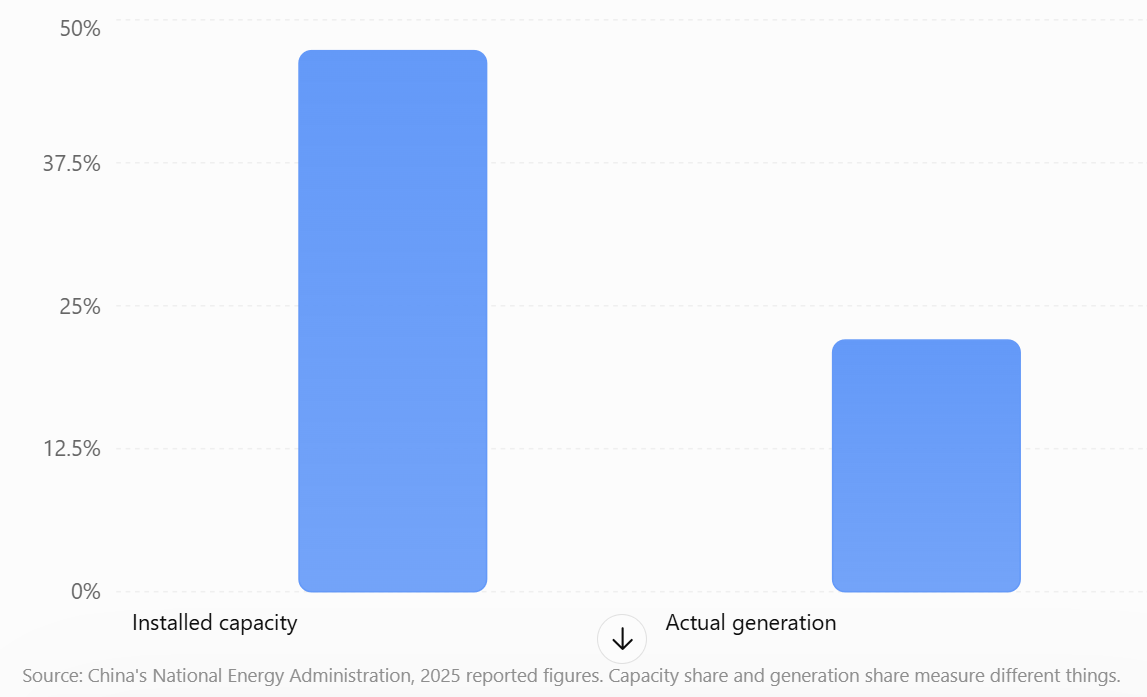
Source: China's National Energy Administration, 2025 reported figures. Capacity share and generation share measure different things.
This distinction matters because building more renewable generation does not automatically solve the electricity system's challenges.
Consider a solar development in western China producing substantial electricity during the middle of the day.
If local demand is limited, the grid needs either sufficient transmission capacity to move that electricity elsewhere, storage to preserve some of it for later, or flexible demand that can use it when available.
Otherwise, generators may be required to reduce production, a problem known as curtailment.
China has experienced this challenge despite its impressive infrastructure investment.
The IEA has noted that rapid renewable expansion has sometimes outpaced transmission and system flexibility, contributing to higher curtailment and difficulties moving electricity efficiently to demand centers.
IEA
This is one of the reasons the future grid cannot simply be a larger version of today's network.
It needs to become more flexible.
Batteries, Pumped Hydro, and a Grid That Can Respond
China is investing heavily in electricity storage to address that problem.
At the end of 2025, the country reported approximately 136 gigawatts of operational new energy storage capacity, with an energy-storage volume of around 351 gigawatt-hours.
That represents substantial growth, although its reported average storage duration of approximately 2.6 hours illustrates an important limitation.
National Energy Administration
Batteries are valuable for shifting electricity over shorter periods, responding quickly to changes in supply and demand, and supporting grid stability.
They cannot, at those durations, solve every challenge associated with several days of weak wind or solar output.
Pumped hydro offers another approach.
When surplus electricity is available, water is pumped from a lower reservoir to a higher one. When electricity is needed, the water flows downhill through turbines to generate power.
The technology has existed for decades, but it is becoming increasingly valuable in systems with large amounts of variable renewable generation.
China also has conventional hydropower, thermal generation, and nuclear capacity that contribute to the wider system.
The goal is to coordinate all these resources more effectively.
In some cases, electricity demand itself can become flexible. Industrial facilities, charging networks, and certain computing workloads may be able to adjust their consumption in response to electricity prices or grid conditions.
Virtual power plants can coordinate distributed batteries, flexible customers, and small generating resources to behave like a larger power-system asset.
China is developing these capabilities alongside its transmission investments.
The future grid is therefore not just about transporting more electricity. It is about managing when and where electricity is produced, stored, and consumed.
The Engineering Problem Most People Never Hear About
The grid must do more than carry electricity. It must remain stable.
In a conventional alternating-current power system, generators and connected equipment must operate within carefully controlled frequency and voltage conditions.
Traditional coal, gas, hydro, and nuclear plants often use large rotating generators. Their rotating mass provides inertia, helping the system resist sudden changes in frequency.
Solar panels and batteries, by contrast, typically connect through power electronics known as inverters.
These systems can provide valuable grid-support functions, but their behavior differs from conventional rotating generators.
As the electricity mix changes, operators need new ways to maintain stability.
The documentary supplied for this article explores synchronous condensers, large rotating electrical machines that provide inertia and voltage support without generating electricity from fuel.
Other solutions include grid-forming inverters, appropriately designed batteries, advanced controls, and improved coordination between generators and network operators.
The challenge became particularly visible after the major blackout affecting Spain and Portugal on April 28, 2025.
Initial commentary frequently focused on renewable energy. But the final investigation published by European transmission-system organization ENTSO-E in March 2026 identified a more complicated combination of factors, including voltage-control deficiencies, oscillations, generator disconnections, and uneven system-stabilization capabilities.
It would be inaccurate to describe the blackout simply as a consequence of solar power replacing conventional generation.
The larger lesson applies to China as well.
Building renewable capacity is one achievement. Operating a reliable electrical system with substantial renewable generation is another.
The next generation of grid technology must address both.
China's Vision for 2030 and 2035
China's ambitions extend beyond individual transmission projects.
A national grid development policy issued at the end of 2025 sets out a vision for a more integrated electricity system by 2030, with further modernization through 2035.
It calls for closer coordination between the main transmission network, distribution infrastructure, and intelligent microgrids.
The 2030 objectives include supporting a larger share of renewable electricity, expanding the grid's ability to accommodate distributed energy, increasing interprovincial electricity exchanges, and supporting tens of millions of charging facilities.
NDRC
This is a significant change in how electricity infrastructure is imagined.
The traditional model was relatively straightforward: large power stations generated electricity, and networks delivered it to customers.
The future system will have electricity moving in more directions.
A household may produce solar electricity. An industrial facility may operate its own battery. An electric vehicle may be charged when electricity is plentiful. A data center may adjust selected computing workloads to reduce demand during periods of grid stress.
Local microgrids may manage combinations of solar generation, storage, and electricity consumption.
Digital monitoring and control systems will become more important because the number of assets participating in the grid is increasing.
China's vision is to coordinate these different components through a more integrated national electricity infrastructure.
The country also has substantial industrial advantages in carrying out that transformation.
It manufactures solar panels, batteries, electrical equipment, and many of the components needed for electricity networks. Companies such as State Grid, China Southern Power Grid, CATL, BYD, and major electrical equipment manufacturers participate in different parts of this industrial ecosystem.
China's strength is not simply its ability to construct large projects. It is the combination of manufacturing capability, infrastructure investment, technical expertise, and long-term planning.
That combination may prove difficult for competitors to replicate quickly.
But China's Model Has Real Risks
It would be a mistake to describe China's electricity transformation as an uncomplicated success.
The country has made extraordinary progress in renewable generation and power infrastructure, but its electricity system remains heavily dependent on coal.
The IEA estimated that Chinese coal-related investment would remain substantial in 2025, reflecting continuing concerns about energy security and reliability.
Although renewable electricity generation expanded strongly and thermal generation declined slightly in 2025, coal remains an important part of China's electricity supply.
China also faces questions about the utilization of its infrastructure.
A transmission line represents enormous capital investment. Its economic value depends on how much electricity it carries, the cost of operation, and the benefits it provides to the wider system.
Renewable projects must be connected to customers, while storage systems must earn revenue sufficient to justify their investment.
China's regional electricity markets and operating arrangements also need to become more flexible if the country is to make full use of renewable generation across different provinces.
There are environmental and social considerations as well. Large transmission corridors require land and can affect communities and ecosystems. Hydropower developments can involve significant ecological impacts, while coal generation continues to contribute to emissions.
And despite China's enormous manufacturing capacity, building a sophisticated electricity system remains expensive.
The relevant question is therefore not whether China can build more infrastructure. It has clearly demonstrated that ability.
The more difficult question is whether it can operate the entire system efficiently, economically, securely, and with progressively lower emissions.
What China's Grid Strategy Means for the Rest of the World
China's experience offers several important lessons for other economies.
The first is that electricity infrastructure cannot be treated as an afterthought in industrial policy.
Countries that want to attract AI infrastructure, advanced manufacturing, semiconductor facilities, electric vehicle production, and other energy-intensive industries must consider how those ambitions will be supplied with power.
The second is that renewable electricity generation and grid development need to progress together.
Installing solar panels is often considerably faster than developing major transmission infrastructure. If the electricity network cannot accommodate new generation, some of the investment may be underutilized.
The third lesson concerns workforce and manufacturing capability.
Power-system expansion depends on electrical engineers, lineworkers, transformer manufacturers, equipment technicians, construction contractors, control-system specialists, and trained operators.
China's long period of infrastructure development has helped sustain a large industrial ecosystem capable of supporting additional expansion.
Other countries face the challenge of rebuilding some of those capabilities after periods of slower infrastructure investment.
The fourth lesson is about resilience.
A modern electricity system must cope with extreme weather, technical failures, cybersecurity threats, fluctuating renewable generation, and changing demand.
More transmission capacity helps, but so do storage, network controls, appropriate market arrangements, and the ability to recover after disruptions.
Finally, China's experience demonstrates that electricity policy is becoming inseparable from economic competitiveness.
Access to reliable power can influence whether a business builds its next factory, data center, or industrial facility in one country rather than another.
The Opportunity for Industry Events and Professionals
The future electricity grid will create opportunities far beyond power utilities.
Electrical equipment manufacturers, battery developers, engineering businesses, construction contractors, software companies, telecommunications specialists, and cybersecurity providers all have roles to play.
The next generation of projects will also require specialists in power electronics, grid-forming inverters, high-voltage direct-current systems, energy storage, industrial automation, and digital infrastructure.
For professionals, this creates an opportunity to develop expertise where established industries meet new technologies.
An electrical engineer may move into advanced grid controls. A construction company may specialize in transmission infrastructure. A battery manufacturer may develop products for utility-scale storage. A software business may provide forecasting and optimization systems.
Industry events can help bring these groups together.
Grid modernization conferences, renewable energy exhibitions, battery storage summits, electrical engineering forums, and infrastructure investment events provide opportunities to understand where technology is moving and which problems remain unresolved.
For businesses looking beyond their domestic markets, China's electricity transformation is also worth watching because it influences global equipment supply chains, technology standards, costs, and competition.
Not every Chinese technology or infrastructure approach will be appropriate for another country. Regulatory systems, geography, market structures, and environmental requirements differ.
But understanding what China is developing can help companies and policymakers make better decisions about their own electricity infrastructure.
The Bigger Picture
The electricity grid is one of the most important industrial systems ever developed, yet most people rarely think about it until something goes wrong.
It connects generating facilities with factories, hospitals, transport systems, homes, and increasingly the computing infrastructure supporting artificial intelligence.
China's transformation is particularly interesting because the country is approaching electricity as the foundation of a broader industrial strategy.
It is expanding renewable generation while building enormous transmission networks, developing energy storage, modernizing grid controls, and maintaining conventional capacity to support reliability.
The strategy is ambitious, expensive, and technically demanding. It is not without contradictions, particularly around coal dependence and the difficulty of integrating renewable electricity at enormous scale.
But it reveals an important economic reality.
A country may have advanced AI companies, electric vehicle manufacturers, and ambitious technology policies. None of those industries can operate successfully without dependable electricity.
Over the next two decades, national competitiveness may depend increasingly on the ability to produce electricity affordably, deliver it efficiently, manage it intelligently, and maintain reliability as the energy system changes.
China is investing heavily in that capability.
The rest of the world has reason to pay attention.
The next industrial advantage may not begin in a semiconductor laboratory or an AI research center.
It may begin with the electricity network that allows both to operate.
Industry Events | IE Insights
Explore conferences, summits, exhibitions, and industry forums covering power grids, renewable energy, energy storage, electrical engineering, advanced manufacturing, AI infrastructure, and industrial technology at industryevents.com.