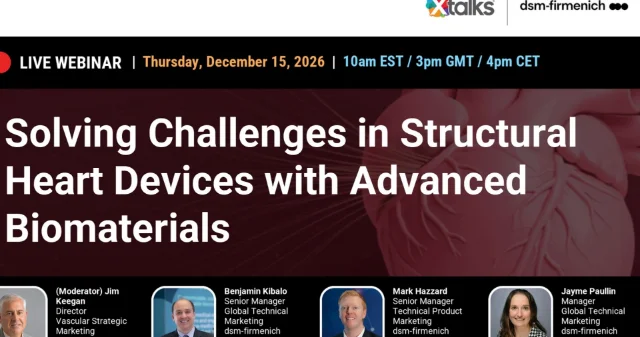
Structural heart therapies continue to advance rapidly, but increasingly complex device designs create equally complex material challenges. Transcatheter heart valves, left atrial appendage closure devices, septal closure systems and their delivery platforms must balance competing requirements, including durability, hemocompatibility, sealing, low profile, flexibility, precise deployment and manufacturability. No single material property solves these challenges in isolation. This webinar explores how advanced biomaterials and material engineering can help address critical structural heart device challenges and inform device development strategies.
The discussion will focus on four key challenges facing device developers and medical practitioners in structural heart applications:
Perimeter leakage:
A strong seal around the perimeter of implanted devices is critical to preventing blood from reversing flow around the device
Leaflet degradation and stenosis:
Valve leaflets must be strong, durable and resistant to calcium accumulation
Thrombus resistance:
Thrombus formation on device surfaces can lead to stroke and downstream complications
Navigation and delivery:
Complex anatomy and tortuous paths can create significant challenges to accurate device placement
This panel will explore how advanced biomaterials and material engineering can become an integral part of structural heart device design, rather than simply a material-selection decision made later in development. Panelists will discuss how thermoplastic polyurethanes, ultra-high molecular weight polyethylene (UHMWPE) fibers and membranes, extracellular matrices, lubricious coatings and composite technologies can help address these critical device challenges.
Attention will be given to emerging approaches such as polymeric valve leaflets, where thermoplastic polyurethanes and reinforced composites offer opportunities to improve fatigue performance, resistance to calcification, hemocompatibility, manufacturability and valve longevity. The discussion will also examine low-profile fabrics and membranes for valve skirts and frame coverings, tunable extracellular matrices for tissue-facing applications, hydrophilic coatings and low-friction materials that can improve the delivery of increasingly complex transcatheter systems.
Additionally, the panel will consider a broader question: How can device developers and biomaterial experts collaborate earlier to solve clinical and engineering challenges at the system level? By integrating materials science with device architecture, processing, testing, regulatory strategy and manufacturing, developers can expand the design space and create structural heart technologies that are more durable, deliverable, scalable and responsive to evolving clinical needs.
Register for this webinar to learn how advanced biomaterials can help overcome structural heart device challenges and support more effective design, development and manufacturing strategies.
Who Should Attend
This webinar will appeal to medical device professionals engaged in the design, development, evaluation and production of devices for structural heart applications, including:
Executive Leadership:
Chief Technology Officers, Chief Innovation Officers, VPs of R&D, Engineering and Innovation
R&D and Engineering:
Directors, Managers and Engineers in R&D, Design Engineering, Device Development and Product Development
Biomaterials and Materials Science:
Directors, Scientists and Engineers specializing in biomaterials, materials science and polymer engineering
Specialized Engineering:
Surface Scientists, Coatings Engineers, Textile Engineers, Fiber/Fabric Engineers, Catheter Engineers and Delivery System Engineers
Manufacturing and Process Development:
Extrusion Engineers, Process Development Engineers and Manufacturing Development Engineers
Register free on Xtalks: https://xtalks.com/webinars/solving-challenges-in-structural-heart-devices-with-advanced-biomaterials/