

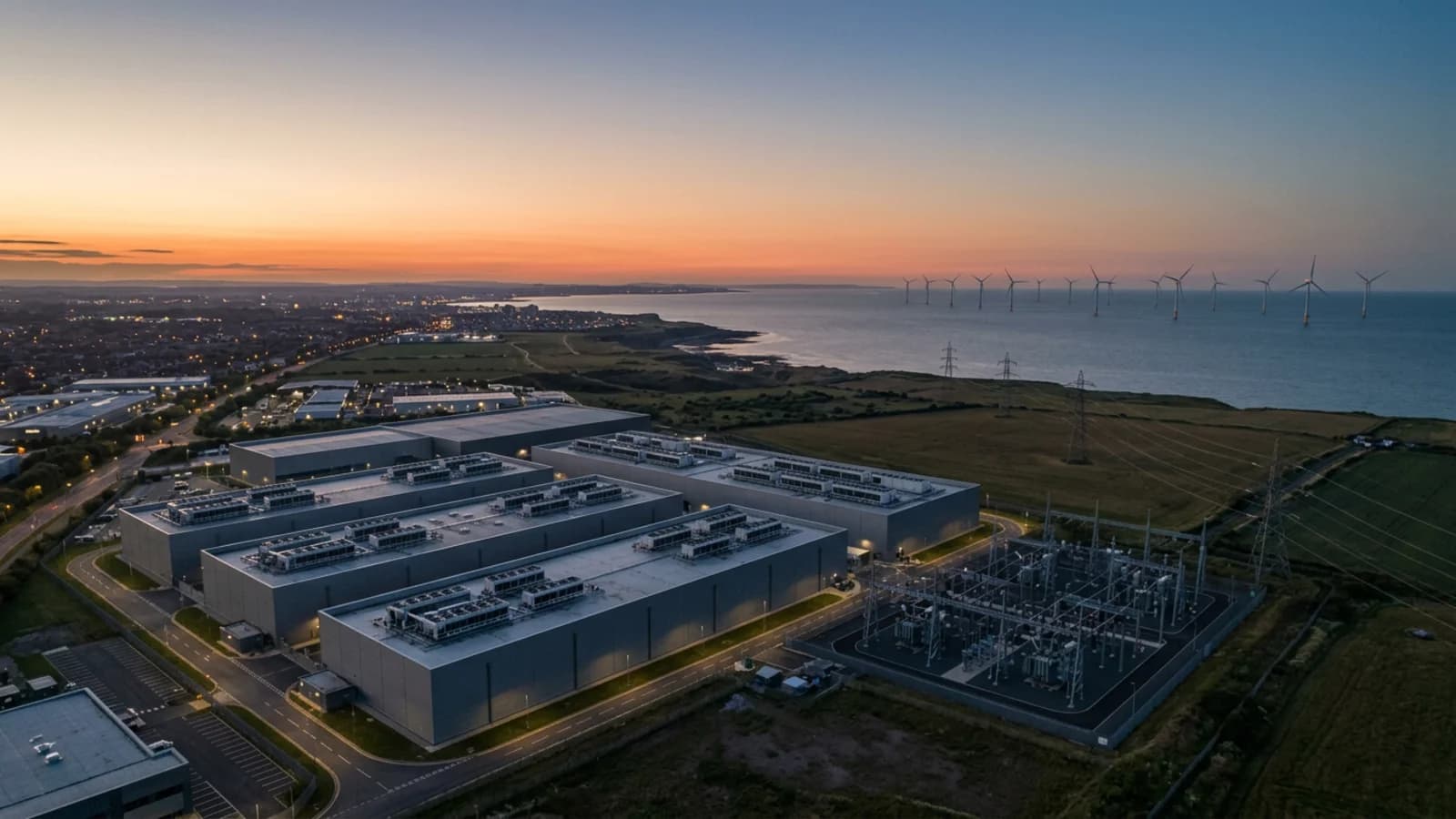
The short version: Data centres are no longer just buildings full of computers. They sit at the centre of a vast economy, pulling in energy, minerals, chips, construction and capital, and powering almost everything from banking to AI. This part maps the industries upstream and downstream, explores the innovations taking data centres under the sea and into orbit, and gives investors and decision-makers a clear way to judge the opportunities and risks.
New here? Part 1 explains how data centres are built, powered, cooled and run.
In Part 1 we walked through a data centre room by room. Now step outside and look at the bigger picture.
Every new data centre sets off a chain reaction. Somewhere a mine ships more copper, a factory builds another transformer, a power company plans a new line, and a pension fund signs a cheque. When the building switches on, thousands of businesses, from hospitals to streaming services, quietly start depending on it.
And the next generation of data centres may not be on land at all.
Three things most people miss:
Few products in history have had a supply chain this long. One AI answer depends on miners, chipmakers, electricians, power stations and investors.
The cheapest cooling may come from nature. Seawater, cold air and even the vacuum of space are all being tested to cool computers.
Space data centres hinge on one number: the cost of launching a kilogram into orbit.
How Part 2 flows: first the economy around data centres, upstream and downstream; then the future and its innovations; then investment, risks, predictions and what it means for you.
1. The Data Centre Economy: Who Feeds It, and Who Depends On It
A simple way to understand any industry is to follow what flows in and what flows out.
Upstream means everything a data centre needs before it can switch on: energy, land, materials, machines, money and people.
Downstream means everyone who relies on it once it's running: from your bank to your doctor to the AI on your phone.
The data centre sits in the middle, like a heart. When it grows, it pulls demand through dozens of industries above it and supports dozens more below it.
Upstream: the industries that feed the data centre
Energy and utilities. Electricity is the biggest running cost and the hardest thing to secure. Data centres drive new demand for power stations, transmission lines, substations, gas, solar, wind, batteries and nuclear. Several tech companies have signed nuclear deals. Microsoft agreed to help restart a reactor at Three Mile Island (renamed the Crane Clean Energy Center). Google agreed to buy 500 MW from small modular reactors that Kairos Power plans to start delivering from 2030. Amazon backed four advanced reactors with X-energy in Washington state [Nuclear Energy Institute, Nov 2024].
Mining and materials. Copper for cables, transformers and busways; aluminium and steel for buildings and racks; lithium and other battery minerals; silicon, gallium and rare earths for chips and electronics. This links AI to mines in Chile, the Congo, Indonesia and Western Australia (IE analysis).
Semiconductors. GPUs, CPUs, memory and network chips, designed by companies such as NVIDIA, AMD, Broadcom and the cloud giants, and largely made by a small number of chip factories in Taiwan, South Korea and the US.
Electrical and mechanical equipment. Transformers, switchgear, UPS systems, generators, chillers, pumps, cooling units and liquid-cooling systems. Long waiting times for this equipment are now one of the biggest delays in building new sites.
Construction and engineering. Designers, engineers, builders, electrical and mechanical contractors, and factories that build prefabricated modules.
Telecoms and fibre. Fibre-optic cable, subsea cables, network equipment and the carriers that connect each site to the world.
Land and real estate. Industrial land near power and fibre, along with the planners, councils and developers who decide where things can be built.
Water. For cooling in some designs, plus treatment and recycling systems.
Finance. Banks, infrastructure funds, private equity, pension funds and sovereign wealth funds that fund projects costing billions.
Education and training. Technical colleges (TAFE in Australia), universities, apprenticeships and certification bodies that produce the electricians, engineers and technicians the industry can't find enough of.
Downstream: the industries that depend on the data centre
Cloud and software. Almost every app, website and business system runs in a data centre.
Artificial intelligence. Training and running AI models is the fastest-growing use of new capacity.
Banking, payments and trading. Every card tap, transfer and share trade passes through data centres, often with very strict speed and reliability needs.
Healthcare. Patient records, medical imaging, telehealth and AI-assisted diagnosis.
Government and defence. Tax systems, identity, emergency services, intelligence and national security, which is why sovereignty matters.
Media, streaming and gaming. Video, music, social media and online games rely on fast, nearby data centres.
Retail and e-commerce. Online stores, logistics tracking, inventory and customer data.
Telecoms. Mobile networks and 5G depend on data centres to route and process traffic.
Manufacturing, mining and logistics. Sensors, robots, digital twins and supply-chain systems.
Science and research. Climate modelling, drug discovery, genomics and space science.
Transport. Navigation, ride-sharing, airline systems and, in future, more automated vehicles.
The "sideways" industries
Some industries are neither upstream nor downstream but grow alongside: insurance (covering billion-dollar assets and outage risk), cyber security, law and regulation (data protection, planning and energy rules), sustainability and carbon accounting, and consulting.
Aha moment: when you ask an AI a question, you're quietly using the work of a copper miner, a transformer factory, a chip plant, a fibre crew, an electrician, a power station and a pension fund. Few products in history have had a supply chain this long.
Enjoying this? Get the next one free. IE Weekly Insights explains one big shift every week, the dots most people miss and the events worth your time. Subscribe on industryevents.com.
Connecting the dots
Energy: data centres are reshaping power grids, gas demand and the case for nuclear. (See "The Hidden Global Highways of Energy".)
Minerals: the AI boom is also a copper and battery-metals story, which matters to mining countries such as Australia and Chile (IE analysis).
Water: cooling choices affect local water supplies, especially in dry regions.
Subsea cables: data centres cluster where undersea cables come ashore, making coastal cities strategic.
Real estate: industrial land near substations has become some of the most valuable land in many regions.
Skills: the AI boom is also a boom for electricians, plumbers and refrigeration mechanics.
The non-obvious one: heat is a by-product that can become a product. In parts of Europe, waste heat from data centres warms homes and offices through district heating networks (IE analysis). The building that powers the cloud can also heat the neighbourhood.
2. The Future of Data Centres: From the Chip to the Seabed to Orbit
The data centre of 2035 will look different from today's. Innovation is happening at every level: inside the chip, inside the building, in how sites are powered, and even in where they're built.
8.1 Inside the building
More work per watt. Each new generation of chips does far more computing for the same energy. Total demand still rises, because cheaper computing gets used for more things.
Liquid everywhere. Liquid cooling will become standard for AI, and new buildings will be designed around pipes rather than air ducts.
Higher-voltage power. The industry is moving to higher-voltage power inside the building to cut losses and copper use as racks head towards hundreds of kilowatts (IE analysis).
Light instead of electricity. "Photonics" and optical connections move data between chips using light. They're faster and use less energy than copper wires.
AI running the building. AI systems already help tune cooling and predict equipment failures. In future, much of a data centre's day-to-day operation may be automated.
Built in factories. More of each data centre will arrive as prefabricated modules, cutting build times.
8.2 New ways to power it
Bring your own power. More campuses will sit next to their own solar, wind, batteries, gas turbines or, eventually, small nuclear reactors.
Nuclear partnerships. The Microsoft, Google and Amazon deals described in Section 1 show tech companies acting as early customers for a new generation of reactors [Nuclear Energy Institute, Nov 2024].
Flexible data centres. Some AI workloads can pause or shift to another time or place. Data centres that dial down during peak grid demand could connect faster and help keep the grid stable (IE analysis).
Heat reuse. Waste heat warming homes, greenhouses, swimming pools and factories.
8.3 New places: under the sea
Why put computers in the ocean? Seawater is a free, endless coolant, many people live near coasts, and a sealed capsule can't be bumped, dusted or tampered with.
Microsoft's Project Natick sank a sealed, nitrogen-filled capsule of 864 servers about 36 metres deep off Scotland's Orkney Islands in 2018. When it was raised two years later, the servers had failed at one-eighth the rate of equivalent servers on land [Data Center Frontier, Sep 2020]. Microsoft ended the program in 2024, saying the lessons would inform future designs, and no longer runs undersea data centres [Techzine, Jun 2024].
China has gone commercial. HiCloud tested underwater data centres off Hainan from 2021 and began commercial service in 2023. Off Shanghai, a 24 MW underwater data centre placed about 35 metres below the surface, powered largely by nearby offshore wind and cooled by seawater, has started commercial operations. It reports a PUE below 1.15 [DatacenterDynamics, 2026].
Aha moment: an experiment that one tech giant shelved became a commercial business for another company in another country. In innovation, "it worked but we stopped" doesn't mean "it failed".
The catch: repairs are hard (you can't easily swap a broken part on the seabed), there are environmental questions about warming local water, and the capsules are small compared with land-based gigawatt campuses. Expect underwater sites to remain a niche for coastal cities rather than a replacement for land (IE analysis).
8.4 Other unusual places
Cold climates: the Nordics, Iceland and other cold regions use outside air for most of their cooling, often with renewable power.
Underground: some data centres are built in former mines, bunkers and caves, which offer stable temperatures and natural protection (IE analysis).
Floating: data centres on barges, cooled by the water they float on, are being tried at ports (IE analysis).
8.5 New places: in space
This is the boldest idea, and it's moving from science fiction into early experiments.
Why space? In the right orbit, a satellite can get almost constant sunlight for solar power. There's no land to buy, no water to use and no neighbours to object.
Who's trying:
Starcloud, backed by NVIDIA, launched a small satellite carrying an NVIDIA H100 GPU in November 2025 and trained a small AI model in orbit [Introl, 2026].
Axiom Space launched two orbital data centre nodes in January 2026 [Introl, 2026].
China's "Three-Body Computing Constellation", led by Zhejiang Lab, launched its first 12 computing satellites in May 2025 and plans to grow to thousands [Yicai Global, citing Xinhua, May 2025].
Google's Project Suncatcher is testing whether its AI chips can survive radiation in orbit, with two prototype satellites planned for early 2027 [Introl, 2026].
SpaceX has filed with US regulators for up to 1 million satellites for orbital computing following its merger with xAI. As at early 2026, the filing had not been approved [Introl, 2026].
The catch, in plain terms:
Getting there is expensive. Launch costs today are roughly US$2,700 per kilogram on a Falcon 9. Analysts suggest they'd need to fall below about US$100 per kilogram for space to compete with the ground [Introl, 2026].
Cooling is harder than it sounds. Space is cold, but there's no air to carry heat away, so it must be radiated out through large panels.
Radiation damages chips, so hardware must be tested and protected.
There's no repair crew. If something breaks, you usually replace the whole satellite.
Aha moment: on Earth, data centres fight over electricity and water. In space, power is plentiful and water isn't needed, but every kilogram costs a fortune to launch. The whole idea depends on one number: the cost of getting to orbit.
Our verdict: space data centres are real experiments, not yet a business. Watch launch costs. If reusable rockets cut them dramatically, orbital computing could become a niche for specific uses, such as processing satellite data in space, well before it challenges ground-based data centres (IE analysis).
8.6 The hype meter: what's real and when
InnovationStatusLiquid cooling, modular builds, heat reuse, AI-optimised operationsHere now and scalingOn-site power, batteries, flexible "grid-friendly" data centresEmerging, growing fastNuclear-powered data centres (new small reactors)Contracted, mostly 2030sUnderwater data centresCommercial niche (China); experimental elsewhereOrbital data centresEarly experiments; business case unproven
The big forces to 2030
Power first: grid access will decide where data centres go.
Bigger campuses: gigawatt-scale campuses (1,000 MW or more) are being planned on several continents.
Sovereign AI: governments want AI capacity on their own soil.
Efficiency pressure: new chips do far more work per watt, but total demand keeps rising.
2030 by region (directional, not dated forecasts)
USA: still the largest market, with growth moving to regions that have power available, plus more on-site generation and nuclear partnerships.
China: large-scale national computing networks, domestic chips and efficient designs.
Middle East: gigawatt AI campuses backed by cheap energy, sovereign capital and global partnerships.
Europe: growth constrained by grids and rules, with leadership in efficiency, heat reuse and the Nordics.
Africa: an emerging market, led by South Africa, Nigeria and Kenya, as cloud providers expand and subsea cables multiply.
South America: Brazil and Chile grow on renewable energy and regional cloud demand.
Asia-Pacific: Johor and India become major hubs. Japan and Korea invest in AI capacity, and Australia grows as a trusted, stable market with strong renewable potential.
Three scenarios
Base case: steady, power-constrained growth, with AI driving most new capacity.
Upside: breakthroughs in efficiency, plus fast build-out of clean power and grids, allow growth without major strain.
Downside: AI demand cools or financing tightens just as many projects finish. That would leave surplus capacity in some markets, while local opposition over power and water slows approvals elsewhere.
3. Investment and Growth Opportunities
Where the value sits in the chain
Think of the data centre economy in four layers. Each has a different risk profile (IE analysis):
Picks and shovels (upstream): power equipment, cooling, construction, materials and chips. These businesses get paid during the build, whoever wins the AI race, but they are exposed to the building cycle.
The landlords (the buildings): colocation operators and developers. Their income comes from long leases and is steadier, but it depends on securing power and on tenants' credit.
The utilities and energy suppliers: steady long-term contracts, with growth limited by grid and permitting speed.
The users (downstream): cloud, AI and software companies, with the highest potential upside and the highest risk if demand or pricing disappoints.
Opportunities
Power infrastructure: substations, transformers, switchgear, grid connections, batteries and on-site generation.
Cooling technology: liquid cooling, CDUs, chillers, heat exchangers and waste-heat reuse.
Construction and modular building: prefabricated power and cooling modules and specialist contractors.
Digital infrastructure assets: colocation platforms, development land with power, and fibre networks.
Efficiency and software: DCIM, AI-based energy optimisation, monitoring.
Skills and training: technical colleges, apprenticeships and certification providers.
Clean energy supply: power purchase agreements, renewables plus storage, and nuclear partnerships.
Questions to ask (not financial advice): Is power secured, and when? Who are the tenants, and how long are their contracts? How dependent is the project on one AI customer or one chip generation? Can the design handle future rack densities and liquid cooling? What are the water, community and planning risks? How exposed is it if AI demand slows?
A checklist for decision-makers
Whether you're a CEO, a board member, a government official or an investor, five questions cut through the noise:
Power: Is the electricity contracted, connected and affordable for 15+ years?
Flexibility: Can the site handle denser racks and liquid cooling as chips change every year or two?
Customers: Who will use the capacity, for how long, and how strong are they financially?
Community: Have water, noise, land use and local benefits been addressed early?
Resilience: What happens if a grid, a supplier, a cable route or a key customer fails?
4. Challenges and Blockers
Power scarcity: grid connections can take years, and some regions have paused new approvals.
Equipment shortages: long lead times for transformers, switchgear and generators.
Labour shortages: not enough electricians, mechanical trades and commissioning experts.
Rising costs: construction costs are rising faster than general inflation [Cushman & Wakefield via CRE Daily, Aug 2026].
Water and community concerns: local pushback over water use, noise, land use and power prices.
Technology risk: chips evolve so fast that a building designed today must handle racks that don't exist yet.
Concentration: a handful of hubs and companies hold much of the world's digital infrastructure.
The sceptic's case: this is a bubble. Too much money is chasing AI, and when demand cools, the world will be left with expensive, half-empty buildings.
Our answer: some markets may overbuild, and some projects will disappoint, as with every infrastructure boom from railways to fibre. But underlying demand for computing, storage and connectivity has grown for 70 years and shows no sign of reversing. Even fibre laid during the dot-com bust was eventually used. The winners will be facilities with secured power, flexible designs and strong tenants, not the ones built on hype.
Author's Vision and Predictions
These are forecasts, not facts.
Data centres will become energy companies, generating, storing and even selling power.
Waste heat will become a selling point, with data centres heating homes, greenhouses and industry.
Australia, the Gulf, the Nordics and Southeast Asia will compete hard as trusted, energy-rich hubs for the world's AI.
Underwater data centres will grow as a coastal niche, paired with offshore wind.
The first useful orbital computing will process data that's already in space, such as Earth-observation images, long before it competes with ground-based data centres.
The biggest winners may be upstream: the suppliers of power, cooling, copper and skills, whoever wins the AI race.
What This Means for You
For Leila, the leader. Your digital strategy rests on a supply chain you don't control. Three things to do:
Map which of your critical systems depend on which cloud regions, and what happens if one fails.
Ask your providers how they're securing power for the next five years.
If your business sits upstream (energy, land, construction, materials), explore partnerships with data-centre developers.
For Omar, the professional. The data centre economy needs people who understand more than one industry. Three things to do:
Pick one upstream link (energy, cooling, construction or finance) and learn how it connects to data centres.
Follow one innovation, such as liquid cooling, nuclear power or orbital computing, and track it for a year.
Attend one data-centre or energy-for-data-centres event and ask people where the bottleneck is.
For Sara, starting out. The future of computing is being invented now, in places as strange as the seabed and orbit. Three things to do:
Combine skills: energy plus computing, or engineering plus data, is a rare and valuable mix.
Read about one space or underwater data-centre project and write down what problem it solves.
Ask a lecturer or industry professional which innovation they think is real and which is hype.
Grow yourself. Great investors and engineers ask "what does this depend on?" Try it with your own week: list the three things your energy and focus depend on most, such as sleep, movement and one calm hour, and protect them first. Mindset tip: strengthen your upstream, and everything downstream gets easier.
Get the next one free. Subscribe to IE Weekly Insights for one big shift every week, the dots most people miss and the events worth your time.
The Bottom Line
Data centres are the hub of a vast economy: fed by energy, minerals, chips, builders and capital, and feeding almost every industry on Earth. Their future is being shaped by power, liquid cooling and smart design, and tested on the seabed and in orbit. For investors and decision-makers, the lesson is simple: follow the power, follow the bottlenecks, and separate what's real from what's hype.
Explore upcoming data centre, cloud and digital infrastructure events on Industry Events.
Researched with AI assistance; written and verified by IE Insights.
Sources
Nuclear Energy Institute, Tech companies and their love of nuclear, Nov 2024
Data Center Frontier, Microsoft: Servers in our underwater data center are super-reliable, Sep 2020
Techzine, Microsoft halts undersea data centers, Jun 2024
DatacenterDynamics, HiCloud's offshore wind-powered underwater data center up and running off Shanghai, 2026
Introl, The Orbital Data Center Race: Every Major Player, Timeline, and Economic Reality in 2026
Yicai Global (citing Xinhua), China launches satellite group to boost space computing power, May 2025
Cushman & Wakefield, 2026 Data Center Development Cost Guide, via CRE Daily, Aug 2026