

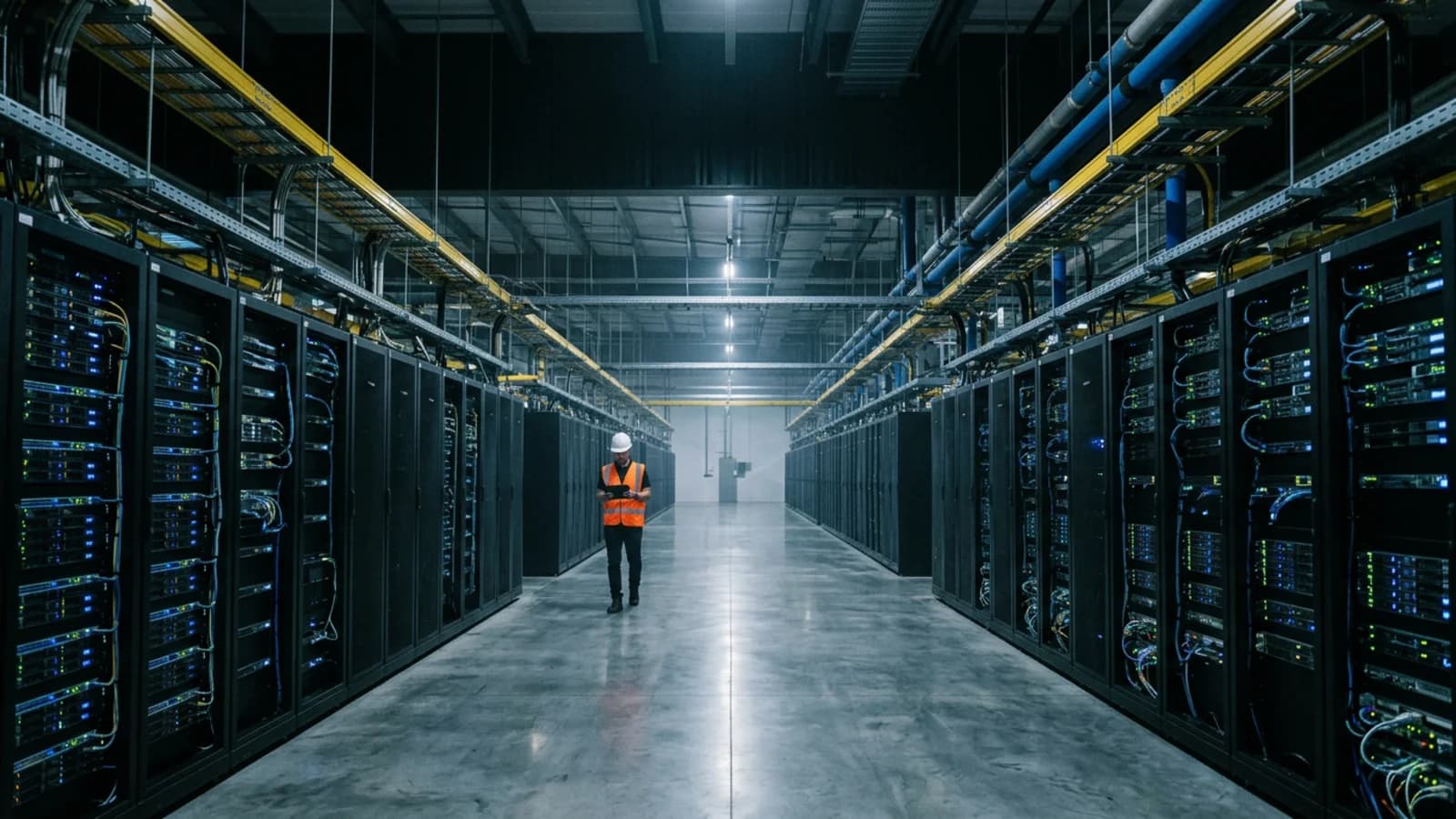
Behind every cloud service and AI application is a physical facility that must be carefully planned, engineered, powered, cooled, secured, and maintained. Building one is an exercise in balancing technology, infrastructure, economics, and people — often years before the first computer is switched on.
Imagine a company announcing plans to build a major new data center.
The investment could be worth hundreds of millions of dollars, perhaps billions if advanced computing equipment is included. The announcement might promise new AI capacity, improved cloud services, or a significant boost to the local digital economy.
But there is something these announcements rarely explain.
Before the first server arrives, the developer must answer a series of difficult questions. Where should the facility be built? How much computing capacity will customers actually need? Can the electricity network supply enough power? What happens when a transformer fails? How will the building handle the next generation of AI processors? And who will operate and protect the facility once construction is complete?
These decisions are closely connected. A poor choice early in development can become an expensive limitation years later.
A site with affordable land may have inadequate electricity infrastructure. A building designed around today's computing equipment may struggle with tomorrow's cooling requirements. An ambitious development could attract investment but be unable to find enough qualified electricians, refrigeration technicians, or commissioning engineers to complete the work.
That is what makes data center development different from ordinary commercial construction.
The building is not simply a place to install computers. It is a carefully engineered environment where electricity, cooling, communications, security, and human operations must function together, often continuously for decades.
And with the extraordinary growth of artificial intelligence, the stakes are becoming considerably higher.
The International Energy Agency estimated that data centers consumed approximately 415 terawatt-hours of electricity globally in 2024. Its updated 2026 outlook estimates 485 TWh for 2025 and projects around 950 TWh by 2030.
Those figures explain why computing infrastructure has become a major concern for electricity companies, investors, governments, and industrial planners.
To understand how this industry works, it helps to follow the decisions made before a data center becomes operational.
1. Planning: What Is the Data Center Actually Being Built For?
The first question in data center development is not where to build it, but what the facility is expected to do.
That distinction matters because different computing services require different kinds of infrastructure.
A bank operating critical financial systems has different priorities from a technology company training an AI model. A hospital storing sensitive medical information may have particular security and regulatory requirements. A cloud provider serving thousands of businesses must consider capacity, customer locations, connectivity, and the reliability of its services.
These differences influence nearly every decision that follows.
A company building a facility for its own operations may be able to forecast its computing requirements based on existing business systems. A commercial data center developer, however, must consider the needs of prospective tenants, the likely demand for capacity, the competition in the local market, and the terms customers are willing to accept.
Large cloud providers such as AWS, Microsoft, and Google operate hyperscale facilities designed to support enormous computing requirements. Colocation providers such as Equinix and Digital Realty offer space, electricity, cooling, and connectivity to customers who want to operate equipment without owning the entire building.
AI-focused facilities introduce further requirements. Training large models can involve thousands of advanced processors exchanging substantial volumes of information. These systems need sophisticated networking, large electrical supplies, and increasingly specialized cooling arrangements.
The developer therefore needs to determine the type of computing workload, the intended customer, the required reliability, and the commercial life of the project.
These decisions influence the building's size and location, but they also determine its financial structure.
The Business Case Comes Before the Building
Data centers require substantial capital investment, and much of that investment must be committed before revenue begins.
Land acquisition, planning approvals, electricity connections, design, construction, mechanical equipment, electrical infrastructure, and commissioning all require funding.
Computing hardware adds another major expense, particularly for AI developments using advanced processors.
For investors, the essential question is whether the facility will generate sufficient long-term income to justify these costs.
A commercial project with committed customers and long-term contracts has a different financial profile from one being developed in anticipation of future demand.
The developer must also consider how much capacity to build initially, how quickly customers are likely to use it, and whether future expansion can be financed.
This is why the planning stage is so important. It establishes not only the physical requirements of the building but also whether the proposed investment makes economic sense.
2. Location Selection: Why the Cheapest Land Is Rarely the Best Site
Once the developer understands the facility's purpose, the search for a suitable location begins.
In conventional property development, location often means proximity to customers, transport connections, and commercial activity.
For a data center, electricity and telecommunications infrastructure can be even more important.
A site may be inexpensive and offer plenty of space, but if a suitable electricity connection cannot be delivered for several years, the financial advantages may disappear.
This is one of the most important changes in the modern data center industry.
Electricity Can Determine the Entire Project
A large data center needs reliable access to substantial electrical capacity.
The developer must understand how much power is available from the existing network, whether a new substation will be required, and how long it may take the utility to provide the necessary connection.
It is not enough for a power line to pass near the property. The network must have the capacity to support the proposed facility without creating unacceptable operational problems.
New infrastructure may require transformers, switchgear, transmission upgrades, land agreements, permits, and major construction work.
Some of this equipment has long manufacturing lead times.
Consequently, the electricity connection can take longer to deliver than the building itself.
Northern Virginia provides a useful example.
The region around Ashburn became one of the world's largest data center markets because of its telecommunications infrastructure, proximity to customers, and concentration of established operators.
Over time, that success created significant pressure on local electricity infrastructure.
Developers increasingly had to consider grid capacity and connection schedules when planning new facilities.
The lesson is straightforward. A successful data center location can eventually become constrained by the very infrastructure that made it attractive.
Connectivity Is the Second Major Consideration
Electricity allows the computers to operate, but telecommunications networks connect them to customers and other facilities.
Developers look for access to high-capacity fiber-optic networks, preferably with multiple independent routes.
The distinction between one connection and several genuinely independent connections is important.
If two fiber cables use the same underground route, a single excavation accident could damage both.
For a facility supporting critical business services, the developer may therefore seek connections entering the site from different directions and using separate telecommunications infrastructure.
Location also influences latency, the delay involved in transmitting information between systems.
For financial services, interactive applications, and certain industrial operations, that delay can be commercially important.
Some AI training workloads are less sensitive to distance from end users, allowing developers to consider more remote locations with access to electricity.
This is one reason different types of data centers are increasingly being built in different markets.
Land, Climate, Water, and Environmental Risk
A suitable site needs more than electricity and fiber.
The developer must assess flooding, extreme weather, seismic risks, ground conditions, nearby industrial hazards, and the availability of access roads.
Local climate can influence cooling costs. In cooler regions, outside air or water may provide opportunities to reduce mechanical cooling demand.
In hotter locations, cooling systems may need more energy or different designs.
Water availability is also relevant because some cooling technologies consume water through evaporation. In regions facing water scarcity, this can become a major planning and community issue.
Noise deserves consideration too. Large mechanical equipment, cooling systems, and backup generators can affect neighboring properties.
These questions should be considered before land acquisition and detailed design, not treated as problems to solve after construction begins.
The strongest site is not necessarily the cheapest or closest to a major city. It is the location that provides the most reliable combination of infrastructure, development feasibility, operating costs, and room for future growth.
3. Sizing and Scalability: How Big Should the Facility Be?
Once a suitable location has been identified, the developer must determine how much capacity to build.
This sounds straightforward until we consider how quickly computing technology changes.
A facility designed for conventional cloud applications may need very different electrical and cooling infrastructure from one intended to support advanced AI systems.
And because data centers can operate for many years, developers must make decisions today about equipment that may not yet exist.
Why Data Centers Are Measured in Megawatts
Data center capacity is commonly described in megawatts rather than simply floor area.
A megawatt measures power. In this industry, it helps describe the electrical capacity available to support computing equipment or the facility as a whole.
The distinction between IT load and total facility load is important.
IT load refers to the power consumed by servers, storage, and networking equipment. Total facility load also includes the electricity required for cooling and other supporting systems.
Consider a hypothetical development designed for 20 megawatts of IT capacity.
If the facility operates with a power usage effectiveness, or PUE, of 1.25, its total power requirement at full IT load would be approximately 25 megawatts.
The additional five megawatts account for supporting infrastructure such as cooling and electrical losses.
That difference matters when negotiating electricity supply and designing the site's infrastructure.
A developer who considers only the power consumed by the computers may underestimate the electricity needed to operate the complete facility.
PUE is a useful measure of infrastructure efficiency, although it does not indicate whether the facility uses renewable electricity, how much water it consumes, or whether the computing itself is economically productive.
The Problem With Planning Around Today's Computers
Computing equipment does not remain unchanged.
Traditional server racks may operate at comparatively modest power densities. High-performance AI racks can require dramatically more electricity and generate substantially more heat.
NVIDIA's GB200 NVL72 is a useful example. The system combines 72 Blackwell GPUs and 36 Grace CPUs in a liquid-cooled rack-scale design.
That kind of equipment changes the requirements of the room surrounding it.
Electrical distribution systems must support greater loads. Cooling systems need to remove more heat from concentrated locations. Floors must accommodate heavy equipment, while access routes need to allow large components to be transported and installed.
A data center built with insufficient electrical or mechanical capacity may become difficult or expensive to upgrade.
This creates a design challenge.
Should the developer install expensive infrastructure for future requirements that may not materialize, or build only for current demand and risk costly modifications later?
The answer often lies in phased development.
Building in Phases Instead of Building Everything at Once
A large campus does not necessarily need to be completed in a single construction program.
A developer might plan for several buildings or computing halls but initially construct only the capacity supported by confirmed customer demand.
Additional phases can be developed when electricity, financing, and commercial requirements justify expansion.
However, phased development only works well when it is considered during the original planning process.
The site must have enough land for future buildings, substations, cooling equipment, access roads, and telecommunications infrastructure.
Engineers must consider how additional equipment will connect to existing systems and whether expansion can occur without interrupting customers already operating in the facility.
For example, it may be sensible to reserve space for additional electrical infrastructure or design pipe networks with future extensions in mind.
Modular construction can also help by allowing standardized electrical and cooling equipment to be manufactured and installed in stages.
The advantage is financial as well as technical. Developers can avoid installing every component before customers require the capacity.
But there is a limit to this approach.
A future phase cannot operate merely because land has been reserved. The developer must also secure the additional electricity, equipment, permits, financing, and customer demand.
Real scalability depends on the entire infrastructure system, not simply the ability to add more server racks.
4. Key Design Concepts: Reliability, Redundancy, and Efficiency
A modern data center is designed around a fundamental operating requirement: customers expect computing services to remain available.
This creates a different engineering philosophy from many conventional commercial buildings.
If air conditioning fails in an ordinary office, employees may experience discomfort while repairs are arranged.
If cooling fails in a data center, processors may rapidly reach temperatures that require equipment to reduce performance or shut down.
Similarly, an electricity interruption can affect applications and services operating far beyond the physical building.
The design must therefore anticipate failures and allow operators to respond without unnecessarily interrupting customers.
Redundancy: Planning for Equipment to Fail
Engineers use redundancy to provide additional capacity or alternative systems.
Suppose a cooling system requires three pumps to operate under normal conditions. A designer may install a fourth pump so that the facility can continue operating when one pump is unavailable.
This is commonly described as an N+1 arrangement: the system has the capacity needed for normal operation plus an additional component.
Other designs use separate distribution paths or duplicated systems to provide greater protection.
The appropriate approach depends on the facility's purpose, its customers, and the consequences of downtime.
Greater redundancy can improve resilience, but it also increases construction costs, equipment requirements, maintenance obligations, and operating complexity.
The aim is not simply to install as much backup equipment as possible. It is to design a system that meets the required level of reliability at a commercially reasonable cost.
Understanding Data Center Tier Classifications
The Uptime Institute's Tier classification system is widely used to assess data center infrastructure designs.
Tier I represents basic site infrastructure. Tier II adds redundant capacity components. Tier III is designed to allow concurrent maintenance, meaning certain equipment can be maintained or replaced without shutting down IT operations.
Tier IV adds fault-tolerant infrastructure intended to allow operations to continue through specified equipment failures.
These classifications concern the design and capabilities of the infrastructure. They should not be treated as simple guarantees that a facility will experience a particular number of minutes of downtime each year.
A well-designed facility can still be affected by poor operating procedures, human error, or failures outside its design assumptions.
This is why operational management is as important as the original engineering.
Designing for Maintenance
One of the less glamorous but most important design considerations is how equipment will be maintained.
Transformers, pumps, batteries, cooling systems, and generators all require inspection, testing, servicing, and eventual replacement.
Engineers must provide sufficient access for technicians to work safely.
Equipment rooms need appropriate clearances, lifting arrangements, isolation points, and maintenance routes.
The building should also allow components to be replaced without unnecessarily exposing operating systems to risk.
These details may appear minor during the design stage, but they can make an enormous difference over the building's life.
A facility that is difficult to maintain may become expensive and operationally risky long before its physical structure reaches the end of its useful life.
5. Infrastructure Requirements: Following Power, Cooling, and Data Through the Building
Once the overall design has been established, the facility's major infrastructure systems can be developed.
Three systems deserve particular attention because they determine whether computing equipment can operate: electricity, cooling, and connectivity.
The Electrical Infrastructure
Electricity generally enters the site through a utility connection and, for larger facilities, may pass through dedicated substation infrastructure.
Transformers adjust voltage levels before electricity passes through switchgear and distribution equipment.
Power distribution units and busways carry electricity toward the computing racks.
But the building also needs protection against interruptions.
Uninterruptible power supply systems, commonly called UPS systems, provide immediate temporary power when the main electricity source becomes unavailable.
Battery systems are commonly used for this purpose.
Backup generators can then take over for a longer period if the design requires them.
This arrangement must be carefully coordinated so that changes between electricity sources do not interrupt critical equipment.
For large facilities, the electrical infrastructure can resemble that of an industrial plant.
It requires specialist engineers, electricians, high-voltage technicians, equipment manufacturers, and commissioning teams.
The work continues after construction because equipment must be monitored, tested, and maintained throughout the facility's operating life.
Cooling and Mechanical Infrastructure
Every computer consumes electricity and generates heat.
Removing that heat is essential to maintaining equipment reliability.
Traditional data centers commonly use air cooling, often arranging servers in hot and cold aisles to reduce mixing between heated exhaust air and the cooler air entering the equipment.
Large air-handling units, chillers, pumps, and associated systems manage temperatures throughout the computing rooms.
Higher-density AI systems increasingly use liquid cooling.
In direct-to-chip designs, coolant passes through cold plates connected to processors. Heat is transferred through a network of pipes and heat exchangers before being rejected through the wider cooling infrastructure.
Other options include rear-door heat exchangers and immersion cooling.
These approaches require different engineering arrangements, and not every facility needs the same solution.
The choice depends on computing density, equipment compatibility, operating conditions, environmental objectives, and cost.
For example, a large facility in a cool climate may have opportunities to reduce mechanical cooling demand by using suitable outside conditions. A facility in a hot, water-stressed region may place greater emphasis on minimizing direct water consumption.
Cooling must also remain available during maintenance and selected equipment failures.
For this reason, mechanical system design and electrical resilience cannot be considered independently.
Telecommunications and Network Infrastructure
A data center is only useful when its computing systems can communicate with customers and other systems.
Fiber-optic cables connect the facility to telecommunications networks, cloud platforms, and other data centers.
Larger commercial facilities may provide connections to several telecommunications operators, allowing customers to select among different providers.
Internally, network engineers design the connections between servers, storage systems, and high-performance computing equipment.
AI clusters place particularly demanding requirements on these networks because large numbers of processors must exchange information rapidly.
A slow connection can reduce the performance of expensive equipment.
Network resilience matters too.
Where practical, operators may use multiple independent fiber routes so that damage to one cable does not interrupt all external connectivity.
The communications design therefore needs to reflect the criticality of the services being delivered.
The Supporting Infrastructure People Rarely Notice
A functioning data center also needs loading and staging areas, equipment storage, maintenance workshops, offices, fuel arrangements, water treatment where applicable, and secure access routes.
New servers need somewhere to be received, inspected, prepared, and tested before installation.
Technicians need spare parts and tools.
Maintenance teams require safe working areas, while operational staff need access to monitoring and control systems.
These supporting spaces are easy to overlook when attention is concentrated on computing capacity.
But they contribute significantly to how efficiently and safely the facility can be operated.
6. Key Skills: The People Who Design, Build, and Keep It Running
Data center development brings together a surprisingly diverse workforce.
The planning stage requires commercial analysts, property specialists, engineers, environmental consultants, legal advisers, and project finance professionals.
Design involves architects, structural engineers, electrical and mechanical engineers, telecommunications specialists, fire protection consultants, security designers, and building information modeling professionals.
Construction then brings in electricians, plumbers, industrial pipefitters, refrigeration mechanics, steelworkers, concreters, crane operators, telecommunications installers, and specialist contractors.
Project managers, procurement teams, site supervisors, safety professionals, and commissioning engineers coordinate the work.
The importance of these skills becomes clearer when considering the technical demands of the building.
Why Electricians Are So Important
Electrical work is fundamental to data center reliability.
Qualified electricians and specialist technicians install, test, and maintain the infrastructure distributing electricity throughout the facility.
High-voltage infrastructure, switchgear, UPS equipment, backup power systems, and monitoring arrangements require careful installation and ongoing maintenance.
For electricians with industrial experience, data centers can provide a pathway into mission-critical infrastructure.
However, the work often requires additional training, strict safety procedures, and familiarity with specialized equipment.
Plumbers, Pipefitters, and Refrigeration Specialists
As cooling systems become more sophisticated, mechanical trades are becoming increasingly relevant.
Plumbers and industrial pipefitters may install networks of pipes, pumps, valves, and heat-transfer equipment.
Refrigeration mechanics and HVAC technicians work on chillers, air-handling systems, and other cooling infrastructure.
Liquid-cooled AI installations create additional demand for specialized thermal management expertise.
These are practical engineering roles where installation quality can directly affect the reliability of expensive computing equipment.
Security, Fire Protection, and Telecommunications Specialists
Physical security teams help protect the facility, while electronic security technicians install surveillance, access-control, and alarm systems.
Fire protection specialists develop and maintain detection and suppression arrangements.
Fiber-optic technicians install and test telecommunications connections, while network engineers manage the systems allowing computing equipment to communicate.
These roles are different, but all contribute to the facility's ability to operate reliably.
Commissioning and Operations
Commissioning specialists have one of the most demanding responsibilities.
Before customers begin using the building, they must verify that the electrical, mechanical, monitoring, and backup systems operate as intended.
Testing includes individual equipment, system interactions, and selected failure scenarios.
Once operational, facility technicians, maintenance engineers, network operations teams, and security personnel take responsibility for the building.
These people need technical expertise, but they also need judgment, discipline, clear communication, and the ability to respond calmly when problems occur.
A modern data center may contain advanced automation, but the quality of its workforce remains a major factor in reliability.
For countries seeking to develop data center industries, investment in apprenticeships, technical education, engineering programs, and specialist certifications should therefore accompany investment in buildings.
7. Security Considerations: Protecting the Building and the Information Inside It
Security is one of the most important aspects of data center design because the infrastructure may support financial services, healthcare systems, businesses, and government operations.
The consequences of unauthorized access or operational disruption can extend far beyond the physical site.
Security therefore begins during planning rather than after the building is completed.
Physical Security
The first level of protection concerns who can approach and enter the facility.
Depending on the site's risk profile, a data center may have perimeter fencing, controlled vehicle access, surveillance systems, security personnel, and monitored entrances.
Inside the building, access is commonly restricted according to the responsibilities of employees, contractors, and customers.
Sensitive areas may require additional identity verification or controlled entry arrangements.
The aim is to prevent unauthorized access while allowing legitimate staff to carry out their work efficiently and safely.
For commercial facilities serving multiple customers, physical separation and access management can be particularly important.
Cybersecurity and Building Systems
Protecting data center infrastructure is not limited to securing servers and networks.
Modern buildings also rely on connected control systems.
Electrical monitoring equipment, cooling controllers, building management platforms, security systems, and other operational technologies may communicate across digital networks.
If these systems are poorly protected, they can create additional security risks.
Designers therefore need to consider network segmentation, access permissions, secure remote maintenance, monitoring, and appropriate protection of operational technology.
A facility can have excellent physical security but still be vulnerable through poorly configured connected systems.
Likewise, sophisticated cybersecurity controls cannot compensate for inadequate physical access management.
Both are necessary.
Fire, Environmental, and Operational Protection
Data centers also need protection against fire, water leaks, equipment failures, and environmental hazards.
Advanced fire detection systems can identify potential problems early, while suppression arrangements must be appropriate for the equipment, building design, and applicable safety requirements.
Water leak detection is particularly important in facilities with extensive cooling pipework.
Environmental monitoring helps detect abnormal temperatures and humidity conditions.
Emergency procedures must be documented, and staff need training to understand how to respond to different incidents.
Security and resilience are therefore broader than preventing deliberate attacks. They also involve preparing for accidents, technical failures, natural hazards, and human error.
Data Sovereignty and Customer Requirements
For some customers, the physical location of the data center has legal and commercial implications.
Governments, healthcare organizations, and financial institutions may have requirements concerning where information is stored, processed, or accessed.
These requirements can influence site selection, network architecture, customer agreements, and operating procedures.
However, operating infrastructure within a country's borders does not automatically mean complete technological independence.
Facilities may still rely on international equipment manufacturers, software providers, telecommunications networks, and maintenance suppliers.
For business leaders and policymakers, sovereignty therefore needs to be understood in practical terms: control over data, access, infrastructure, governance, and operational dependencies.
8. Commissioning: The Final Test Before the Building Opens
When construction appears complete, the data center is not necessarily ready to operate.
The next step is commissioning.
This is the process of confirming that equipment and infrastructure perform as intended, both individually and together.
Engineers test electrical distribution systems, cooling equipment, backup power arrangements, controls, alarms, and monitoring systems.
They also test how the building responds when selected equipment becomes unavailable.
For example, a test may simulate an interruption to the main electricity supply to confirm that UPS equipment and backup generators respond correctly.
Other tests examine how cooling systems react when pumps or other components are taken out of service.
These procedures are essential because individual equipment may function correctly while problems emerge when systems interact.
The objective is to identify those problems before customers depend on the facility.
Commissioning also provides an opportunity to verify that operating teams understand the systems, maintenance requirements, and emergency procedures.
A data center is not truly ready simply because the equipment has been installed. It is ready when the infrastructure has been tested, documented, and handed over to people capable of operating it reliably.
9. What Determines Whether the Project Succeeds?
The commercial success of a data center depends on more than completing construction.
A facility needs customers, reliable electricity, appropriate technology, manageable operating costs, and an organization capable of maintaining its infrastructure.
Its design must remain relevant as computing requirements change.
A building that was suitable for conventional servers may require significant upgrades to support newer high-density AI equipment. A site that cannot obtain additional power may struggle to expand even when customer demand exists.
Operational costs matter as well. Electricity, maintenance, staffing, equipment replacement, insurance, and financing all affect profitability.
Environmental expectations are also becoming more important. Customers, investors, regulators, and communities increasingly want to understand electricity sources, water consumption, carbon emissions, and the broader impact of development.
This means the strongest projects are not necessarily the largest or most expensive.
They are the facilities that align their commercial purpose with appropriate site selection, scalable engineering, reliable infrastructure, skilled operations, and realistic long-term economics.
Why This Matters for Industry Events
The development of a data center brings together people from industries that do not always operate in the same professional circles.
A cloud provider needs electricity infrastructure. A power company needs to understand computing demand. An engineering firm may need to develop new cooling expertise. A construction contractor may be unfamiliar with the reliability requirements of mission-critical facilities.
Security businesses, telecommunications providers, equipment manufacturers, investors, and workforce training organizations all have roles to play.
These connections make industry events particularly valuable.
A data center conference can introduce energy developers to computing infrastructure operators. An electrical engineering exhibition can help contractors understand new equipment requirements. A cooling technology forum may reveal applications for industrial refrigeration and mechanical services businesses.
Cybersecurity and physical security events provide insights into protecting critical infrastructure, while workforce conferences can connect employers with technical training providers.
For professionals, the opportunity is not necessarily to move into an entirely different career. It may be to understand how existing expertise can be applied in a developing industry.
An electrician may specialize in critical power infrastructure. A plumber or pipefitter may move into liquid-cooling installation. A refrigeration technician may develop experience in advanced thermal management. A security professional may focus on protecting digital infrastructure.
For investors and business leaders, these events also provide an opportunity to understand the practical constraints behind major development announcements.
The most useful conversations often concern the problems that need solving: electricity availability, equipment delivery, cooling requirements, skilled workers, reliability, and project financing.
Those problems are where many commercial opportunities begin.
The Bigger Picture
A modern data center may appear to be a building filled with computers, but its development involves a much wider set of decisions and industries.
Planning determines the commercial purpose. Site selection determines whether the facility can be supplied with the necessary infrastructure. Sizing and scalability influence whether it can respond to future demand.
Engineering design establishes how reliably it will operate. Electrical, mechanical, telecommunications, and security systems make that operation possible.
Skilled workers build, test, maintain, and protect the infrastructure.
And behind every decision are economic considerations that determine whether the investment will remain commercially viable.
Understanding this process changes how we look at the digital economy.
The cloud is not an abstract place. It is a carefully planned, engineered, and operated physical environment.
Artificial intelligence may be changing what computers can do, but the facilities supporting those computers still depend on electricity, materials, skilled trades, effective design, and sound business decisions.
That is what makes data center development such an interesting meeting point between traditional industry and emerging technology.
And it leads naturally to the next question.
Once these facilities are built, what happens to the industries supplying them, the businesses depending on them, and the investment opportunities forming around them?
That is where Part 2 begins.
Industry Events | IE Insights
Explore conferences, summits, exhibitions, and professional forums covering data center planning, engineering, electrical infrastructure, cooling, construction, cybersecurity, and digital technology at industryevents.com.