

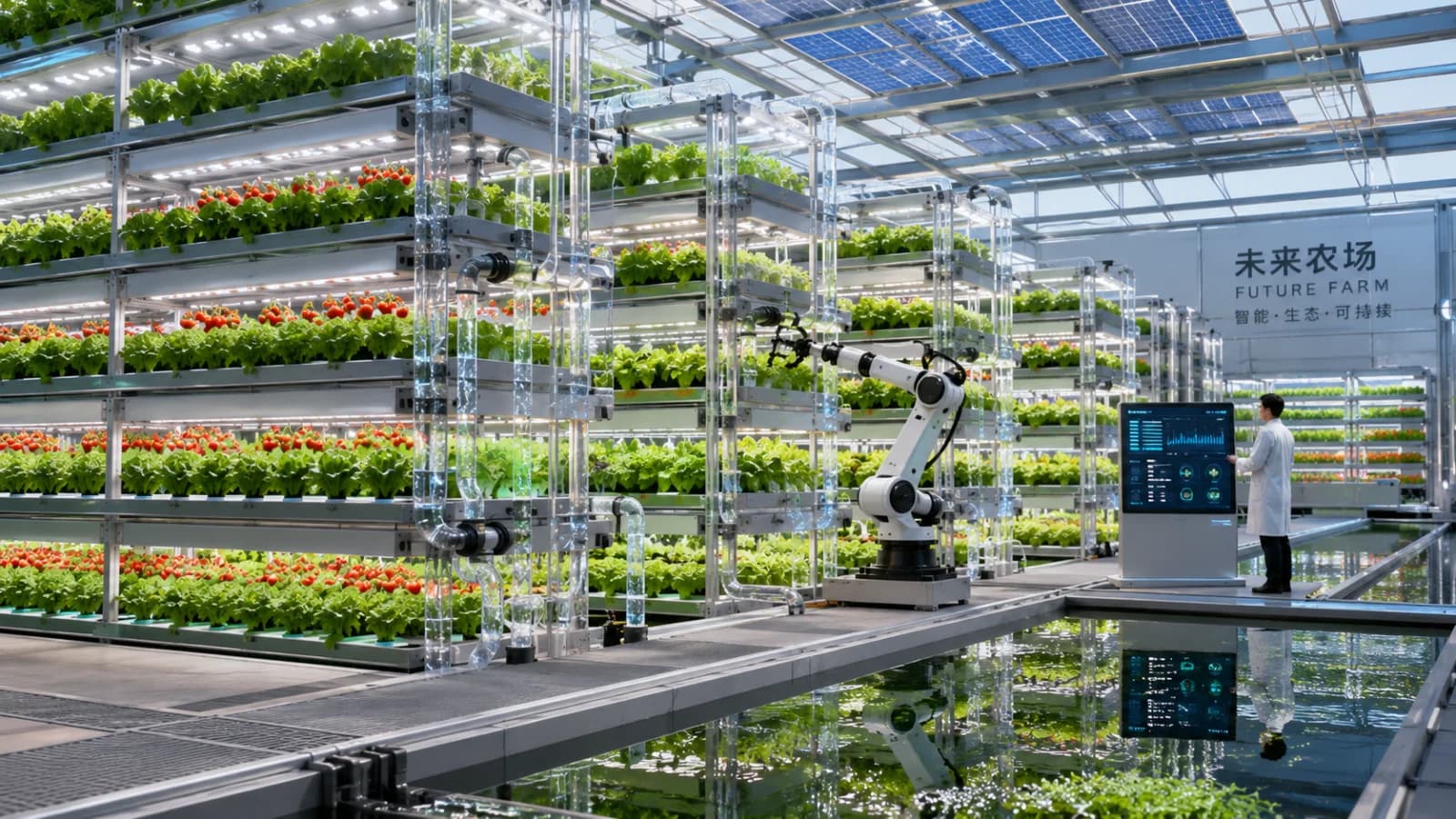
Everybody deserves access to healthy fruits and vegetables, and we have to figure out how to grow more food with less resources. For us, it's how do we use modern technology but put nature first.” – Jackie Roberts
The global food system is facing a polycrisis: depleted aquifers, collapsing topsoil, and climate-driven weather events that wipe out harvests with terrifying regularity. As Jackie warns, “It is now. It's not the future. We need to be doing this now.”
While the popular narrative often fixates on a single “vertical farming” archetype, the reality is a mosaic of hyper-local strategies. Each nation is deploying AI, robotics, and closed-loop systems according to its own geography, water availability, and economic capacity. Here is how eight major players—China, Israel, the broader Middle East, Brazil, India, the United States, Spain, and the Netherlands—are leading the charge, each with a distinct playbook.
1. China: The AI-Powered "Plant Factory" Superpower
China is not just building indoor farms—it is building national food fortresses. With only 7% of the world's arable land to feed 1.4 billion people, the Chinese government has made vertical farming a pillar of its "Digital Agriculture" strategy.
The Latest Verified Tech:
AI-Driven Crop Morphing: In facilities like the Beijing Vertical Farm (operated by AgriGarden), computer vision systems monitor every leaf in real time. Algorithms adjust LED spectrums—shifting from blue to far-red light—to manipulate plant genetics on the fly, forcing lettuce to produce sweeter, crunchier, and denser leaves in half the normal growth cycle.
5G + Robotic Harvesting: Shanghai’s high-tech greenhouses now deploy collaborative robots with 3D depth sensors. These robots identify ripe produce, snip it with precision shears, and pack it—all without human touch, operating 24/7.
Solar-Symbiotic Greenhouses: Companies like Tongwei and Midea have integrated massive rooftop solar arrays directly into their vertical farms. They generate their own power, slashing the single largest operational cost (electricity) and making their operations carbon-negative.
Scale: China currently operates over 200 commercial-scale "plant factories" —more than any other nation—and has committed billions in state subsidies to build 1,000 more by 2030, specifically targeting urban peripheries to cut food-miles.
The Strategy: Food sovereignty. China is insulating itself from global grain and vegetable price shocks, ensuring that even in a global crisis, its cities remain fed.
2. Israel: The Desert Agri-Tech Pioneer
Israel is a global anomaly: a country with 60% desert, chronic water shortages, and yet it produces 95% of its own food and exports high-value produce to Europe. The secret is not indoor farming per se—it is precision agriculture that has been perfected over decades. Today, Israel is merging its legendary irrigation expertise with AI, robotics, and closed-environment systems.
The Latest Verified Tech:
Drip Hydroponics & Aeroponics: Israel’s flagship innovation—drip irrigation—has evolved into closed-loop hydroponic and aeroponic systems. Companies like Vertical Field deploy "green walls" in urban centres, using nutrient mist (aeroponics) that reduces water use by up to 90% compared to traditional hydroponics. These walls are now installed in hospitals, hotels, and even military bases.
AI-Driven Fertigation: Israeli startups like Prospera use computer vision and machine learning to monitor every plant’s water and nutrient levels in real time, adjusting fertigation down to the individual plant.
Desalination-Powered Greenhouses: Israel leads in desalination. New facilities combine solar-powered desalination with high-tech greenhouse climate control, enabling year-round tomato and pepper production.
Bio-Sensors & Pest Control: Startups like CropX use soil-moisture sensors and AI to predict disease outbreaks and deploy biological control agents at precisely the right time.
The Strategy: Maximize yield per drop. Israel exports its ag-tech knowledge globally, positioning itself as a R&D hub.
3. The Middle East (UAE, Saudi Arabia): Farming the Desert with Solar
The broader Middle East has the most acute water scarcity on Earth. Countries like the UAE and Saudi Arabia are turning to indoor farming as a matter of existential survival.
The Latest Verified Tech:
Solar-Powered Vertical Deserts: In the UAE, Pure Harvest Smart Farms and Madar Farms run entirely on solar panels, using closed-loop hydroponics that recapture 99% of their irrigation water. Desalinated seawater is the input, but solar offsets the energy cost.
High-Value Crop Focus: Strawberries, cherry tomatoes, and specialty herbs justify the high upfront costs.
AI for Climate Control: Saudi Arabia’s Makkah Greenhouses use AI algorithms to predict temperature fluctuations and pre-emptively adjust shading, ventilation, and misting.
The Strategy: De-risk food imports. The UAE imports 90% of its food; Saudi aims to produce 50% of its fresh produce domestically by 2030.
4. Brazil: The Tropical Greenhouse Tech Revolution
Brazil faces a paradox: massive land, yet severe climate volatility and pressure to stop deforestation. Its indoor farming is about high-tech, semi-controlled greenhouses that protect crops from extreme heat and pests.
The Latest Verified Tech:
LED Cooling + Passive Ventilation: Startups like Biotrop and Tecnoplant use high-efficiency LEDs with evaporative cooling pads, allowing heat-sensitive crops during the scorching summer.
Biopesticide Integration: AI-powered pheromone dispensers release natural predators at exact times, eliminating chemical pesticides.
Agrivoltaic Canopies: Semi-transparent solar panels over greenhouses generate electricity and diffuse harsh sun, reducing cooling costs by up to 30%.
The Strategy: Reduce the deforestation footprint. Intensify yields indoors to meet export demands without expanding into the Amazon.
5. India: The Low-Cost, High-Impact "Frugal Innovation" Model
India faces a massive population, monsoon variability, and limited capital. It pioneers ultra-cheap, decentralized indoor farming for smallholder farmers.
The Latest Verified Tech:
The "Container-in-a-Box" Revolution: Kheyti offers modular greenhouse kits costing $500–$2,000, using solar misting systems that reduce water usage by 98%. Over 5,000 farmers now use them.
Solar + Aeroponics for Urban Clusters: Terra Greens in Bengaluru uses rooftop aeroponic towers with gravity-fed nutrient dosing—no pumps, no electricity—growing over 100,000 heads of lettuce monthly.
AI on a Budget: Machine learning models on smartphones send SMS alerts for pH and nutrients, avoiding expensive sensors.
The Strategy: Climate-proof the rural economy. Decentralized, democratized tech protects farmers and reduces food waste.
6. United States: The Venture-Backed Innovation Lab
The US is the global epicenter of venture capital and cutting-edge R&D in indoor farming, with aggressive private-sector innovation.
The Latest Verified Tech:
Closed-Loop Water Systems: AppHarvest in Kentucky captures rainwater, stores it, and uses sensors to deliver only what plants need—95% less water than field farming.
AI + Robotics for Logistics: Plenty and Bowery use AI to model plant growth and robotic arms for transplanting and harvesting. Plenty’s "digital twin" simulates thousands of growth scenarios daily.
LED Energy Innovations: US firms like Fluence achieve over 3.5 µmol/J—a 50% improvement in five years—with smart dimming to match sunlight.
Educational Integration: Schools like Carter G. Woodson Academy turn shipping containers into teaching labs for agri-tech.
The Strategy: Build resilient local food hubs within 100 miles of major cities to reduce emissions and offset Western drought vulnerability.
7. Spain: The European Greenhouse Powerhouse
Spain’s Almería region has the largest concentration of greenhouses on Earth—over 40,000 hectares. It is retrofitting this network with high-tech innovations.
The Latest Verified Tech:
Desalinated Water + Recirculation: New greenhouse systems use closed-loop drainage recapture, cutting water consumption by 40% compared to traditional Mediterranean farming.
Biological Pest Control: Spain deploys predatory insects bred in on-site bio-factories, guided by AI monitoring.
Solar-Powered Climate Control: Replacing fossil-fuel heaters with biomass boilers and solar thermal collectors extends growing seasons.
Smart Ventilation & Shading: Automated weather stations adjust vents and shade screens in real time, minimizing electricity use.
The Strategy: Maintain European market dominance. Spain supplies 30% of Europe’s fresh vegetables and meets EU "Farm to Fork" sustainability targets.
8. The Netherlands: The High-Tech Greenhouse Capital of the World
The Netherlands is a small, densely populated country with limited land, yet it is the second-largest exporter of agricultural products globally (after the US). This miracle is built on decades of innovation in controlled-environment agriculture (CEA). The Dutch have turned their greenhouses into highly efficient, data-driven food factories.
The Latest Verified Tech:
Closed-Loop Water & Nutrient Systems: Dutch greenhouses use recirculating hydroponics that capture and filter 100% of drainage water. Nutrients are reused, and water consumption is reduced by up to 90% compared to open-field farming. This is standard in the renowned Westland region.
LED + High-Pressure Sodium Hybrid Lighting: The Netherlands pioneered the use of supplemental lighting. Today, top facilities combine energy-efficient LEDs with high-pressure sodium (HPS) lamps for optimal light spectrum and heat generation, controlled by AI that adjusts intensity based on outside sunlight and crop stage.
CO₂ Enrichment: Dutch greenhouses inject concentrated CO₂ (captured from local industrial plants or produced via natural gas boilers) into the air to boost photosynthesis. This increases yields by up to 30% and is precisely dosed using real-time sensors.
Geothermal & Solar Energy: Many large greenhouse complexes, like those in Greenport Venlo, use geothermal heat from deep underground to warm the facilities in winter, while rooftop solar panels supply electricity for lighting and ventilation. Some even use thermal storage in aquifers to balance seasonal heating and cooling.
AI-Driven Climate Computers: Every Dutch greenhouse is controlled by a central "climate computer" (e.g., from Priva or Ridder) that integrates hundreds of sensors—temperature, humidity, CO₂, light, leaf temperature, and even plant sap flow. Machine learning algorithms optimize all parameters simultaneously, achieving unprecedented yields per square metre—often 10–20 times higher than open field.
Mobile Robotics & Harvesting: Startups like Metazet and Bom Group have developed autonomous carts that move along rails, harvesting vine crops (tomatoes, cucumbers) with computer vision and soft grippers, reducing labour costs and improving precision.
The Strategy: Export excellence through efficiency. The Netherlands does not aim for self-sufficiency alone—it exports 75% of its greenhouse produce. Its strategy is to be the world's "Agri-Tech Silicon Valley" , selling not just produce but also the technology, seeds, and expertise to other nations. Dutch companies are now building turnkey greenhouses in China, the US, and the UAE, exporting their knowledge as a service.
The Global Bottom Line: A Multi-Pronged Race
These eight regions are not competing on the same playing field—they are solving completely different problems with completely different tools, each tailored to its own geography, climate, and economy.
China, facing severe land scarcity and a massive population, is betting on AI-driven robotic factories and 5G-connected plant factories, all backed by state subsidies—its strategy is absolute food sovereignty, insulating itself from global price shocks.
Israel, living in extreme desert with chronic water scarcity, has turned drip irrigation into a high-tech export: aeroponics, AI-driven fertigation, and desalination-powered greenhouses. Its goal is both self-sufficiency and becoming a global R&D hub for ag-tech.
The Middle East (UAE and Saudi Arabia), where water is scarcer than oil, is building solar-powered vertical deserts with closed-loop hydroponics that recapture 99% of every drop—its strategy is import substitution, aiming to produce half its own fresh food by 2030.
Brazil, blessed with land but cursed with heat, drought, and deforestation pressure, is deploying solar canopies and LED cooling in semi-controlled greenhouses to grow high-value exports—its strategy is export density, doing more on less land to protect the Amazon.
India, where monsoon volatility and poverty collide, is pioneering ultra-cheap, low-tech solutions: container‑in‑a‑box greenhouses for $500 and SMS-based AI alerts—its strategy is rural resilience, democratizing climate-proof farming for millions of smallholders.
The United States, battered by Western drought and obsessed with food‑miles, is using venture‑backed robotics, digital twins, and smart LED systems to build hyper‑local food hubs within 100 miles of cities—its strategy is distributed resilience, cutting transport and water waste.
Spain, facing water shortages and strict EU sustainability rules, is retrofitting its vast Almería greenhouse network with desalination, biological pest control, and solar‑thermal heating—its strategy is export sustainability, keeping its 30% share of Europe’s vegetables while meeting green regulations.
And the Netherlands, with limited land and high energy costs, has become the undisputed master of controlled‑environment agriculture: geothermal heating, CO₂ enrichment, AI climate computers, and recirculating hydroponics that achieve 10–20 times the yield of open fields—its strategy is to be the world’s ag‑tech exporter, selling both produce and knowledge.
Yet beneath this dazzling diversity, one philosophy unites them all: “We have to now plant that seed with young people to think of careers and futures inside of a pathway of farming that didn't exist 10 years ago.” In China, that means AI agronomy degrees; in India, rural entrepreneurship; in the UAE, high‑tech horticulture engineers; in Israel, precision agronomists; in the US, coding and biology; in Spain, precision agronomy; and in the Netherlands, entire university curricula in greenhouse engineering and climate modelling. The tools vary—but the mission is one: grow more food, with less, for a hotter, drier world.
Conclusion: The Relentless Imperative
“Innovate or die. We're on this finite planet, this rock that's flying around a sun called planet Earth, and it's burning. We can either use technology and innovate, or we can see things crumble around us.”
The indoor farming revolution is not a Western fad. It is a global survival toolkit, customized to the specific geology, climate, and economics of each nation. China builds massive AI factories. Israel turns desert into farmland with micro-precision. The Middle East builds solar-powered oases. Brazil builds climate-smart greenhouses. India builds affordable, farmer-owned boxes. The US builds high-tech data-driven hubs. Spain retrofits its vast greenhouse network. And the Netherlands—the quiet giant—builds the most efficient, technologically advanced greenhouses on the planet, exporting both food and know-how to the world.
None of these approaches is "better" than the others. But together, they represent the most profound shift in human agriculture since the Green Revolution—a shift where water is no longer wasted, land is no longer destroyed, and every citizen, from Shanghai to rural Gujarat, from California to Almería to Rotterdam, has access to the food they deserve.
The technology is verified. The capital is flowing. The only question is speed.