

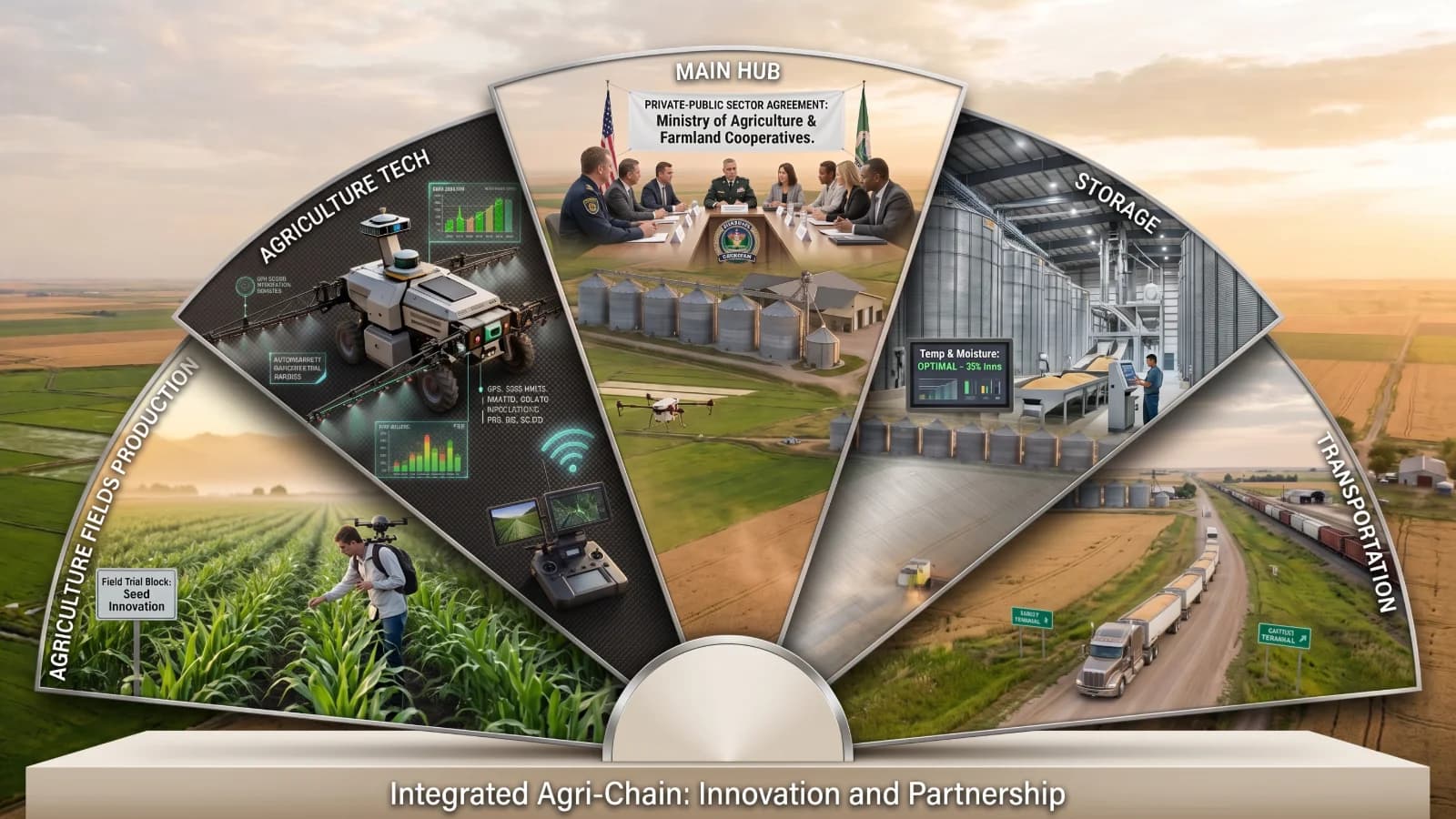
The short version: China feeds about one in six people on Earth with less than a tenth of the world's farmland. It does it with a deliberate playbook: protect farmland, grow more on it, store huge reserves, diversify imports, own its seeds, cut waste and write food security into law. Whatever your country, there are lessons here. Food is a commodity, but it's also resilience, stability and power.
Most of us only think about food security when the supermarket shelves are empty.
Some countries think about it every single day. China is one of them. With around 17% of the world's population but under 10% of its arable land, it has roughly 0.08 hectares of farmland per person, about a sixth of what the United States has [CSIS–Brookings, Mar 2024]. Feeding that many people from that little land is one of the great logistical challenges on Earth.
China's answer has been to treat food not as a market that takes care of itself, but as strategic infrastructure, like energy or defence. This article looks at how that works, what other countries do differently, and what it means for leaders, professionals and young people everywhere.
This piece steers clear of politics. It's about a question every nation, business and family eventually faces: what happens if the food stops coming?
Three things most people miss:
Food security is often feed security. A big share of what countries import isn't eaten by people directly. It feeds the animals that become meat.
The cheapest new farmland already exists. It's hidden in food that gets wasted and in the gap between average farms and the best ones.
Food power comes in more than one form. Storing well, buying from many places and being a trusted exporter are all forms of power.
1. Food Security, Without the Mumbo Jumbo
Food security simply means everyone, at all times, can get enough safe and nutritious food. The UN's Food and Agriculture Organization breaks it into four everyday questions:
Is there enough food? (availability)
Can people afford and reach it? (access)
Is it nutritious and safe? (utilisation)
Will it still be there next month and next year? (stability)
A country can be rich and still insecure if it depends on a few suppliers or shipping routes. A country can grow lots of food and still have hungry people if they can't afford it.
Jargon buster
Arable land: land that can be used to grow crops.
Self-sufficiency: the share of food a country produces for itself.
Strategic reserves: stockpiles of grain and other foods held for emergencies.
Germplasm: the genetic material of plants and animals, the raw material for breeding better seeds.
Food loss and waste: food that's lost on the way from farm to shop, or thrown away by shops and households.
Yield: how much food is produced per hectare.
2. China's Playbook: Seven Moves
Move 1: Draw a red line around farmland
China has set a minimum of 1.8 billion mu (about 120 million hectares) of arable land that must be protected, known as the farmland "red line" [CSIS–Brookings, Mar 2024]. As cities and industry expand, every hectare built on must be replaced elsewhere. The catch: reclaimed land is often less productive than the land it replaces [CSIS–Brookings, Mar 2024].
Move 2: Grow more on the same land
China harvested a record 714.88 million tonnes of grain in 2025, up 1.2% on the year before [Gov.cn, Dec 2025]. A long-running program to build "high-standard farmland", with better irrigation, drainage and soil, aims to lift yields and protect harvests against floods and droughts [CSIS–Brookings, Mar 2024].
Move 3: Store food like a central bank stores gold
China holds the world's largest grain reserves. US Department of Agriculture estimates for 2022 put China's share of global stocks at about 69% of corn, 60% of rice and 51% of wheat [CSIS–Brookings, Mar 2024].
Aha moment: a single country with under a fifth of the world's people was estimated to hold more than half of the world's stored wheat and rice. Reserves are China's shock absorber against bad harvests, price spikes and supply disruptions.
Move 4: Import smartly, and from many places
China is the world's biggest food importer, spending a record US$98.3 billion on agricultural imports in 2022 [CSIS–Brookings, Mar 2024]. Its biggest import is soybeans, mainly to feed pigs and poultry. In the first nine months of 2025, China imported about 86 million tonnes of soybeans, with Brazil supplying close to 90% [Datamar News, Oct 2025].
Aha moment: much of China's food security is really animal-feed security. Soybeans grown in Brazil end up as pork and chicken on dinner tables in China.
Move 5: Own the seeds
Seeds are often called the "chips" of agriculture: small, high-tech and decisive. China revised its Seed Law in 2021 to strengthen protection for new plant varieties, and invests heavily in seed research and breeding [CSIS–Brookings, Mar 2024].
Move 6: Waste less
Around 27% of food in China was lost or wasted between 2014 and 2018, according to research cited by CSIS and Brookings. The response included a "Clean Your Plate" campaign in 2020 and an Anti-Food Waste Law in 2021 [CSIS–Brookings, Mar 2024].
Aha moment: cutting waste is the cheapest farmland there is. Every tonne not wasted is a tonne that didn't need land, water, fertiliser or a ship to arrive.
Move 7: Make it law, and modernise how food is produced
China's Food Security Law took effect on 1 June 2024. It protects farmland from being converted to other uses, protects seed genetic resources, targets lower grain losses, and requires a national grain emergency plan and monitoring system [World Grain, Jun 2024].
Production is modernising too. In Ezhou, in Hubei province, two 26-storey buildings house a pig-farming operation designed to produce about 1.2 million pigs a year [South China Morning Post, Jul 2024]. It's farming, reimagined as vertical industry.
Enjoying this? Get the next one free. IE Weekly Insights explains one big shift every week, the dots most people miss and the events worth your time. Subscribe on industryevents.com.
3. Why It Matters: Your Plate, Your Country, Your Planet
To you. Food prices respond to weather, energy costs, shipping, currency moves and global demand. When a big buyer stockpiles or a major exporter has a bad harvest, prices can move everywhere.
To your country. Every nation has to choose its mix: grow, store, import or innovate. Too much dependence on one source creates risk; too much self-sufficiency can be expensive and hard on land and water. The right balance depends on geography, money and climate.
To the world. About 673 million people faced hunger in 2024, around 8.2% of humanity. Hunger fell in Asia and Latin America, but rose in Africa (to about 307 million people) and Western Asia [FAO, Jul 2025]. The UN projects 512 million people could still be chronically undernourished by 2030, almost 60% of them in Africa [FAO, Jul 2025]. How big buyers manage their food systems affects global prices and availability for everyone.
4. How Other Countries Play the Food Game
There's no single "right" model. Each country plays to its geography.
Singapore: the import specialist. A small city-state that produces less than 10% of its own food. It set a "30 by 30" goal to produce 30% of its nutritional needs locally by 2030, using high-tech farms, but put the goal under review in 2025 because of higher costs, weaker investment and energy price uncertainty [Eco-Business, Mar 2025]. Lesson: technology helps, but economics still rule.
The Gulf states: buying resilience. The GCC imports more than 85% of its food, including virtually all its rice and more than 90% of its cereals. Governments invest in strategic reserves, multiple suppliers, selected local production such as dairy and poultry, and logistics [Simon-Kucher, Apr 2026]. Lesson: if you can't grow it, secure the supply chain.
Japan: the careful importer. Japan produces only about 38% of its food on a calorie basis and has struggled to lift that rate towards its targets [Reuters via Investing.com, Oct 2025]. Lesson: rich, advanced countries can still be heavily import-dependent.
Australia: the food bowl. Australia exports around 70% of its agricultural, fisheries and forestry production, including about 78% of its wheat and 75% of its beef and veal [ABARES, 2025]. Lesson: being a reliable exporter is its own kind of food power, and makes Australia a key partner for import-dependent countries.
Brazil and the Americas: the world's pantry. Brazil supplies most of China's soybeans [Datamar News, Oct 2025] and is one of the world's agricultural superpowers.
Africa: the biggest challenge and the biggest opportunity. Africa has the fastest-rising hunger [FAO, Jul 2025], but also vast farmland, young populations and huge room to raise yields.
The pattern: China builds a fortress (land, reserves, seeds and law), Singapore and the Gulf build a network (imports, logistics and technology), Japan balances, Australia and Brazil feed others, and Africa is the frontier where the next big gains could happen.
5. The Toolkit: How to Grow More, and Better, Food
Here's the good news. Most of the world doesn't need a miracle to grow more food. It needs to use what already works, more widely. Researchers estimate that closing "yield gaps", meaning the difference between what farmers harvest today and what they could harvest with good water and nutrient management, could raise production by 45% to 70% for most crops [Mueller et al., Nature, 2012].
Aha moment: the world's biggest untapped farmland isn't new land. It's the gap between average farms and good farms.
Two words matter here. Yield is how much you harvest from each hectare. Quality is what that harvest is worth: its taste, nutrition, safety, size, shelf life and price. The best tools lift both.
1. Start with the soil
Healthy soil is the foundation everything else stands on. Farmers improve it by:
Testing the soil before they plant, so they know what's missing instead of guessing.
Rotating crops, for example following wheat with legumes such as chickpeas or lentils, which add nitrogen naturally and break pest and disease cycles.
Growing cover crops between seasons to protect bare soil from wind and rain and add organic matter.
Reduced or no-till farming, which disturbs the soil less, keeps moisture in and protects soil structure.
Simple version: treat soil like a savings account. Keep adding to it, and it pays you back every season.
2. Feed the crop precisely: the "4Rs"
Fertiliser works best when farmers use the right source, right rate, right time and right place. Too little starves the crop; too much wastes money and can wash into rivers. A common trick: split nitrogen into several smaller doses timed to the crop's growth, instead of one big dose. Same bag of fertiliser, more grain.
3. Make every drop count
How water reaches the plant changes everything. The FAO's indicative field efficiencies are about 60% for surface (flood or furrow) irrigation, 75% for sprinklers and 90% for drip irrigation [FAO, Irrigation Water Management]. Drip delivers water, and often fertiliser too ("fertigation"), straight to the roots.
Aha moment: moving from flooding a field to drip can cut the water lost before it reaches the plant from about 40% to about 10%. In a drying world, water efficiency is food security.
4. Better seeds
Seeds set the ceiling on what a farm can achieve.
Hybrids: crossing two parent lines produces more vigorous plants. Hybrid rice yields about 15% to 20% or more than the best conventionally bred varieties [FAO, Hybrid Rice for Food Security].
Marker-assisted breeding: scientists read a plant's DNA to find useful traits (drought or disease tolerance) early, cutting years off breeding programs.
Gene editing: tools such as CRISPR make precise changes to a plant's own genes. In 2021 a gene-edited tomato with higher levels of GABA, a naturally occurring compound, went on sale in Japan, one of the first gene-edited foods sold to consumers anywhere [ISAAA, 2021]. Rules on gene editing differ by country, so check local regulation.
Climate-ready varieties: crops bred to tolerate heat, drought, flooding or salty soil keep harvests steady in bad years, which matters as much as a record year.
Biofortification: breeding staple crops with more vitamins and minerals, so better nutrition comes "built in" rather than added later.
This is why China, and many other countries, treat seeds as strategic (see Move 5).
5. Precision agriculture: farming by data
Instead of treating a whole field the same, precision agriculture treats each part of it according to what it needs.
GPS auto-steer guides tractors to within a few centimetres, reducing overlaps, fuel and wasted inputs.
Variable-rate application spreads more seed or fertiliser where the soil can use it, and less where it can't.
Yield maps from harvesters show exactly which parts of a paddock perform, and which don't.
Drones and satellites spot crop stress, pests and water shortages, often before they're visible from the ground.
Soil-moisture sensors tell farmers when to irrigate, not just how much.
AI advisory apps bring weather, pest alerts and planting advice to smallholders through a basic smartphone.
Simple version: the farm stops guessing and starts measuring.
6. Protect the crop, smartly
Integrated pest management (IPM) combines monitoring, natural predators, resistant varieties, crop rotation and targeted spraying only when needed. Biologicals, such as beneficial microbes (biofertilisers), natural pest controls (biopesticides) and biostimulants, are a growing market that works alongside conventional chemistry rather than replacing it.
7. Control the environment
Greenhouses and protected cropping shield crops from weather, pests and hail, and can produce several harvests a year with high, consistent quality. Vertical farms stack crops indoors under LED lights, using little land and water. The trade-off is energy cost, which is why vertical farming works best today for high-value leafy greens and herbs, not wheat or rice. Singapore's experience (Section 4) shows why the economics matter.
8. Machines and robots
Mechanisation lets fewer people farm more land on time, and timing matters: planting or harvesting a week late can cost real yield. The next wave is robotics: robotic weeders, fruit-picking robots and autonomous tractors, driven partly by ageing farm workforces in many countries.
9. Save what you've grown: post-harvest
A harvest isn't food security until it reaches a plate.
Proper drying stops mould and toxins forming in grain.
Hermetic (airtight) storage bags, such as PICS bags, starve insects of oxygen without chemicals. Studies of maize stored for eight months found they preserved grain quality as well as or better than ordinary woven bags [Williams et al., PLOS ONE, 2017].
Cold chains, refrigerated storage and transport, keep fruit, vegetables, meat and dairy fresh from farm to shop.
Aha moment: a low-cost airtight bag can protect a smallholder's harvest from insects without chemicals. Sometimes the most powerful food technology costs less than a meal out.
10. Prove the quality
Buyers pay more for food they can trust. Grading and sorting (increasingly with cameras and AI), traceability systems that track food from farm to fork, and food-safety certification turn good produce into premium, export-ready produce. Quality is where farmers capture more of the price.
Putting it together
No single tool wins. The farms and countries that get ahead stack them: healthy soil + the right seed + precise water and nutrients + data to guide decisions + good storage. Each layer lifts the next. Notice how closely this matches China's playbook: high-standard farmland, seeds, modernisation and less waste.
The executive takeaway: the growth in food is shifting from more land to more output per hectare, per drop and per kilogram of fertiliser. The companies that win will sell productivity: better seed, smarter inputs, data, water efficiency and storage. If your business touches any of these, you're in the food-security business whether you call it that or not.
6. Connecting the Dots: Food Is an Energy, Shipping and Data Story
Direct industries: agriculture, food processing, grain trading, storage and logistics, retail. Indirect industries: energy, fertiliser, chemicals, shipping, water, insurance, finance, technology. Enabling technologies: satellites, AI, genetics, precision farming, cold chains, robotics.
Energy is in every meal. Natural gas makes nitrogen fertiliser, diesel runs tractors and trucks, and electricity runs cold chains. Energy shocks quickly become food shocks. (See our Insight "Gas, Fertiliser and Food Security".)
Shipping lanes are food lanes. Grain, soybeans and fertiliser move by sea. When major shipping routes are disrupted, food prices feel it. (See "The Hidden Highways of Energy".)
Satellites watch the crops. Earth-observation satellites track crop health, drought and harvests worldwide, helping farmers, traders and governments act early. (See "Look Up: How Satellites Quietly Run Your Day".)
Pork depends on Brazil. Animal feed links meat prices in Asia to harvests in South America [Datamar News, Oct 2025].
The non-obvious one: waste is a security issue. Reducing food loss strengthens food security as surely as new farmland does, and costs far less [CSIS–Brookings, Mar 2024].
7. 2030: What the World Looks Like
These are directional outlooks, not dated forecasts.
China: continued focus on high grain output, protected farmland, reserves, seed technology and diversified imports.
USA: a major exporter facing more competition from South America for big buyers.
Europe: balancing farm productivity with environmental rules and climate pressures.
Middle East: heavier investment in reserves, logistics, controlled-environment farming and overseas partnerships.
Africa: the region where hunger is projected to be highest [FAO, Jul 2025], and where better seeds, storage, irrigation and finance could transform output.
South America: an ever-larger role as the world's pantry, especially for soybeans and meat.
Asia-Pacific (including Australia and India): Australia remains a key reliable exporter; Southeast Asia invests in resilient supply; India balances a huge population with food stocks and exports.
Three scenarios:
Base case: steady trade, slowly rising yields and more investment in storage and technology.
Upside: technology, better seeds and less waste lift output faster than demand, easing prices and hunger.
Downside: climate shocks, conflicts and trade disruptions hit several breadbaskets at once, pushing up prices and hunger.
8. Investment and Growth: Where the Money Is Moving
Storage and cold chains: silos, warehouses, refrigerated transport and monitoring to cut loss.
Seeds and genetics: higher-yield, drought- and heat-tolerant varieties.
Precision farming: sensors, satellites, drones and AI to use less water and fertiliser.
Water efficiency: drip irrigation, soil-moisture monitoring and water recycling.
Soil health and biologicals: soil testing, biofertilisers, biostimulants and biological pest control.
Controlled-environment farming: vertical farms, greenhouses and modern livestock systems, where energy costs allow.
Food waste solutions: better packaging, demand forecasting and redistribution.
Alternative proteins and aquaculture: new sources of protein beyond traditional livestock.
Logistics and trade: ports, shipping and digital trade platforms for food and fertiliser.
Questions to ask (not financial advice): Does the business reduce risk for buyers or governments? How exposed is it to energy, water and climate shocks? Does it depend on subsidies or policy that could change? Can it scale in markets where food demand is growing fastest?
9. Challenges and Blockers: What Could Go Wrong
Climate change: heat, drought and floods threaten harvests worldwide.
Water: many farming regions face falling groundwater and competing demands.
Ageing farmers: in China and many other countries, farmers are getting older and young people are leaving rural areas [CSIS–Brookings, Mar 2024].
Soil health: intensive farming can degrade soil over time.
Cost of self-sufficiency: producing everything at home can be expensive and inefficient compared with trade.
Dependence on a few suppliers: concentrating imports from one or two countries creates risk, even when trade relations are good.
Waste: large shares of food are still lost before reaching plates [CSIS–Brookings, Mar 2024].
The sceptic's case: stockpiling and self-sufficiency are expensive and distort global markets. Open trade is the cheapest way to feed the world.
Our answer: open trade does feed the world efficiently in normal times. But the last few years of pandemic, conflict and climate shocks have shown that normal times can end suddenly. The smartest strategies combine both: trade for efficiency, and reserves, diverse suppliers and local capacity for resilience.
10. Skills and Careers: How to Get Involved and Thrive
Food is one of the largest employers on Earth, and it's becoming more scientific, digital and global.
Where the jobs are
On the farm: farm managers, agronomists, livestock specialists, machinery and drone operators, precision-agriculture technicians and irrigation specialists.
In the lab: plant breeders, geneticists, soil scientists, food scientists and animal-health specialists.
In the data: agricultural data analysts, remote-sensing specialists and AI developers for farming.
In the supply chain: grain traders, logistics and cold-chain managers, port and warehouse operators, quality inspectors.
In policy and finance: food-security analysts, commodity analysts, agricultural lenders, insurers and policy advisers.
In new food: vertical-farm engineers, aquaculture specialists and alternative-protein developers.
Skills that matter
Human skills: systems thinking (food links energy, water, climate and trade), problem-solving under uncertainty, collaboration with farmers and communities, cross-cultural communication for global trade, and a long-term mindset.
Technical skills: agronomy and biology, data analysis, GIS and satellite data, supply-chain management, engineering for storage and cold chains, and commodity market literacy.
Pathways
Agricultural science, food science, engineering and environmental degrees; vocational training in farming, machinery and logistics; and moves from tech, finance, logistics and energy, all of which have skills the food system needs.
Getting in the room
Food and agriculture events bring together farmers, traders, technologists, investors and policymakers. Pick one area (agtech, food processing, trade or storage), bring three questions (What's your biggest risk? What technology are you adopting? Which skills are hardest to hire?), and follow up within 48 hours. Food and beverage expos and agri-food summits are listed on Industry Events.
Author's Vision and Predictions
These are forecasts, not facts.
Food will be treated like energy: more countries will build strategic reserves and national food-security strategies.
"Friend-sourcing" of food will grow, with long-term supply partnerships replacing one-off purchases.
Reducing waste will become a major industry, from smart storage to AI demand forecasting.
Seeds and genetics will become strategic technologies, as important to nations as chips.
Africa will be the decade's biggest agricultural growth story, if investment in seeds, storage and irrigation arrives.
Reliable exporters like Australia and Brazil will gain influence as partners for food security.
Food skills will be in short supply, especially in agronomy, agricultural data and cold-chain engineering.
What This Means for You
For Leila, the leader. Food costs reach your business whether you sell food or not: through wages, customers, logistics and energy. Resilience is the goal. Three things to do:
Map how exposed your costs and suppliers are to food, fertiliser and freight price swings.
Look at one partnership in agtech, storage or logistics that cuts risk for your customers.
Track where large importers are signing long-term supply deals. That's where demand is being locked in.
For Omar, the professional. Farming and food supply chains are going digital fast, and they need people from outside agriculture. Three things to do:
Learn how satellite, sensor and data tools are used on farms. A short online course is enough to start.
Attend one food, agri or agtech event this year.
Connect with three people in logistics, commodity trading or agtech.
For Sara, starting out. Few careers combine purpose, science, technology and global reach like food does, and the field is short of young talent. Three things to do:
Explore agricultural, food or environmental science courses, or a traineeship.
Follow one agtech company and learn what problem it solves.
Ask a farmer, food scientist or trader for a 15-minute chat.
Grow yourself. Food security starts at home. This week, plan your meals for three days, use what's already in the fridge first, and add one extra serving of vegetables or legumes a day. You'll waste less, save money and eat better. Mindset tip: small, steady habits build resilience, for countries and for people.
Get the next one free. Subscribe to IE Weekly Insights for one big shift every week, the dots most people miss and the events worth your time.
The Bottom Line
Food is the most basic form of power: the power to stay stable when the world isn't. China's answer has been to protect its land, store its harvests, own its seeds, spread its imports, waste less and make food security law. The tools to grow more and better food already exist; the real gap is how widely they're used. Other countries choose different paths, from Singapore's networks to Australia's exports. The lesson for everyone is the same: food security doesn't happen by accident. It's built, one decision at a time, long before the shelves go empty.
Explore upcoming food, beverage and agriculture events on Industry Events.
Researched with AI assistance; written and verified by IE Insights.
Sources
CSIS and Brookings, "China's Food Security: Key Challenges and Emerging Policy Responses", Mar 2024
Gov.cn (National Bureau of Statistics), China's grain output tops 714 million tonnes in 2025, Dec 2025
Datamar News, Brazil supplied nearly 90% of China's soybean imports in 2025, Oct 2025
World Grain, New China food security law takes effect, Jun 2024
South China Morning Post, Skyscraping hi-tech China swine farm produces 1.2 million pigs a year, Jul 2024
FAO, Global hunger declines, but rises in Africa and Western Asia (SOFI 2025), Jul 2025
Eco-Business, Singapore's "30 by 30" food security goal under review, Mar 2025
Simon-Kucher, GCC food security: why this challenge is different, Apr 2026
Reuters via Investing.com, Japan's food self-sufficiency stuck at 38%, Oct 2025
ABARES, Snapshot of Australian Agriculture, 2025
Mueller, N.D. et al., "Closing yield gaps through nutrient and water management", Nature, 2012
FAO, Irrigation Water Management: Irrigation Scheduling (Table 8, field application efficiency)
FAO, Hybrid Rice for Food Security (Introduction)
ISAAA Crop Biotech Update, Japan's gene-edited GABA tomato, 2021
Williams, Murdock & Baributsa, "Storage of Maize in Purdue Improved Crop Storage (PICS) Bags", PLOS ONE, 2017