

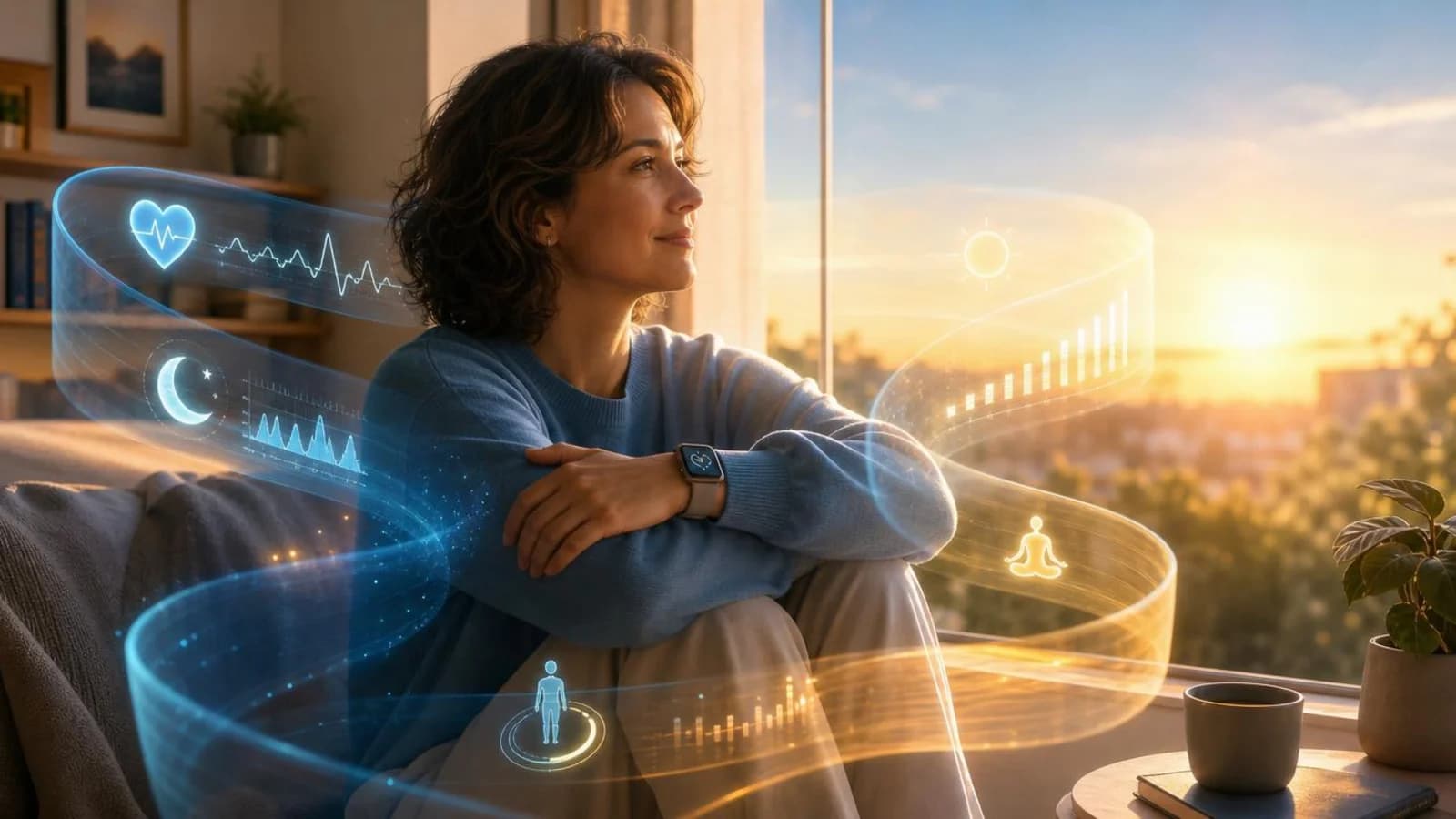
For most of modern history, medicine has run on a single rhythm. You feel unwell. You book an appointment. You get tested. A doctor reads the results. Treatment begins — after the problem has already arrived.
That model is not going away. But another one is now growing beside it, and it inverts the timing. Instead of waiting for disease to announce itself, it tries to catch the warning signs first.
This is predictive medicine: the idea that the data our bodies already produce — blood chemistry, genetics, imaging, sleep, heart rate, the ordinary patterns of a life can flag risk before it becomes crisis. It is not new as an ambition. What is new is that artificial intelligence has finally made it practical at scale.
The temptation is to look for the single breakthrough device, the app that changes everything. That is the wrong frame. The real shift is structural, and it is simpler to state than to grasp: healthcare is becoming continuous. Not a moment of contact when something feels wrong, but a signal measured, tracked, and supported over time. This isn't a far-off vision; its foundations are being built right now, with some of the most compelling and scalable innovations emerging from China.
That is a bigger change than any one product, and it is worth understanding clearly, including where it is real, and where it is still hype.
From Sick Care to Predictive Care
Modern medicine is very good at treating problems it can see. It is far weaker at the ones it cannot — and many of the most serious conditions, from heart disease and diabetes to kidney disease, cancer and dementia, develop silently for years before a symptom ever surfaces.
Predictive medicine attacks the timing of that failure. Can risk be spotted earlier? Can intervention come sooner? Can prevention be made personal, rather than generic advice handed to everyone alike?
AI matters here for one blunt reason: medicine drowns in data. Scans, lab panels, clinical notes, prescriptions, genomic sequences, wearable signals, lifestyle histories — no human can hold all of it in view at once, let alone connect it. Pattern-finding at that scale is precisely what machine learning is built for. In 2024, global venture funding for AI in healthcare reached $11 billion, a signal of the immense bet being placed on this convergence. But the real story isn't the money; it's the shift from one-off diagnostics to systems of continuous, intelligent monitoring.
The realistic future is not an AI doctor in your pocket, delivering dramatic verdicts. It is quieter and more useful than that: AI as a layer of support that helps a clinician, or a patient, notice what would otherwise have been missed.
Mapping Risk Beyond the Genome
When people hear "predictive medicine," they often think of genetic testing — the search for mutations that seal a fate written in DNA. But genes are only one part of a much larger story. For most common diseases, the biggest risk factors are not inherited mutations but the ordinary, measurable details of a life: blood pressure, blood sugar, cholesterol, inflammation markers, organ function, lifestyle, environment. This is the territory of non-genomic risk mapping, and it is where some of the most practical predictive tools are emerging.
The idea is simple to state but powerful in practice: by drawing together routine clinical data that already exists — lab results, vital signs, medical history, demographics — an algorithm can estimate the likelihood of a future event, such as a heart attack, a stroke, or the progression of chronic kidney disease, long before it happens. No expensive genetic sequencing required. The inputs are cheap, widely available, and already collected in ordinary care.
This is not theoretical. One of the most ambitious real-world deployments is underway in China. In 2021, Ping An Insurance, one of the world's largest financial and healthcare conglomerates, published a study in the Journal of Medical Internet Research detailing a deep-learning model that predicts the onset of 35 different diseases, including hypertension, diabetes, and chronic kidney disease, using only structured electronic health record data and lifestyle surveys. The system, trained on over 3 million patient records from Ping An's healthcare network, is designed not as a research paper but as an operational tool for population-wide risk stratification. The goal is to give insurers and health systems the power to identify high-risk individuals and intervene with targeted prevention programs years before a diagnosis would typically be made.
The shift is from a healthcare system that reacts to one that anticipates, and it does so using data far more mundane — and far more immediately actionable — than a genome sequence. The challenge, as always, is making sure the prediction leads to an intervention that actually helps, rather than just a warning that creates anxiety. A risk score that doesn't change care is a wasted number. But when it triggers an early medication adjustment, a targeted lifestyle program, or a more frequent screening schedule, it becomes one of the most powerful tools in medicine.
The Trends Carrying the Shift
What follows are the key trends carrying that shift — and, just as important, the ones that aren't ready yet.
AI reads scans faster than a human — and sometimes sees what a human can't.
The most mature use of AI in medicine isn't the chatbot; it's the algorithm reading your CT, X-ray, or MRI. Radiological image analysis is now the single largest category of FDA-cleared medical AI, accounting for over a quarter of all clearances. The clearest wins are in time-critical conditions. In China, this is already a reality at scale. Beijing-based Infervision has deployed its AI-assisted diagnostic system in over 2,000 hospitals across the country to read CT scans for strokes and lung nodules, serving as a tireless second reader that helps radiologists triage high-risk cases faster. A 2024 study published in The Lancet Regional Health - Western Pacific evaluating a similar AI system for stroke detection in a Chinese hospital network found it reduced the door-to-treatment time for acute stroke patients, demonstrating how integration can directly speed up critical care pathways. The tools that succeed share three traits: a narrow problem, prospective outcome data, and tight integration that puts the alert in front of the right clinician. The AI reading your scan isn't replacing the radiologist. It’s triaging the queue and catching the finding a tired eye might miss on the eightieth read of a shift.
Health assistants are getting personal.
The first wave of consumer health AI was generic: a chatbot answering questions with no idea who was asking. The next wave is connected — to records, lab results, wearable data, and history. This turns a vague question ("what does fatigue mean?") into a precise one ("what changed in my sleep, bloods, and activity this month?"). Ping An Good Doctor, one of China's largest telemedicine platforms, uses AI as a triage layer for its 200 million+ registered users. The system analyzes a patient’s symptoms and medical history from its database before a human doctor ever enters the consultation, delivering structured insights that turn a 10-minute history-taking into a more focused, efficient conversation. It is a far more powerful model. It is also a far heavier responsibility: once AI sits this close to a person's medical record, the contest is no longer won by the smartest model. It is won by the system people can trust.
Diagnostics are leaving the clinic.
Home blood collection and remote testing are moving the first step of care to where people actually live — useful for chronic-disease monitoring, screening, and medication management. Testing is the gateway to treatment; when it is inconvenient or delayed, problems are caught late. The catch is quality: home diagnostics still need reliable sampling, real lab integration, and clinician review. The future is not "do it all yourself." It is better-connected care, closer to home. The innovation lies in making this seamless and continuous, rather than a one-off event.
Robots are entering the routine, not the operating theatre.
The medical robot people imagine is a futuristic surgeon. The one arriving first is more mundane — and far more practical for strained health systems. Robotic phlebotomy systems can use ultrasound to find a vein, position the arm, and standardise blood draws, a repetitive, high-volume task made harder by staff shortages and difficult veins. The most useful medical robots may be the least dramatic ones: the machines that quietly improve consistency and ease the load on overstretched nurses and technicians.
AI scribes are fixing a pain doctors actually feel — but the evidence is more mixed than the marketing.
Clinicians spend enormous time on notes, a documented driver of burnout that steals time from patients. AI scribes listen during a consultation and turn it into structured notes, and adoption is real. The best evidence is genuinely encouraging — a 2025 Yale study of 263 physicians across six U.S. health systems found burnout fell from 51.9% to 38.8% in a single month of using one tool. But rigorous trials disagree on the headline claim. Marketing routinely cites "50% less documentation time," yet a randomized trial of 238 physicians found one leading product produced no statistically significant change in time-in-note versus usual care. The honest read: scribes reliably improve how clinicians feel and reduce after-hours "pajama time," but their effect on raw minutes is real, modest, and vendor-dependent. Patients should know when one is in use, and every note still needs a human to check it.
Wearables are becoming signal engines.
What began as step counters now track heart-rate variability, resting heart rate, sleep, respiratory rate, and skin temperature — clues to stress, recovery, and illness risk. Heart-rate variability is the most telling, a readout of the nervous system's balance. The promise is earlier detection of change. The caution is discipline: a smartwatch reading is not a diagnosis. The next step, already being researched, is turning this data into a genuine early warning system. A 2024 study published in Cell Reports Medicine by researchers from Stanford and institutions in China demonstrated that smartwatch data, when processed with AI, could predict flare-ups in chronic inflammatory diseases like rheumatoid arthritis hours before the patient felt symptoms. This is the frontier: not just tracking a metric, but interpreting a constellation of subtle physiological changes to see the future.
Longevity is getting practical.
The old story was science fiction — a magic pill, a billionaire's war on ageing. The serious version is unglamorous: prevention, metabolic health, sleep, strength, cardiovascular fitness, inflammation, biomarkers, and personalized risk reduction. AI's role is to connect those threads into a view of health that is genuinely individual. The field is thick with hype. The credible end of it is not selling immortality. It is helping people stay healthier for longer.
AI is already designing real drugs.
Finding new medicines is slow, ruinously expensive, and defined by failure — and this is where AI has moved furthest from promise to proof. In June 2025, Insilico Medicine, a company with labs in Hong Kong and mainland China, published positive Phase IIa results in Nature Medicine for rentosertib, a treatment for the fatal lung disease idiopathic pulmonary fibrosis. It was the first drug for which both the biological target and the molecule were discovered entirely using generative AI to show clinical benefit in humans. The economics are the point: the team nominated its candidate after screening 78 molecules rather than the usual thousands. This is not scientists replaced; it is scientists testing more ideas, faster, before the costly experiments begin. It may prove one of the most consequential long-term effects of AI in medicine.
The Caution Zone: Not Everything Here Is Ready
Predictive medicine is exciting, and excitement is exactly when scrutiny slips. Several ideas wearing the language of the future are not yet fit for mainstream use.
"Consumer digital twins" — a virtual model of your body predicting what happens next — sound powerful, but most products using the phrase are early, narrow, or clinically unvalidated. Smart toilets that read health signals from waste raise real privacy and dignity questions. Sensor-laden earbuds may one day qualify as medical devices; many still lack the evidence. Subscription wearables can genuinely help, until the most useful data sits locked behind a permanent fee.
The rule is not complicated. If a technology claims to predict disease, guide treatment, or stand in for a medical decision, it needs validation, governance, and accountability. In health, the cost of hype is not a bad review. It is a missed diagnosis.
The New Careers This Creates
A shift this large redraws the workforce. Predictive medicine will need people who understand health and digital systems — a combination still rare.
Some will build the tools: AI engineers, biomedical data scientists, wearable-sensor specialists, and clinical-informatics experts. Some will protect the system: privacy specialists, AI-safety reviewers, and health-data governance leads. And some will help people actually use it: digital health coaches, patient navigators, and personalized-prevention advisers.
That last group points to something easy to miss. As care becomes more digital, it also becomes more confusing — a tangle of apps, portals, wearables, results, referrals, and insurance rules. The more advanced healthcare gets, the more human guidance it seems to need, especially for older adults and anyone with chronic illness. Navigation itself is becoming a profession.
The skills underneath it all are consistent: health literacy, data literacy, AI literacy, privacy awareness, evidence-based thinking, and the plain ability to explain something complicated clearly.
Why It Matters
Strip away the devices and the drama, and predictive medicine is about one thing: the timing of care.
Earlier signals. Better prevention. More personal guidance. Less pressure on clinics. More support in the long gaps between appointments. Better-informed conversations when patient and clinician finally sit down together.
From an AI that reads a stroke scan in a Beijing hospital, to a risk model that spots future disease in routine lab work, to a smartwatch that predicts a flare-up before the pain begins, the best future is not one where AI replaces the doctor. It is one where AI helps care arrive earlier — before the appointment, before the crisis, before the disease has finished its quiet work.
Healthcare before disease strikes. That is the promise. The task now is to build it responsibly enough to keep it.
Industry Events
Artificial Intelligence Conferences Events
Healthcare & Medicine Conferences Events
------------------------------------------------------------------------------
Top 10 — Artificial Intelligence, 2026
World Summit AI Amsterdam ⭐7–8 Oct Amsterdam, Netherlands
World Summit AI Qatar ⭐16–17 Dec Riyadh, Saudi Arabia
USA AI Summit 2026 ⭐7 Nov Albany, New York, USA
AI in Healthcare & Pharma Summit ⭐18–19 Nov Boston, USA
4th Data Science & AI Summit 2026 — London ⭐1–2 Oct London, UK
The AI Forum Kenya ⭐7 Sep Nairobi, Kenya
4th Tech Summit on AI & Robotics 20–22 Aug France
2nd MedTech Meets AI 1–2 Oct Spain
ARIA 2026 — AI & Applications 22–23 Aug Dubai, UAE
PRAI 2026 — Pattern Recognition & AI 14–16 Aug Shanghai, China
Top 10 — Health & Medicine, 2026
Global Health Exhibition 2026 ⭐26–29 Oct Riyadh, Saudi Arabia
AI in Healthcare & Pharma Summit ⭐18–19 Nov Boston, USA
Intl. Conference on Precision Medicine & AI Healthcare ⭐27–28 Jul Prague, Czech Republic
8th European Congress on Infectious Diseases ⭐24–25 Sep Hungary
Global Vaccines Innovation & Immunology Conference ⭐21–23 Sep London, UK
Global Public Health & Epidemiology Congress ⭐21–23 Sep UK
2nd Intl. Cancer & Precision Oncology Conference ⭐23–25 Nov Singapore
6th World Congress on Global Healthcare & Medicine 2–3 Nov Dubai, UAE
ICIMH 2026 — Intelligent Medicine & Health13–15 NovChina10
19th Global Healthcare, Preventive Medicine & Public Health Summit8–9 Dec Malaysia