

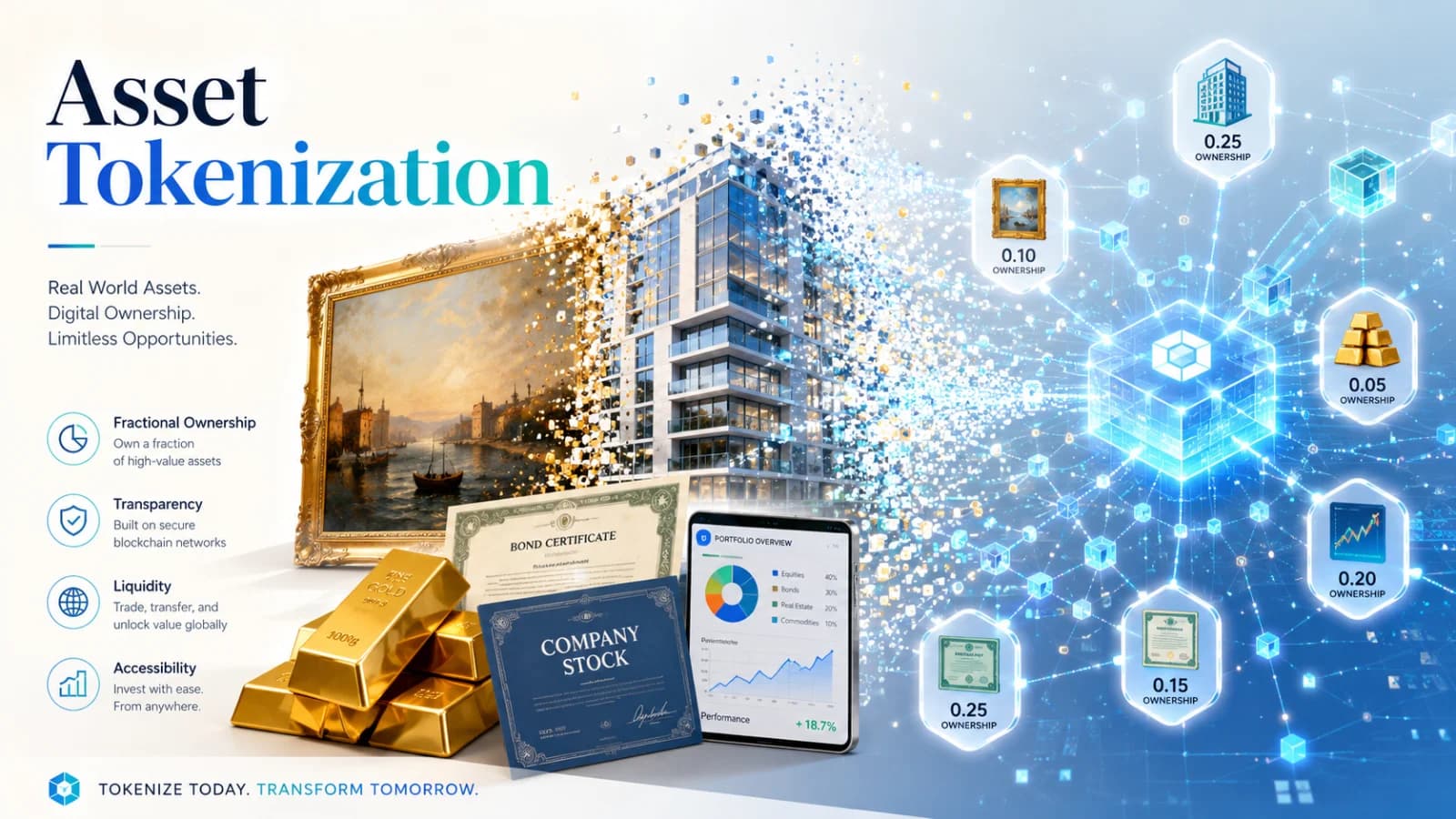
Asset tokenization is building a bridge between trillions of dollars in real-world assets and the digital speed of blockchain — opening the door to a future where opportunity is not reserved for the few, but accessible to many.
For decades, some of the most valuable investment opportunities have lived behind closed doors: commercial property, private credit, government bonds, private funds, fine art, infrastructure projects, and early access to companies before they become public.
These assets can help build wealth, but they are often difficult for everyday people to access. The problem is not a lack of ambition. It is the structure of the old system: high minimums, private networks, slow settlement, legal complexity, and layers of middlemen.
Asset tokenization could begin to change that.
It is not just a crypto trend. It is a new way of thinking about ownership, markets, and access.
1. What Asset Tokenization Means
Asset tokenization is the process of taking something valuable in the real world and representing it with a digital token on a blockchain.
That asset could be a building, a government bond, a money market fund, gold, private credit, a stock, artwork, farmland, or even royalty income from music and media.
The token can represent ownership, income rights, or exposure to the value of that asset. In simple terms:
Real-world asset + legal structure + blockchain token = tokenized asset
A skyscraper does not literally move onto a blockchain. A gold bar does not become code. Instead, the blockchain creates a digital record that can represent a claim connected to that asset.
This matters because many valuable assets are hard to divide, hard to trade, and hard for smaller investors to reach. Tokenization could make those assets more flexible by allowing ownership to be split into smaller digital units.
The big idea is not just that assets become digital.
The big idea is that ownership could become more open.
2. How It Works
The process sounds technical, but the basic structure is simple.
First, an asset is chosen. This could be a building, a fund, a bond, a gold reserve, a loan portfolio, or another valuable asset.
Second, the asset is placed into a legal structure. This is one of the most important steps. The legal structure explains what the token holder actually owns or has a claim to. Without this, the token is just a digital promise.
Third, the asset must be held, managed, or verified by a trusted party. If the token represents gold, the gold must be stored securely. If it represents real estate, the property must be managed. If it represents a fund, the fund must be properly administered.
Fourth, digital tokens are created on a blockchain. Each token represents a defined share, claim, or right connected to the real-world asset.
Fifth, smart contracts can help automate parts of the process, such as ownership transfers, compliance checks, payments, redemptions, or supply controls.
Finally, the tokens may be bought, sold, transferred, or redeemed depending on the rules of the project.
A simple example would be a building worth $10 million. Instead of one investor needing to buy the whole building, the asset could be divided into 100,000 digital tokens. Each token could represent a small economic interest in that property. If the building earns income, token holders may receive a share, depending on the legal structure.
This is the power of tokenization: it can take assets that are normally expensive, slow, and difficult to divide, and make them easier to access, track, and transfer.
But the real-world link must be strong. Blockchain can record the token, but trust still depends on legal rights, custody, audits, management, and regulation.
3. Why It Matters for Access and Opportunity
The investment world has never been completely equal.
Large institutions and wealthy investors often get access to private deals, exclusive funds, commercial real estate, and early-stage opportunities. Everyday investors usually get access much later, if they get access at all.
Tokenization could help narrow that gap.
A person may not be able to buy an office tower. But one day, they might be able to own a small tokenized share of one.
A student may not be able to enter a private fund. But tokenized structures could eventually make certain private-market products easier to reach.
A community may not be able to buy a local development outright. But tokenization could help create new models for community ownership.
That does not mean every tokenized asset is safe. It does not mean everyone will get rich. It does not mean every product should be open to every investor.
But it does create a new possibility: broader participation.
McKinsey has estimated that tokenized market capitalization across asset classes could reach around $2 trillion by 2030, excluding cryptocurrencies and stablecoins, with a wider scenario range depending on adoption.
The exact number is uncertain. The direction is not.
Tokenization is moving from a crypto experiment to a serious conversation about the future of financial infrastructure.
4. Countries and Global Players Leading the Race
Tokenization is not happening in one country only. It is becoming a global competition to build the next layer of financial markets.
United States: The U.S. is important because many of the world’s largest financial institutions, asset managers, fintech companies, and blockchain firms are based there. BlackRock launched its BUIDL fund, officially the BlackRock USD Institutional Digital Liquidity Fund, as its first tokenized fund issued on a public blockchain through Securitize. The fund invests in cash, U.S. Treasury bills, and repurchase agreements.
Singapore: Singapore has become one of the most important tokenization hubs. The Monetary Authority of Singapore’s Project Guardian supports industry trials involving tokenized funds, multiple currencies, and financial products. Singapore’s approach matters because it treats tokenization as regulated financial innovation, not just crypto speculation.
Japan: Japan is building real digital securities infrastructure. BOOSTRY, connected to Nomura-related infrastructure, has developed ibet for Fin, a consortium-type security token network in Japan operated by major Japanese financial institutions. This shows that Japan’s focus is not only crypto trading, but modernizing securities, bonds, and financial market infrastructure.
Middle East: The UAE, especially Dubai and Abu Dhabi, is positioning itself as a digital asset and tokenization hub. Dubai’s DFSA launched a Tokenisation Regulatory Sandbox to support firms exploring tokenized investment products and services in the DIFC. The Middle East has a strong opportunity because it combines capital, real estate, infrastructure ambition, and a desire to become a global financial technology center.
Europe: Europe is important because regulators are paying close attention to digital assets, tokenized securities, and investor protection. The region is likely to play a major role in shaping how tokenized stocks, funds, and market infrastructure are supervised.
The key point is that tokenization is not just being built by crypto startups. It is being explored by banks, asset managers, exchanges, fintech platforms, regulators, and blockchain networks around the world.
5. Institutional Demand, ETFs, and Market Infrastructure
The strongest signal in tokenization is not the hype. It is institutional demand.
When major financial firms explore tokenized funds, digital bonds, tokenized Treasuries, blockchain settlement, and stablecoins, it shows that the technology is moving closer to the core of finance.
BlackRock’s BUIDL fund matters because it shows how traditional cash-like products can be issued and managed on-chain. Robinhood has also launched stock tokens for EU customers and announced plans for a Layer 2 blockchain designed to support financial services and tokenized real-world assets.
ETFs are another major part of the access story.
An ETF allows investors to access an asset through a familiar brokerage account instead of buying and storing the asset directly. That matters because mainstream adoption often happens when new technology is wrapped in familiar products.
XRP ETFs, Bitcoin ETFs, Ethereum ETFs, tokenized funds, and tokenized stock products all point to the same bigger trend: digital assets are being connected to traditional financial structures.
Stablecoins are also essential. If tokenized assets are going to move quickly, investors need reliable digital money for payment and settlement. Ripple’s RLUSD is one example of a stablecoin designed to maintain a one-dollar value, issued on both XRP Ledger and Ethereum, and backed by cash and cash equivalents.
This is where the market becomes more sophisticated.
The future may not be about one blockchain winning everything. Some assets may use Ethereum. Some may use XRP Ledger. Some may use Stellar, private blockchains, Layer 2 networks, or custom systems created by banks and asset managers.
The real story is bigger than one coin.
It is about the new infrastructure of ownership, settlement, compliance, and access.
6. Uncertainty, Risks, Hype, and Scams
This is where the conversation needs to stay honest.
Tokenization is exciting, but it is not magic.
The first risk is legal risk. Investors must understand what the token actually represents. Does it represent ownership? A claim on income? A fund unit? A debt instrument? A derivative? Or only exposure to the asset’s price?
The second risk is custody risk. If the token represents a real asset, someone must protect that asset. Gold must be stored. Buildings must be managed. Loans must be serviced. Funds must be audited.
The third risk is liquidity risk. Just because something is tokenized does not mean it will be easy to sell. A token may exist on-chain but still have few buyers, few sellers, and very little trading activity. Recent research on RWA markets warns that tokenization and liquidity should be treated as different outcomes.
The fourth risk is technology risk. Smart contracts can have bugs. Wallets can be hacked. Private keys can be lost. Data feeds can fail.
The fifth risk is regulatory risk. Tokenized assets often touch securities law, tax rules, investor protection, custody standards, anti-money-laundering rules, and cross-border compliance. IOSCO has warned that tokenization can create uncertainty about whether investors own the underlying asset or only a token representing it.
The sixth risk is hype.
This may be the most dangerous risk for ordinary investors.
It is easy to hear words like “trillions,” “BlackRock,” “ETFs,” “XRP,” “stablecoins,” and “global adoption” and jump straight to price predictions. But price predictions can become dangerous when they turn a serious technology discussion into a lottery ticket.
A blockchain can be useful without its token capturing all the value.
A company can build real infrastructure without every related coin becoming a winning investment.
A bank may use stablecoins instead of volatile crypto.
An asset manager may choose Ethereum, XRP Ledger, Stellar, a private blockchain, or build its own system.
A tokenized asset may exist, but still not be liquid.
This is why scams are a serious concern. Be careful of projects that promise guaranteed returns, use fake partnerships, hide the legal structure, provide no proof of the asset, pressure people to buy quickly, or focus more on hype than transparency.
A serious tokenized asset should be able to answer basic questions:
What is the asset?
Who owns it legally?
Who holds it?
Who audits it?
What rights does the token holder have?
Can it be redeemed?
Where can it be traded?
What are the fees?
What happens if the issuer fails?
If those questions cannot be answered clearly, that is a red flag.
7. Jobs, Opportunities, and the Bigger Future
Asset tokenization will create more than investment opportunities. It will create career opportunities.
This field will need smart contract developers, blockchain security auditors, financial analysts, digital asset lawyers, compliance specialists, product managers, UX designers, data analysts, custodians, auditors, and educators.
It will also need entrepreneurs building the missing infrastructure: proof-of-reserve tools, tokenization platforms, custody systems, compliance software, investor dashboards, secondary marketplaces, and educational products.
For students and young professionals, this is a major opportunity.
The future will reward people who can connect different worlds.
Finance people who understand blockchain.
Technology people who understand regulation.
Lawyers who understand smart contracts.
Designers who understand trust.
Communicators who can explain complex ideas clearly.
The opportunity is not only to buy tokens.
The bigger opportunity is to help build the system.
Start by learning the basics of finance: assets, stocks, bonds, funds, real estate, credit, collateral, liquidity, yield, and risk.
Then learn blockchain: wallets, tokens, smart contracts, Layer 1 networks, Layer 2 networks, stablecoins, oracles, custody, and settlement.
Then learn trust: who owns the asset, who stores it, who audits it, what rights investors have, and what happens if something goes wrong.
Asset tokenization could become one of the most important financial technologies of the next decade. Not because it makes everything digital, but because it asks a deeper question:
What if ownership could be easier to access?
What if more people could participate in valuable assets?
What if communities could invest in local projects?
What if financial markets became faster, more transparent, and more open?
That is the promise.
But the bridge must be built carefully.
If the legal rights are weak, the token is weak.
If the custody is weak, the token is weak.
If the data is weak, the token is weak.
If the regulation is unclear, the market is weak.
If the technology is unsafe, the system is unsafe.
The goal should not be to tokenize everything just because we can.
The goal should be to build a better financial system — one where opportunity is not locked behind private doors, ownership is easier to understand, and more people can participate.
That is why asset tokenization matters.
It is not just a new way to trade assets.
It is a new way to open the door.
8. Upcoming Industry Events
Blockchain Futurist Conference Toronto 2026 21 - 22 July 2026, Canada
Mining Disrupt 2026 — July 21-23, Florida, USA
WikiEXPO HK 2026 — July 23-24, Hong Kong
Money Movement Ecosystem — Sept 9-10, Chicago, USA
Middle East Banking Innovation Summit 2026 — Sept 16, Dubai, UAE
European Blockchain Convention — Sept 16-17, Barcelona, Spain
5th Financial Innovation Forum – Payments & Regtech — Sept 17, UK
NextGen Payments & RegTech Forum - UAE — Oct 8, Dubai
25th NextGen Payments & RegTech Forum - Athens — Oct 15, Greece
Global Blockchain Show (GBS) — Nov 10, Abu Dhabi
26th NextGen Payments & RegTech Forum - Austin, TX — Nov 12, USA