

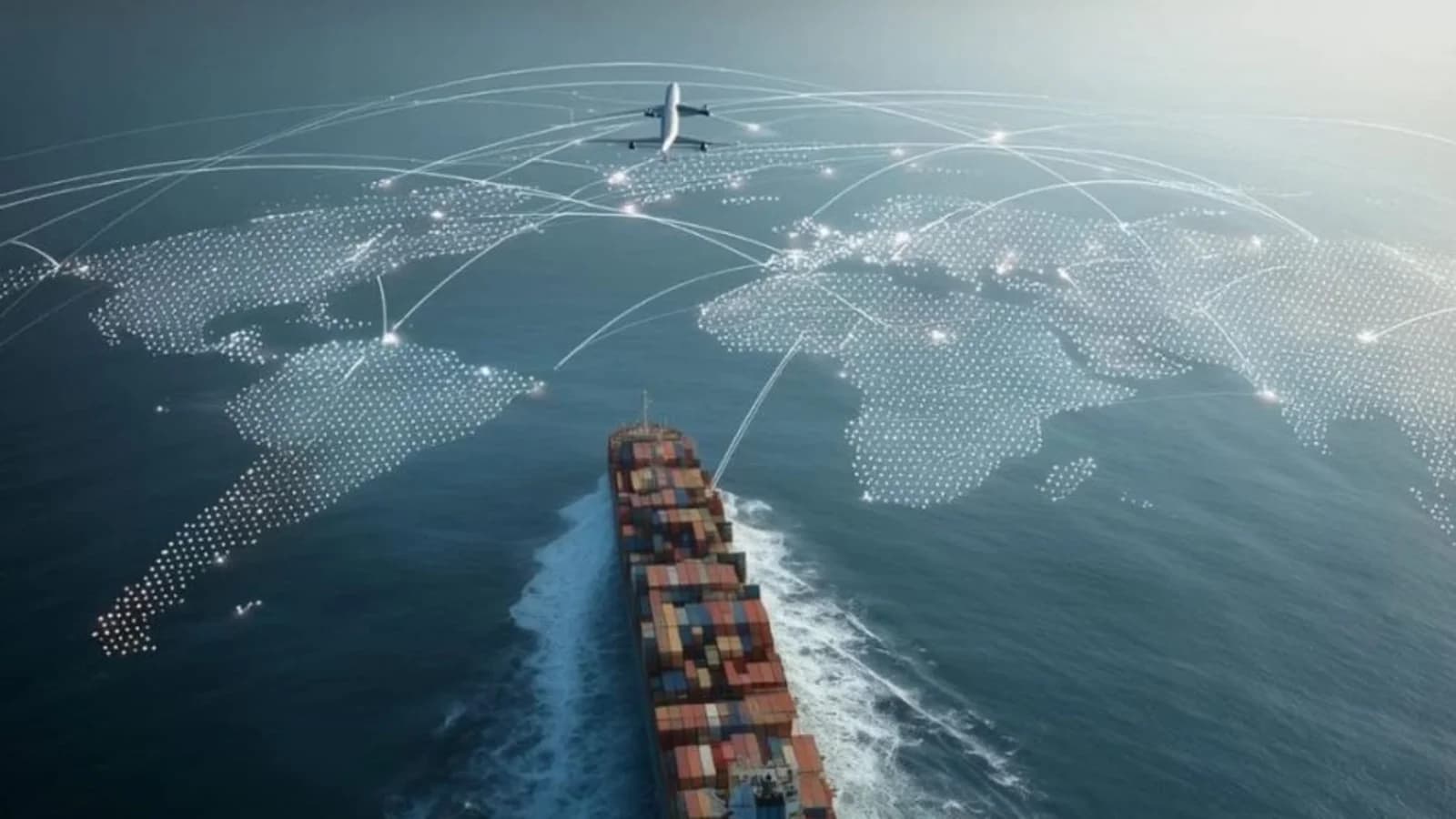
A container is delayed at port. The customer still expects delivery in four days. The receiving warehouse is almost full. One electric truck is available, but it is scheduled to charge when power prices are lowest. A faster route exists, although severe weather is moving across it.
Today, those decisions are usually split across transport planners, warehouse teams, energy managers, freight forwarders and insurers. The next generation of logistics technology is being built around a harder problem: can one system reason across all of them at once?
That is already beginning to happen.
The most important shift in logistics is not a single technology such as autonomous trucks or warehouse robots. It is the emergence of a new coordination layer combining AI agents, optimisation software, digital twins, electrified fleets, energy management and increasingly sophisticated risk models.
The companies that control that layer could gain influence over something much larger than transport software. They could help determine how physical trade itself is scheduled.
AI is moving from reporting problems to making bounded decisions
Traditional logistics software was designed mainly to record and coordinate activity. Warehouse systems tracked inventory. Transportation systems planned loads. Telematics showed where vehicles were. ERP software recorded orders and invoices.
The difficult decisions still fell to people.
Agentic AI changes that model because an agent can work toward an objective, query multiple systems, compare alternatives and execute approved actions.
A useful example comes from JD Logistics. The company has described its Super Brain system as connecting AI decision-making with a digital representation of people, vehicles, inventory and facilities. Its stated goal is not simply to predict demand but to coordinate warehousing, transport and fulfilment together.
That matters because many logistics problems are interconnected. Moving inventory to one warehouse may reduce delivery time but raise transport cost. Consolidating two loads can lower cost but violate a customer delivery window. Reassigning a truck can affect charging availability later in the day.
The useful AI architecture is therefore less like a chatbot and more like an orchestration system:
order data → inventory position → vehicle availability → constraints → optimisation → approved action
The crucial word is approved.
Near-term logistics AI is likely to operate through bounded autonomy rather than unrestricted control. A system might automatically rebook a routine carrier or reschedule a low-risk warehouse task, while escalating a decision that would breach a customer contract, change a dangerous-goods route or materially increase cost.
That distinction is important because an AI hallucination in a conversation is annoying. An incorrect instruction involving a 40-tonne truck, warehouse inventory or customs documentation can create a real operational loss.
China’s electric-truck advantage is becoming an infrastructure advantage
China is already the centre of electric heavy-truck adoption.
In 2025, one in four trucks sold in China was electric, and China accounted for more than 90% of global electric-truck sales. The IEA also estimates CATL supplied roughly 80% of the batteries used in Chinese electric trucks.
Those numbers matter because they create something more valuable than a large vehicle market: a dense industrial ecosystem of battery makers, truck manufacturers, mines, ports, fleet operators and charging infrastructure.
CATL’s battery-swapping programme shows how that ecosystem could change freight economics.
In May 2025, CATL announced a standardized heavy-truck battery system and plans for an “Eight Horizontal and Ten Vertical” swap network covering 150,000 kilometres of Chinese trunk roads. Its stated target is to cover 80% of national trunk-transport capacity by 2030.
The commercial logic is straightforward.
A heavy truck earns money when it is moving. A conventional charging stop takes the vehicle out of service. Battery swapping separates the truck’s working schedule from the battery’s charging schedule.
CATL says its current heavy-truck swap model can return a truck to service in roughly 3–5 minutes. In June 2026 it announced a programme with J&T Express covering more than 5,000 heavy-duty trucks.
That means the operator can potentially:
run the truck → swap the depleted battery → keep the truck working → recharge the removed battery when power is cheaper
This changes more than downtime.
It creates the possibility of treating the battery as an energy asset rather than merely a component of the vehicle.
The charging operator can choose when to buy electricity. A fleet can exploit lower-price periods. The battery can potentially be financed separately from the truck. And the company operating the swap network gains influence over vehicle compatibility, energy purchasing and fleet economics.
China’s advantage, therefore, is not simply that it builds electric trucks. It is beginning to connect vehicle manufacturing, batteries, road infrastructure and energy management into one operating system.
Quantum computing has a specific job: constrained optimisation
Quantum computing is often described vaguely as a technology that will make logistics “faster”.
That is not the useful way to understand it.
The relevant problem is combinatorial optimisation.
Imagine 1,000 vehicles moving through a factory. Each vehicle may have a different specification. Some require a panoramic roof, others a sliding door, different paint combinations or different components.
The factory cannot simply build them in any order.
It must respect constraints including:
component availability
paint-shop sequencing
workstation capacity
labour constraints
vehicle configuration
production throughput
As the number of vehicles and constraints grows, the possible schedules increase extremely quickly.
Ford Otosan has put a hybrid quantum optimisation system into production for sequencing Ford Transit vehicles. The company and D-Wave reported that scheduling a run of 1,000 vehicles fell from around 30 minutes to under five minutes.
The important detail is how.
D-Wave’s machines use quantum annealing. An optimisation problem is translated into an objective function in which undesirable combinations receive penalties and desirable combinations produce lower-energy solutions.
Conceptually, the system is trying to minimise something like:
production disruption + sequence-change penalties + resource conflicts + unmet constraints
The scheduling problem is represented in a form suitable for an annealing solver, often using binary variables: a vehicle occupies a particular production slot or it does not; a constraint is satisfied or violated.
The quantum processor explores candidate configurations, while classical software handles parts of the problem that are better suited to conventional computation. That is why Ford Otosan’s implementation is described as hybrid quantum, rather than a pure quantum workflow.
The real operational value is not simply the five-minute result.
It is the ability to re-optimise quickly when reality changes.
Ford Otosan has explained that if a truck carrying a particular component is delayed, planners can regenerate the production sequence so vehicles requiring that missing part are moved out of the affected slots.
That is exactly the kind of logistics problem quantum optimisation is being tested against: many possible combinations, many hard constraints, and a need to recalculate quickly after disruption.
IBM has explored a related hybrid approach for last-mile delivery. In one experiment involving 1,200 delivery locations in New York City, classical machine learning and optimisation first generated candidate routes. Quantum algorithms were then used to investigate and refine a subset while respecting 30-minute delivery windows and vehicle-capacity constraints. IBM presents the work as experimental, not proof of general quantum advantage.
That caveat matters.
Quantum computing has not displaced classical vehicle-routing algorithms.
Today's strong routing systems already use techniques such as mixed-integer programming, constraint programming, local search, genetic algorithms and specialised heuristics.
The more plausible model is hybrid:
AI identifies the problem → classical software reduces the search space → specialised optimiser solves the difficult subproblem → AI evaluates the operational result
The optimiser might be classical, quantum-inspired or quantum depending on which performs best.
The end user may never need to know.
Autonomous freight is becoming real — but only inside defined operating domains
Autonomous trucking provides another example of why practical detail matters more than futuristic language.
Aurora began regular commercial driverless freight operations between Dallas and Houston in April 2025 for customers including Uber Freight and Hirschbach. The initial operating domain was deliberately narrow: a defined Texas highway corridor, daytime operation, clear-weather conditions and specific trailer configurations.
That is a much more useful signal than saying “driverless trucks are coming.”
Autonomy tends to become commercially viable first where the environment can be tightly specified.
Long-distance highway freight is attractive because the operating conditions are generally more predictable than dense urban driving.
A practical autonomous model therefore looks something like:
human-loaded depot → autonomous highway segment → transfer hub → human-controlled local delivery
This is often called hub-to-hub autonomy.
Its economic appeal is that highway driving consumes large amounts of driver time, particularly where hours-of-service rules limit continuous human operation.
But deployment remains conditional.
Aurora temporarily moved an observer from the rear seat to the driver’s seat in May 2025 at PACCAR’s request because of prototype components in the base vehicle. Aurora said its automated system remained responsible for the driving.
That small detail captures the reality of commercial autonomy: software maturity is only one requirement. Vehicle redundancy, manufacturer approval, insurance, maintenance and regulation all matter.
Cheap electricity becomes valuable only when software can use it
Electrifying freight creates a new optimisation problem that diesel fleets largely do not have.
Diesel is stored energy. A truck refuels and leaves.
Electricity has a time dimension.
Wholesale electricity prices can vary dramatically by hour. In South Australia, negative wholesale prices occurred for roughly 25% of hours in both 2023 and 2024, largely because periods of high renewable generation exceeded demand and system flexibility.
That does not mean electricity was free for every truck operator. Network charges, retail tariffs, infrastructure and batteries still cost money.
But it creates a new source of operational flexibility.
Consider a depot with 100 electric trucks.
At 6 p.m., perhaps 30 must leave again by midnight, another 40 by 5 a.m., and 30 will remain parked until midday.
A fleet-energy platform can combine:
battery state of charge
next delivery assignment
electricity tariff
charger capacity
grid demand
onsite solar
stationary battery storage
The optimisation problem becomes:
charge enough energy into the right trucks before departure while minimising total electricity and demand costs
That is very different from simply plugging every vehicle in when it arrives.
CATL’s swap model takes the idea further because the truck does not need to remain attached to its own battery while that battery charges.
The fleet problem and the energy problem become partially separable.
That may turn electricity procurement into a genuine logistics capability.
Insurance can move from an annual purchase into a routing decision
Weather risk shows how financial technology may enter the same operating system.
Traditional logistics software asks:
Can the shipment make the route?
A more advanced system can ask:
What is the expected financial loss if it uses the route?
Swiss Re and researchers at UC Berkeley have developed models for supply-chain business-interruption risk that represent suppliers and production facilities as connected nodes. A disruption at one plant is propagated through dependent facilities so insurers and companies can estimate downstream production and financial loss.
That turns supply-chain risk into a network problem.
If a component plant closes for ten days, the relevant issue is not simply the plant itself. The model needs to identify:
which downstream factories depend on it → how much production is lost → how long inventories last → what financial loss follows
That creates a much more useful input for operational AI.
Now add parametric insurance.
Munich Re offers parametric products linked to measurable conditions such as river levels. If an agreed water-level threshold is breached, the policy can trigger a predefined payment mechanism designed to help cover additional logistics costs.
The reason this matters becomes obvious on waterways such as the Rhine.
Low river levels can force ships to carry less cargo, pushing freight onto more expensive modes.
A future logistics platform could therefore compare:
Route A: lowest normal freight cost, high river-level disruption exposure.
Route B: higher transport cost, lower disruption exposure.
Route C: use Route A but purchase parametric cover tied to river depth.
That is no longer simply route optimisation.
It is risk-adjusted route optimisation.
There is an important limitation: basis risk. The insurance trigger may occur without producing the expected loss, or a company may suffer a loss even though the specified trigger is not met.
Better algorithms do not eliminate uncertainty.
They simply make it more visible.
The warehouse is becoming an energy asset
The same logic will affect industrial real estate.
Traditionally, logistics sites have been selected around:
land price
highway access
labour
customer proximity
port access
Electrified fleets and automated warehouses introduce another variable:
available electrical capacity.
An automated distribution centre can contain conveyors, robotics, refrigeration, charging infrastructure and potentially hundreds of electric commercial vehicles.
Two sites with identical land and road access may therefore have very different strategic value if one has a 20 MW grid connection and the other faces a multi-year upgrade queue.
That means logistics real estate increasingly intersects with energy infrastructure.
The valuable asset may no longer be just:
warehouse + road access
but:
warehouse + road access + grid capacity + charging + storage + renewable generation
This is a second-order consequence of transport electrification that deserves more attention.
AI, quantum and automation will not replace one another
One of the most misleading ways to discuss logistics technology is to treat AI, quantum computing, robotics and autonomous vehicles as competing technologies.
They solve different layers of the problem.
A plausible future stack looks more like this:
AI agent
interprets the objective and coordinates systems.
Digital twin
represents the state of vehicles, warehouses, inventory and infrastructure.
Optimisation engine
solves routing, scheduling or allocation problems.
Autonomous system
executes part of the physical movement.
Energy platform
optimises charging and electricity procurement.
Risk engine
quantifies disruption exposure.
Insurance layer
transfers selected risks.
The value comes from integration.
A brilliant route optimiser is useless if the warehouse cannot load the vehicle.
An autonomous truck creates little value if the depot does not have capacity to turn it around.
A cheap electric truck becomes expensive if it consistently charges during peak tariffs.
The constraint that matters is often not the technology itself but the connection between systems.
Why China matters — and why it will not own every layer
China has an exceptional position in the physical foundations of this transition.
More than 90% of electric trucks produced globally in 2025 came from China. CATL supplied around 80% of batteries used in Chinese electric trucks. Chinese manufacturers also benefit from local battery, component and industrial supply chains.
But logistics intelligence will not be won solely through manufacturing.
The United States retains powerful advantages in cloud infrastructure, AI software and autonomous driving.
Europe has major logistics operators, industrial automation companies and truck manufacturers, along with regulation that is forcing faster decarbonisation of heavy transport.
The result is unlikely to be one global winner.
Different regions may dominate different layers of the stack.
China could remain strongest in batteries, electric commercial vehicles and physical infrastructure.
The US could lead parts of the intelligence and autonomy layer.
Europe may retain strength in industrial systems, fleet operations and regulated logistics networks.
The interesting competition is therefore not merely between countries.
It is between architectures.
The next five years: watch integration, not demonstrations
The technologies discussed here are already at very different stages.
Electric trucks are commercial.
Battery swapping is scaling rapidly in selected Chinese freight applications.
Driverless trucking is commercial on tightly defined US routes.
Agentic logistics software is entering production environments.
Parametric insurance already exists.
Quantum optimisation has reached specific production applications but has not established broad superiority over classical methods.
That leads to a useful test for the next five years.
Do not ask whether a company has demonstrated a technology.
Ask whether it can connect the technology to a measurable economic outcome.
For AI:
Did it reduce inventory, kilometres, delays or labour?
For autonomous trucks:
Did utilisation increase enough to justify vehicle and support costs?
For electric fleets:
Did charging strategy reduce total cost per kilometre?
For quantum optimisation:
Did it consistently beat the best classical alternative once total computation and integration cost were included?
For parametric insurance:
Did faster liquidity outweigh basis risk and premium cost?
Those are the numbers that will separate genuine infrastructure shifts from impressive demonstrations.
The bigger opportunity is the orchestration layer
The future supply chain will still contain ports, trucks, warehouses, people and factories.
What changes is the intelligence connecting them.
A shipment increasingly has several simultaneous attributes:
location, delivery promise, inventory value, energy requirement, carbon exposure, disruption probability and financial risk.
Once software can reason across those dimensions, logistics stops being a collection of isolated optimisation problems.
It becomes one integrated decision system.
That is where the largest long-term opportunity may sit.
Not in the AI chatbot.
Not in the quantum processor.
Not in the electric truck.
But in the system capable of deciding which tool to use, when to use it and whether the resulting decision actually improves the economics of moving goods.
That is also where the hardest work remains.