Publication:
Submitted papers will be peer reviewed by program committees and technical committee, and accepted papers will be published into conference proceedings by IEEE after registration and presentation. The proceedings will be submitted for inclusion into IEEE Xplore and indexed by Ei Compendex & Scopus.
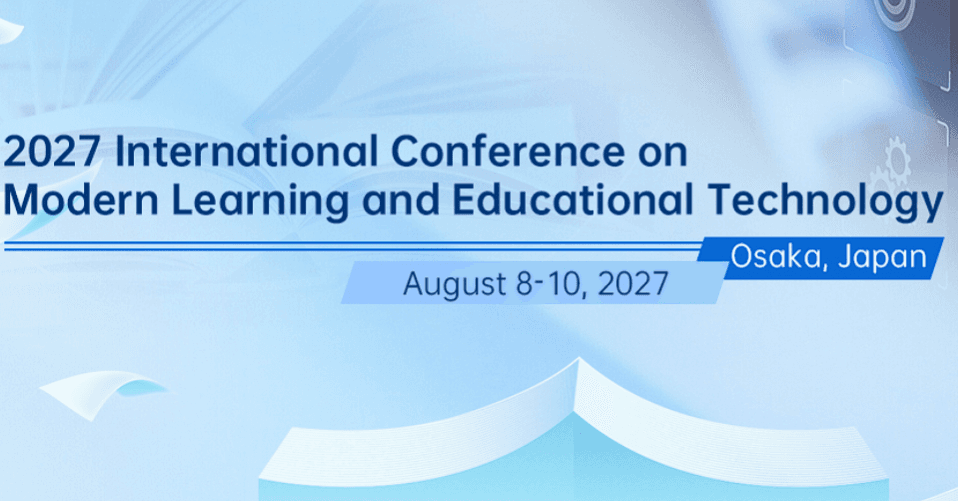
MLET 2027 has been included in IEEE event list!
https://conferences.ieee.org/conferences_events/conferences/conferencedetails/74143
Topics
Topics of interest for submission include, but are not limited to:
Track 1: Artificial Intelligence and Data-Enhanced Learning
Generative AI for content creation and tutoring
AI-driven personalized and adaptive learning pathways
Learning analytics, educational data mining, and dashboard design
Predictive analytics for student performance and intervention
Automated assessment, evaluation, and intelligent feedback systems
Ethical AI, algorithmic bias, and transparency in educational tools
Track 2: Immersive and Interactive Learning Environments
Virtual Reality (VR), Augmented Reality (AR), and Mixed Reality (MR) applications
Educational game design, serious games, and gamification strategies
Simulation, virtual labs, and digital twins for skill training
Metaverse platforms, social VR, and collaborative virtual spaces for education
Haptic technology and multi-sensory immersive experiences
Track 3: Innovative Pedagogy and Digital Learning Design
Hybrid, blended, and flexible learning models
Design and impact of MOOCs, micro-credentials, and nano-degrees
Technology-enhanced active learning and collaboration strategies
Digital storytelling, multimedia, and interactive content creation
Universal Design for Learning (UDL) and technology integration
Track 4: Equity, Inclusion, and Accessible Educational Technology
Assistive technologies and adaptive tools for learners with disabilities
Digital solutions for neurodiverse and special needs education
Culturally responsive pedagogies and multilingual learning technology
Bridging the digital divide: access, affordability, and digital literacy
Designing for global and cross-cultural educational contexts
Track 5: Systems, Leadership, and the Future of Learning Ecosystems
Next-generation Learning Management Systems (LMS) and Learning Experience Platforms (LXP)
Institutional data strategy, governance, and data-informed decision-making
Leadership, policy, and managing change for digital transformation
Cybersecurity, privacy, and ethical data management in education
Future skills, workforce preparation, and lifelong learning infrastructure
Track 6: Critical Perspectives and Emerging Sociotechnical Trends
Teacher roles, agency, and professional development in the AI era
Critical digital literacy, media literacy, and digital citizenship
Sustainability, green computing, and EdTech's environmental impact
Neuroscience, cognitive science, and technology-enhanced learning
Futures studies, speculative design, and horizon scanning for education
Submission Guideline
1.English is the official language. Paper should be prepared in English.
2.Abstract submission is for presentation only without publication.
3.Full paper submission is for both presentation and publication. (No less than 5 pages in two-column)
4.Submission Methods:
- By online submission system: https://easychair.org/my/conference?conf=mlet2027
- Or Submit to mlet_conf@yeah.net as attachment
For more details, please visit: http://mlet.net/sub.html
The University of Osaka, Japan
The University of Osaka, abbreviated as UOsaka or Handai, is a national research university in Osaka, Japan. The university traces its roots back to Edo-era institutions Tekijuku (1838) and Kaitokudo (1724), and was officially established in 1931 as the sixth of the Imperial Universities in Japan, with two faculties: science and medicine. Following the post-war educational reform, it merged with three pre-war higher schools, reorganizing as a comprehensive university with five faculties: science, medicine, letters, law and economics, and engineering. After the merger with The University of Osaka of Foreign Studies in 2007, UOsaka became the largest national university in Japan by undergraduate enrollment. The official name of the university in English has been changed from "Osaka University" to "The University of Osaka (UOsaka)" as of April 2025. UOsaka is one of the most productive research institutions in Japan. Numerous prominent scholars and scientists have attended or worked at UOsaka, such as Nobel Laureate in Physics Hideki Yukawa, Nobel Laureate in Medicine Shimon Sakaguchi, manga artist Osamu Tezuka.
Contact Us
Conference Secretary: Miss Yolanda Dong
Email: mlet_conf@yeah.net
Website: https://www.mlet.net/