Conference Plenary Speakers:
Prof. Steven Li, Western New England University, USA
Prof. Francesco Di Maio, Politecnico di Milano, Italy
Prof. Shaoping Wang, Beihang University, China
Session Keynote Speaker:
Bin Wang, Politecnico di Milano, Italy
Publication:
The accepted papers passed through the peer-reviewed process after proper registration and presentation will be included in ICRE 2026 Conference Proceedings, which will be archived in IEEE Xplore , and indexed by EI Compendex, Scopus, and other indexing services.
Call for Papers:
Topics of interest for submission include, but are not limited to:
Track 1: T1. Methodology Areas (All Methodological Innovations in Reliability)
Track 2: T2: Application Areas (All Industries with Reliability Challenges)
Special Session 1: Industrial AI-Driven Operation and Maintenance
Special Session 2: Multiphysics Modeling, Uncertainty Quantification, and Intelligent Health Management for Highly Reliable Components and Systems
Special Session 3: Physics-Informed Machine Learning for Prognostics and Health Management of Industrial Equipment
Special Session 4: Innovation and Practice of Data-Driven Soft Computing Methods in Renewable Energy Forecasting
Special Session 5: Multimodal Foundation Models for Digital Twin–Integrated Prognostics and Health Management of Complex Engineering Systems
Special Session 6: Explainable AI for Prognostics and Health Management of Aerospace and Avionic Systems
Special Session 7: Artificial Intelligence for Fault Diagnosis and Prognostics of Complex Engineering Systems
Special Session 8: Belief Reliability Theory and Applications: Recent Advances, Methods, and Practices
Special Session 9: Physics-Informed Digital Twin for Reliability Assessment of Nuclear and Renewable Energy Systems
Special Session 10: Reliability, Safety, and Uncertainty Management in Aviation and New Energy Systems
Special Session 11: Resilience of Oil and Natural Gas Pipeline Network Systems to Multi-Source Hazards and Cascading Failures
Special Session 12: Reliability and Resilience of Renewable Energy Systems under Uncertainty
Special Session 13: Intelligent Operation & Maintenance and Reliability for Ships and Marine Engineering Equipment
Special Session 14: Resilience and Risk Mitigation of Industrial Cyber-Physical Systems Against Cascading Failures
Special Session 15: Secondary Risks, Cascading Effects, and Resilient Decision-Making in Complex Engineering and Infrastructure Systems
Special Session 16: Reliability of Passive Systems and Digital Instrumentation & Control in Nuclear Power Plants
More Topics, please visit at: https://www.icre.org/cfp.html
Submission:
1. Full Paper (Presentation and publication)
The submission should be more than 8 pages, and less than 20 pages. Accepted full paper will be invited to give the oral presentation at the conference and be published.
2. Abstract (Presentation only)
Accepted abstract will be invited to give the oral presentation at the conference, the presentation will not be published.
Welcome to submit the paper or abstract by Electronic Submission System:
https://www.zmeeting.org/submission/icre2026
More details about submission, please visit at: https://www.icre.org/sub.html
Conference Program:
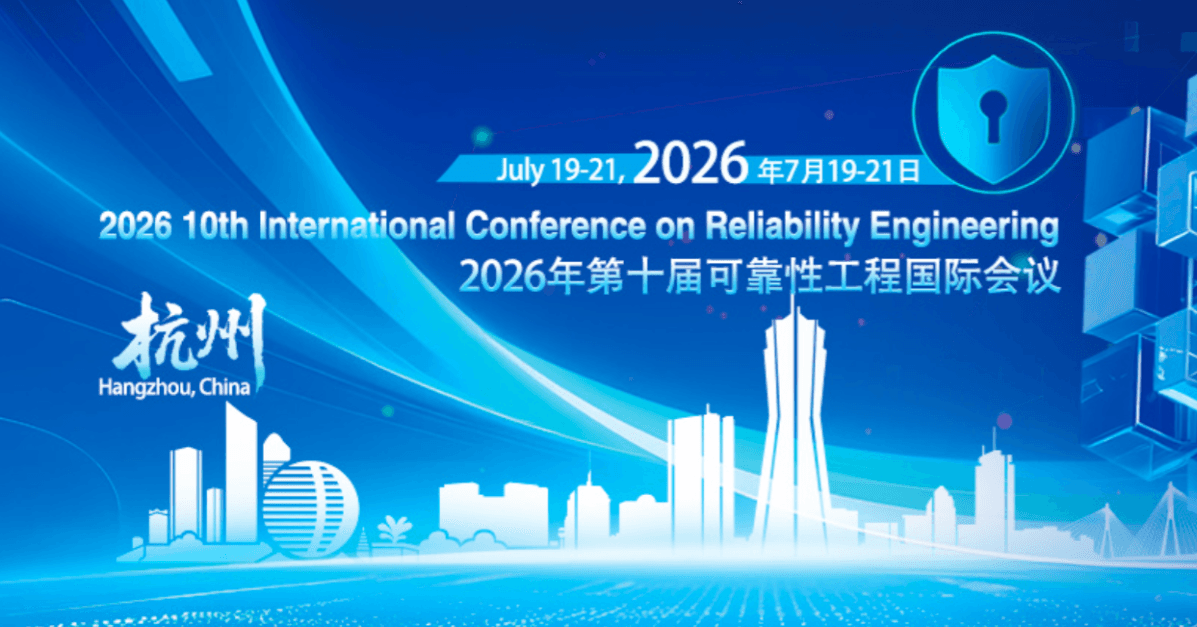
July 19, 2026 | CONFERENCE
July 20, 2026 | CONFERENCE + COURSE + TRACKS
July 21, 2026 | TECHNICAL EXCELLENCE & TRIBUTE
July 12-25, 2026 | Young Scholar Symposium + 2026 Beihang International Summer School
Conference Venue:
Conference Venue: Hangzhou International Innovation Institute of Beihang University
Address: No. 166, Shuanghongqiao Street, Pingyao Town, Yuhang District, Hangzhou City
Contact:
Conference Secretary: Ms. Lesley
Email: icre_conf@outlook.com
Web: http://www.icre.org
Prof. Steven Li, Western New England University, USA
Prof. Francesco Di Maio, Politecnico di Milano, Italy
Prof. Shaoping Wang, Beihang University, China
Session Keynote Speaker:
Bin Wang, Politecnico di Milano, Italy
Publication:
The accepted papers passed through the peer-reviewed process after proper registration and presentation will be included in ICRE 2026 Conference Proceedings, which will be archived in IEEE Xplore , and indexed by EI Compendex, Scopus, and other indexing services.
Call for Papers:
Topics of interest for submission include, but are not limited to:
Track 1: T1. Methodology Areas (All Methodological Innovations in Reliability)
Track 2: T2: Application Areas (All Industries with Reliability Challenges)
Special Session 1: Industrial AI-Driven Operation and Maintenance
Special Session 2: Multiphysics Modeling, Uncertainty Quantification, and Intelligent Health Management for Highly Reliable Components and Systems
Special Session 3: Physics-Informed Machine Learning for Prognostics and Health Management of Industrial Equipment
Special Session 4: Innovation and Practice of Data-Driven Soft Computing Methods in Renewable Energy Forecasting
Special Session 5: Multimodal Foundation Models for Digital Twin–Integrated Prognostics and Health Management of Complex Engineering Systems
Special Session 6: Explainable AI for Prognostics and Health Management of Aerospace and Avionic Systems
Special Session 7: Artificial Intelligence for Fault Diagnosis and Prognostics of Complex Engineering Systems
Special Session 8: Belief Reliability Theory and Applications: Recent Advances, Methods, and Practices
Special Session 9: Physics-Informed Digital Twin for Reliability Assessment of Nuclear and Renewable Energy Systems
Special Session 10: Reliability, Safety, and Uncertainty Management in Aviation and New Energy Systems
Special Session 11: Resilience of Oil and Natural Gas Pipeline Network Systems to Multi-Source Hazards and Cascading Failures
Special Session 12: Reliability and Resilience of Renewable Energy Systems under Uncertainty
Special Session 13: Intelligent Operation & Maintenance and Reliability for Ships and Marine Engineering Equipment
Special Session 14: Resilience and Risk Mitigation of Industrial Cyber-Physical Systems Against Cascading Failures
Special Session 15: Secondary Risks, Cascading Effects, and Resilient Decision-Making in Complex Engineering and Infrastructure Systems
Special Session 16: Reliability of Passive Systems and Digital Instrumentation & Control in Nuclear Power Plants
More Topics, please visit at: https://www.icre.org/cfp.html
Submission:
1. Full Paper (Presentation and publication)
The submission should be more than 8 pages, and less than 20 pages. Accepted full paper will be invited to give the oral presentation at the conference and be published.
2. Abstract (Presentation only)
Accepted abstract will be invited to give the oral presentation at the conference, the presentation will not be published.
Welcome to submit the paper or abstract by Electronic Submission System:
https://www.zmeeting.org/submission/icre2026
More details about submission, please visit at: https://www.icre.org/sub.html
Conference Program:
July 19, 2026 | CONFERENCE
July 20, 2026 | CONFERENCE + COURSE + TRACKS
July 21, 2026 | TECHNICAL EXCELLENCE & TRIBUTE
July 12-25, 2026 | Young Scholar Symposium + 2026 Beihang International Summer School
Conference Venue:
Conference Venue: Hangzhou International Innovation Institute of Beihang University
Address: No. 166, Shuanghongqiao Street, Pingyao Town, Yuhang District, Hangzhou City
Contact:
Conference Secretary: Ms. Lesley
Email: icre_conf@outlook.com
Web: http://www.icre.org